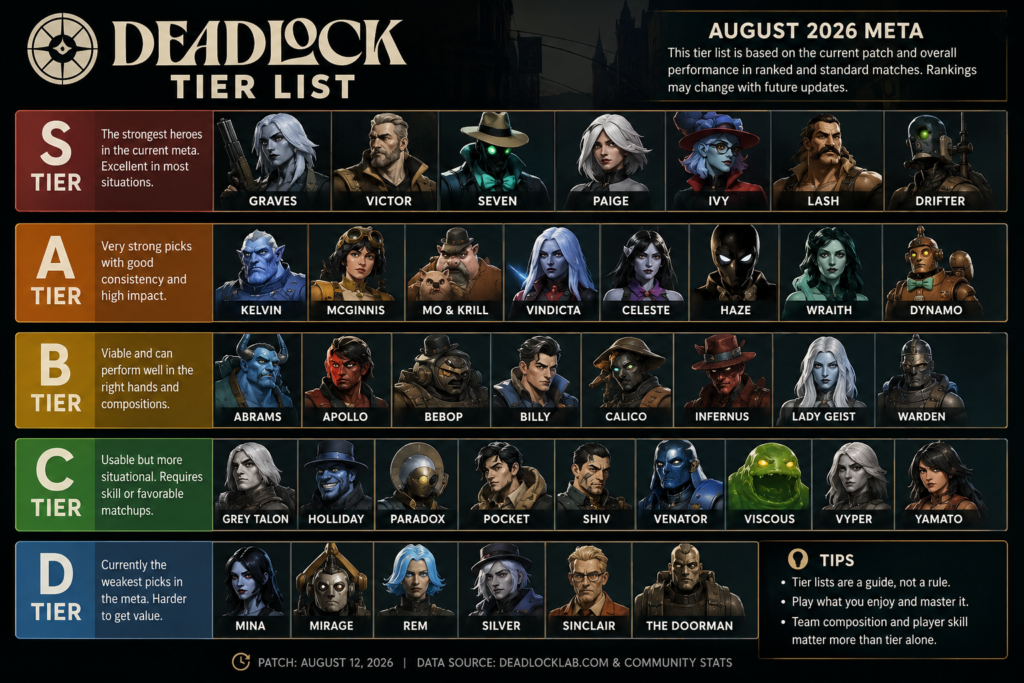
The Deadlock tier list is one of the easiest ways to understand which heroes are performing well in the current competitive environment and which ones require more specialized play. Deadlock has a large roster with very different playstyles, so choosing a hero simply because they look powerful can sometimes lead to disappointing results. A good tier list gives players a starting point by comparing performance, consistency, flexibility, team-fight value, and how well a hero fits into the current meta.
For this guide, the rankings are based on the current August 2026 environment and recent statistical trends rather than treating an older tier list as permanent. Deadlock’s balance changes can move heroes between tiers quickly, and the introduction of ranked play has also made reliability more important. Recent tracking sites show meaningful differences between overall, ranked, and Street Brawl results, so a hero’s placement should always be viewed as a snapshot of the current meta rather than an absolute statement about power.
The current picture has several familiar names near the top. Graves, Victor, Seven, Paige, Ivy, Lash, and Drifter are among the heroes showing particularly strong numbers in recent datasets. At the same time, heroes placed lower on a general tier list can still be extremely effective when played by someone who understands their abilities, matchups, farming patterns, and item choices. In other words, the best Deadlock hero is not always the hero with the highest statistical win rate.
How the Deadlock Tier List Works
A useful Deadlock tier list should consider much more than raw win rate. Win rate is valuable because it tells us how often a hero’s team wins, but it can be misleading when the hero has a very small sample size or is primarily played by highly experienced specialists. Pick rate, match volume, consistency, lane strength, mobility, objective pressure, team-fight contribution, and late-game scaling all provide additional context.
For example, a hero with a 56% win rate across hundreds of thousands of matches gives us a stronger statistical signal than a hero with a dramatically higher win rate in a tiny sample. DeadlockLAB’s current methodology similarly combines winning performance with presence, match volume, and combat impact instead of relying exclusively on one statistic. This is especially important in a game where new patches can cause certain heroes to become popular before players fully understand how to counter them.
For this article, S Tier represents heroes that are exceptionally strong or consistently useful in the current environment. A Tier contains reliable picks that can comfortably compete at a high level but may have more noticeable weaknesses. B Tier heroes are viable and can perform well with the right player or team composition. C Tier heroes generally require more favorable circumstances or stronger mechanical understanding, while D Tier heroes currently have more significant competitive limitations.
S Tier Heroes: The Strongest Picks Right Now
The S Tier is reserved for heroes that combine strong performance with practical value. Current statistics consistently put several heroes near the top, although exact ordering varies between databases and game modes. Recent DeadlockLAB data places Graves, Victor, Seven, Paige, Ivy, Lash, and Drifter among its S-tier performers, with Graves and Victor showing especially impressive overall win rates.
Graves is one of the most interesting top-tier choices because she combines strong damage output with meaningful control over fights. Recent tracking has placed her around the mid-50% win-rate range with a substantial match sample, which makes her performance especially noteworthy. She can punish exposed opponents while remaining useful when the game becomes more organized and objective-focused.
Victor is another standout. Recent statistics have put him close to the top of the overall rankings, with DeadlockLAB reporting a win rate around 55.8% in its current hero data. His strength comes from being useful in extended engagements while still having enough offensive presence to influence fights. Players who enjoy a more aggressive brawler style can get enormous value from him.
Seven remains one of the safest names to mention when discussing the current Deadlock meta. Recent data has him around the 55% win-rate mark, while other August rankings also place him at or near the very top. His combination of wave control, damage, and team-fight pressure makes him useful in a wide range of matches.
Graves, Victor, and Seven: Why They Stand Out
Graves deserves particular attention because she has maintained strong statistical performance while also having a meaningful amount of match volume. That matters because high performance becomes more convincing when it is repeated across a large number of games. A hero does not need to be universally popular to be powerful, but consistent results across a healthy sample are difficult to ignore.
Victor offers a different type of strength. Rather than relying entirely on long-range pressure, his value comes from being difficult to deal with once he gets comfortable in a fight. This makes positioning and target selection particularly important. A good Victor player can create problems for opponents simply by forcing them to respect his presence instead of freely attacking weaker teammates.
Seven, meanwhile, is the kind of hero who can turn small advantages into enormous team-fight pressure. His abilities allow him to contribute damage while also threatening grouped opponents. That makes him particularly attractive in matches where teams frequently contest objectives together. Current ranked-focused lists also identify Seven as one of the strongest choices in the competitive environment.
Paige, Ivy, Lash, and Drifter
Paige has become another notable top-tier option in current statistical tracking. DeadlockLAB’s August data lists her around a 53.8% win rate with a substantial number of matches, while other datasets also place her highly. Her strength comes from being able to contribute consistently rather than depending on one narrow win condition.
Ivy is another flexible option that rewards players who understand positioning and team coordination. Recent overall data places her close to the mid-50% range, and she continues to appear in high-tier rankings. She can fit into compositions that value mobility, pressure, and coordinated engagements.
Lash is a strong choice for mechanically confident players. He has remained near the top of current tracking despite not having the easiest learning curve. His mobility and ability to disrupt fights can make him extremely difficult to handle when the player controlling him understands terrain and timing. Recent DeadlockLAB statistics put Lash around a 52% win rate with a large match sample.
Drifter also deserves S-tier consideration in current data. His recent numbers show strong overall performance, including a roughly 51.2% win rate and one of the higher pick rates among the tracked heroes. His value comes from the ability to pressure opponents while remaining relevant throughout different stages of the game.
A Tier Heroes: Powerful and Reliable Choices
A Tier is where players will find many heroes that are absolutely capable of carrying games. These heroes may lack one of the overwhelming advantages possessed by S-tier characters, but they often compensate through flexibility. In practical matches, an experienced A-tier player can easily outperform an inexperienced player using an S-tier hero.
Current data places heroes such as Kelvin, McGinnis, Mo & Krill, Vindicta, Celeste, Haze, Wraith, and others around the A-tier range depending on the dataset and mode. DeadlockLAB’s current general statistics, for example, list Celeste, Haze, Ivy, Kelvin, McGinnis, Mo & Krill, and Vindicta among its A-tier heroes. This demonstrates why tier lists should not be interpreted as simple “play S tier or lose” charts.
Kelvin is particularly attractive for players who enjoy controlling space and helping their team survive difficult fights. He may not always produce the flashiest scoreboard, but his utility can have enormous strategic value. McGinnis is another excellent option for players who understand defensive positioning, lane pressure, and objective control.
Haze is more dependent on execution and timing, but her carry potential is obvious. When she reaches the right items and finds favorable opportunities, she can quickly turn a fight around. Vindicta and Celeste offer different approaches to ranged pressure, rewarding players who are comfortable managing distance and finding safe damage windows.
B Tier Heroes: Strong Picks With More Specific Conditions
B Tier does not mean bad. In fact, this is where many players can find excellent comfort picks. These heroes usually have identifiable strengths but may struggle when opponents understand how to exploit their weaknesses. In a coordinated environment, B-tier heroes can also rise significantly because team composition and communication can compensate for individual limitations.
Heroes such as Abrams, Apollo, Bebop, Billy, Calico, Dynamo, Infernus, Lady Geist, Warden, and Wraith have appeared around the middle of recent general rankings, although exact placements vary by source and mode. DeadlockLAB’s current list, for example, puts several of these heroes in B tier based on its tracked performance data.
Dynamo is a great example of why raw tier placement needs context. A hero with strong team utility can sometimes be more valuable than their individual win rate suggests. Dynamo can provide tremendous setup and team-fight opportunities when teammates understand how to follow his initiation. Similarly, Bebop can completely change the flow of a match when his abilities are used intelligently, even if his current overall numbers are not among the highest.
Infernus and Wraith can also be dangerous when played correctly. Their effectiveness can depend heavily on itemization, timing, and how the enemy team positions itself. A B-tier hero that fits your personal playstyle is often a better choice than an S-tier hero you have barely practiced.
C Tier Heroes: Viable but More Difficult to Maximize
C Tier heroes generally have more noticeable limitations in the current meta. That does not make them unusable. Instead, they often require more specific strategies, better mechanical execution, or favorable matchups. Players who already specialize in these heroes may continue to perform extremely well despite their lower statistical ranking.
Recent DeadlockLAB data places heroes such as Grey Talon, Holliday, Paradox, Pocket, Shiv, Venator, Viscous, Vyper, and Yamato across the lower-middle tiers, depending on their individual performance. Some of these heroes can be surprisingly powerful when the player understands their mechanics deeply.
Pocket, for instance, rewards creative movement and aggressive decision-making. A skilled player can make him look much stronger than a basic tier ranking suggests. Paradox can similarly create enormous value through precision and good setup, but mistakes are punished more heavily than they would be on simpler heroes.
Yamato is another example of a hero whose effectiveness can vary significantly depending on player skill. Heroes like this often have a higher skill ceiling than their current tier suggests. If you already have hundreds of games on a C-tier hero, switching to an unfamiliar S-tier pick may not automatically improve your results.
D Tier Heroes: When Should You Play Them?
D Tier is generally reserved for heroes currently showing the largest combination of statistical weakness, limited flexibility, or difficulty finding consistent value. Current tracking lists several heroes in this category, including Mina, Mirage, Rem, Silver, Sinclair, and The Doorman. Other ranked-focused lists have similarly identified Mirage, Silver, The Doorman, and Viscous as weaker options in their particular analysis.
However, it would be a mistake to read this as “never play these heroes.” Tier lists are designed to describe the current competitive environment, not to determine whether a hero is fun or impossible to win with. Balance patches can change everything, and a hero that looks weak today may become a first-pick option after a single update.
D-tier heroes can also have specialized strengths. If a hero has a particularly strong matchup into something common in your games, that matchup may matter more to you than the hero’s average global win rate. Likewise, a specialist who understands a hero’s unusual mechanics can generate value that statistics do not fully capture.
Ranked Mode Changes How You Should Read a Tier List
The arrival of ranked play is an important part of the current Deadlock environment. Ranked play began with Beta Season 1 on July 30, 2026, creating a more competitive setting where consistency and reliability matter more than they might in casual games. This means players should pay attention to ranked-specific statistics instead of automatically copying a general or Street Brawl tier list.
Different modes can produce very different results. One current tracker, for example, separates ranked and standard data and reports millions of matches across both environments. A hero that dominates one mode may not have the same impact in another because objectives, player behavior, team coordination, and matchmaking conditions can change.
For ranked players, the safest approach is to build a small hero pool rather than constantly switching between the highest-ranked character. Pick two or three heroes that cover different roles or playstyles and learn their item paths, lane matchups, power spikes, and team-fight responsibilities. That approach usually produces better results than chasing every small movement on a tier list.
Why Win Rate Alone Should Not Decide Your Main
Win rate is one of the most useful statistics in Deadlock, but it is not the complete story. A hero can have a high win rate because of a smaller group of highly experienced players. Another hero may have a slightly lower win rate but a much larger player base and a far more demanding role. Comparing those numbers without context can lead to poor conclusions.
Pick rate is useful as a second measurement. If a hero has a strong win rate and a meaningful pick rate, the result becomes more convincing. Match volume matters for the same reason. Current Deadlock tracking services are working with millions of match records, which provides a much stronger basis for identifying broad trends than isolated games or personal experiences.
There is also the question of player skill. A hero with complicated mechanics can have an average win rate that hides a very powerful high-skill ceiling. Conversely, a simple hero may perform well across the player base because the character is easy to execute. The best tier list therefore combines numbers with gameplay understanding.
How to Choose the Best Deadlock Hero for Your Playstyle
If you are new to Deadlock, start with heroes that have straightforward strengths and enough flexibility to teach you the game’s fundamentals. Learning how to farm, deny, rotate, take objectives, manage souls, position during fights, and recognize enemy power spikes is more important than immediately mastering the most complicated character in the roster.
Players who prefer aggressive close-range combat may want to experiment with heroes such as Victor, Lash, Drifter, or other brawler and assassin-style options. If you enjoy ranged damage, Graves, Ivy, Vindicta, or Celeste may feel more natural. Players who enjoy utility and team coordination can look toward heroes such as Kelvin, Dynamo, McGinnis, or Mo & Krill.
The most important factor is consistency. If you can play one hero confidently and understand their matchups, you will usually get better results than constantly changing characters. Use the tier list to identify strong candidates, then spend enough time with those heroes to determine which one actually fits your decision-making and mechanical strengths.
How Tier Lists Change After Patches
Deadlock’s meta is not static. A balance patch can change damage numbers, cooldowns, item interactions, movement options, or other mechanics, and even a small adjustment can alter how a hero performs. Current tier trackers explicitly compare hero scores and movement between patches because the direction of change can be as important as the current ranking.
This is why an old article should never be treated as a permanent authority. For example, data from May or June can look very different from data gathered after the July ranked update and the August balance changes. Recent trackers identify the August 12 minor update as the current patch window for their hero statistics.
When a new patch arrives, give the meta a little time to settle. Players need enough matches to discover new builds and counter strategies. The first few days can produce unusual statistics because the community is experimenting. After a larger sample develops, tier placements become much more meaningful.
Deadlock Tier List: Quick Ranking Summary
For a practical August 2026 overview, the strongest current group includes Graves, Victor, Seven, Paige, Ivy, Lash, and Drifter, although the exact tier assigned to each hero depends on the tracker, mode, and rank range being measured. These are the heroes I would investigate first if the goal is to understand the current meta.
The next group includes strong and flexible choices such as Kelvin, McGinnis, Mo & Krill, Vindicta, Celeste, Haze, Wraith, Dynamo, and several other competitive options. These heroes may not dominate every statistic, but they can provide excellent value when matched with the right playstyle and team composition.
Lower-ranked heroes such as Mirage, Silver, Sinclair, Rem, Mina, and The Doorman currently face more statistical challenges in some datasets. Still, their placement should be treated as a current-meta observation rather than a permanent judgment. Deadlock’s balance environment can shift quickly.
Final Thoughts on the Deadlock Tier List
The best way to use a Deadlock tier list is as a guide rather than a rulebook. Current statistics clearly show that heroes such as Graves, Victor, Seven, Paige, Ivy, Lash, and Drifter deserve serious attention, but statistics do not replace mechanical skill, game knowledge, communication, and smart decision-making. A strong player on a supposedly weaker hero can still dominate someone who has selected the highest-ranked character without understanding how to use them.
The current meta is also more complicated because Deadlock now has different competitive environments, including ranked play. Recent sources show that hero performance can vary considerably depending on whether the data comes from ranked, standard, or another mode. That makes it important to check the specific mode before deciding that one hero is universally better than another.
Ultimately, the ideal hero is the one that combines current strength with personal comfort. Start with the upper tiers, test several heroes, study their item builds and matchups, and then build a small roster you can play consistently. As future patches arrive, revisit the tier list and watch which heroes are rising or falling. That approach will keep you ahead of the meta without forcing you to abandon a hero simply because a ranking moved by one tier.
YOU MAY HAVE MISSED