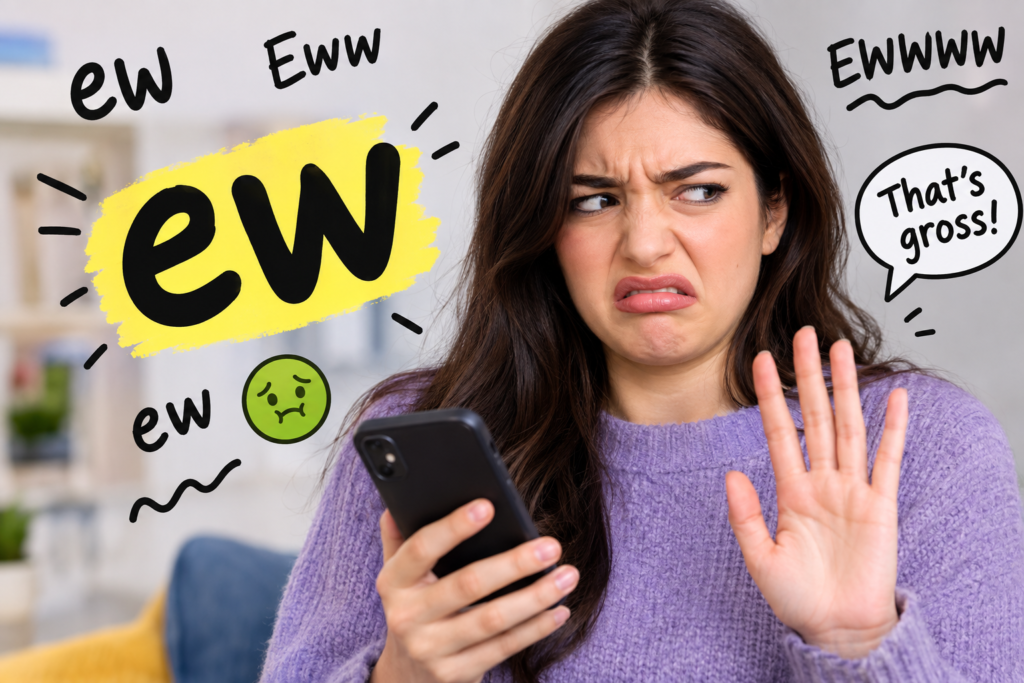
The tiny word “ew” may look almost too simple to deserve an article, but it has become one of the most recognizable expressions in everyday English, texting, social media, entertainment, and casual conversation. A person can type “ew” in just two letters and communicate an immediate emotional reaction without writing a complete sentence.
Most commonly, “ew” is an expression of disgust, dislike, or aversion. Dictionaries describe it as an interjection used when something seems unpleasant, disgusting, or undesirable. However, modern communication has made the word much more flexible. Depending on context, “ew” can be serious, playful, exaggerated, sarcastic, humorous, or even affectionate.
That flexibility is one reason the word continues to appear everywhere online. From text messages and comments to memes and entertainment, “ew” has developed into a convenient way of reacting to something instantly. It does not require a long explanation, and its meaning is usually understood from the situation.
What Does EW Mean?
At its most basic level, “ew” means that something is unpleasant or disgusting. It is an interjection rather than a conventional sentence, meaning it can stand alone as a reaction. Someone might see something dirty, smell something unpleasant, taste something strange, or encounter something they strongly dislike and simply respond, “Ew!”
The expression can also be written as “eww,” “ewww,” or “ewwww.” Adding extra letters usually increases the emotional intensity. A simple “ew” might communicate mild dislike, while “ewwww” can suggest a much stronger reaction. This makes spelling itself part of the emotional message.
Another important point is that “ew” is not normally an acronym. It is better understood as a written representation of a sound or spontaneous reaction. Similar expressions include “ugh,” “yuck,” and “gross,” although each carries its own tone and emotional flavor.
Why Do People Say “Ew”?
People say “ew” because it is fast, natural, and emotionally expressive. Disgust is a strong human reaction, and people often respond to something unpleasant before they have time to formulate a detailed thought. Saying “ew” captures that immediate response.
For example, imagine someone opens an old container in the refrigerator and discovers spoiled food. Instead of explaining, “This food has probably been sitting here for several weeks and now smells terrible,” they might simply say, “Ew!” The short reaction communicates the important information immediately.
The same principle applies to digital communication. When people encounter an unpleasant image, strange food combination, awkward situation, or uncomfortable message, typing “ew” can reproduce the feeling of an immediate spoken reaction. That is part of why the expression works so well in texting and social media.
The Difference Between EW, EWW, and EWWWW
The number of letters in “ew” can change the perceived intensity of the reaction. While there is no strict grammatical rule controlling the number of letters, internet communication has developed an informal system for expressing emotion through repetition.
“Ew” is often relatively direct. It can communicate simple dislike without making the reaction dramatic. “Eww” feels stronger and more expressive, while “ewwww” can be intentionally exaggerated. The longer version may be used for humor just as much as for genuine disgust.
This is similar to the way people stretch words in conversation. Someone might write “nooooo” instead of “no” to show stronger emotion. Likewise, “ewwww” visually represents an extended emotional reaction. It makes written language feel more like spoken language.
EW in Text Messages
Texting has made “ew” especially useful because conversations often move quickly. People do not always want to write complete explanations for every reaction. A short word can keep the conversation moving while still showing a clear emotional response.
Consider a friend sending a photograph of an unusual meal. One person might respond with a long explanation about why the food looks unappealing. Another might simply write, “Ew.” Both communicate the same basic reaction, but the second response is faster and more casual.
In texting, however, context matters. A message such as “ew” can sometimes sound harsher than intended because written communication does not include facial expressions or vocal tone. Someone joking with a close friend may use “ew” playfully, while the same word directed at a stranger could be interpreted as rude.
EW on Social Media
Social media has helped transform “ew” into more than a simple spoken reaction. It can function as a comment, caption, meme element, reaction, or humorous punchline.
People may use it under posts involving strange food, embarrassing moments, awkward behavior, unpopular opinions, or bizarre trends. Because social platforms are built around rapid reactions, a short expression like “ew” fits naturally into the format.
At the same time, social media often encourages exaggeration. Users may write “EW,” “EWW,” or “EW STOP” to create a dramatic reaction even when they are not genuinely disgusted. The expression can therefore become part of online performance and humor rather than a literal statement of physical disgust.
EW Can Be Serious or Playful
One of the most interesting characteristics of “ew” is that its meaning depends heavily on tone. The same two letters can communicate completely different emotions in different situations.
If someone sees rotten food and says “ew,” the meaning is probably literal. If a friend shows up wearing an intentionally ridiculous outfit and another friend says “ew 😂,” the expression may be playful. The emoji, relationship between the speakers, and surrounding conversation all influence interpretation.
This flexibility makes “ew” particularly useful in casual communication. It can express genuine disgust, friendly teasing, exaggerated humor, or mild disapproval without requiring a complicated explanation.
The Relationship Between EW and Humor
“Ew” has become strongly connected with comedy because disgust is often used as a humorous device. Comedians, television shows, memes, and social media creators frequently exaggerate reactions to ordinary situations.
A person might dramatically say “EWWWW!” after seeing something only slightly unpleasant. The humor comes from the contrast between the relatively minor situation and the exaggerated reaction.
This is also why the word can appear in situations where nobody is actually disgusted. The expression can be deliberately theatrical. It becomes a way to play a character, imitate a dramatic reaction, or make an ordinary conversation more entertaining.
EW in Popular Culture
The word has also appeared prominently in entertainment. A notable example is the recurring “Ew!” comedy sketch associated with The Tonight Show, where exaggerated disgust became part of the humor. Entertainment Weekly has also covered the return of the sketch with celebrity guests including Zoë Kravitz and Sabrina Carpenter.
The popularity of such comedy demonstrates something important about the word: audiences recognize “ew” instantly. A performer does not need to explain what the expression means before using it. The reaction is already deeply familiar.
That universal familiarity makes “ew” useful in entertainment because it can establish a character’s personality almost immediately. A character who frequently says “ew” might appear dramatic, judgmental, playful, childish, sarcastic, or simply expressive.
EW and the Phrase “Ew, David!”
Another memorable example comes from Schitt’s Creek, where the phrase “Ew, David!” became closely associated with Alexis Rose, played by Annie Murphy. The phrase transformed a simple expression of disgust into a recognizable piece of pop-culture dialogue.
Entertainment Weekly has discussed the phrase in connection with Murphy and even covered a later Sesame Street appearance involving Dan Levy and Oscar the Grouch that played with the familiar “ew” reaction.
What makes examples like this interesting is how a basic everyday expression can become associated with a particular character. Once an audience recognizes the delivery and personality behind the phrase, “ew” becomes more than a dictionary definition. It becomes part of the character’s identity.
Is EW Always Negative?
Not necessarily. Although the traditional meaning of “ew” is negative, the expression can be used jokingly or ironically.
Friends might say “ew” when teasing each other about a harmless situation. Someone might write “ew, you actually like that?” without genuinely expressing serious disgust. In these situations, the word functions more like playful criticism.
Internet culture has also made irony extremely common. A person may describe something as “ew” precisely because they secretly enjoy it. Understanding this kind of usage requires attention to context rather than relying only on the literal dictionary definition.
EW Compared With “Yuck”
“Yuck” is another common expression of disgust, and the two words can often be used interchangeably. Both communicate that something is unpleasant or undesirable.
However, they have slightly different personalities. “Yuck” can sound more traditional or childlike, while “ew” often feels more conversational and internet-friendly. The difference is subtle, but people may choose one based on the mood they want to create.
In casual digital conversations, “ew” is especially convenient because it is extremely short. It also works naturally as a reaction to photographs, videos, comments, and messages.
EW Compared With “Ugh”
“Ugh” is related to “ew,” but the emotional meaning is broader. “Ugh” can express frustration, annoyance, disappointment, exhaustion, or dislike. “Ew,” by comparison, is more strongly associated with disgust or aversion.
For example, someone who discovers that their flight has been delayed might say “ugh.” Someone who finds spoiled food might say “ew.” The first expresses frustration, while the second expresses disgust.
Of course, real conversations are flexible. People sometimes use “ew” for emotional discomfort or “ugh” for something disgusting. Language rarely follows perfectly rigid boundaries, especially in informal communication.
How EW Became So Effective Online
Online communication removes many physical signals that normally help people understand emotion. In face-to-face conversation, a person can communicate disgust through facial expressions, voice, gestures, and body language.
Text does not provide those signals automatically. As a result, people have developed short expressions, emojis, punctuation patterns, and spelling variations to compensate.
“Ew” works perfectly in this environment because it carries emotional information in only two letters. Capitalizing it, extending it, or adding an emoji can further strengthen the intended reaction.
Capitalized EW Versus Lowercase ew
Even capitalization can influence the perceived tone. Lowercase “ew” may feel casual and understated, while uppercase “EW” can appear louder or more dramatic.
For example, “ew” might suggest a small reaction. “EW!” looks more like someone shouting. Similarly, “EWWWW!” can communicate exaggerated disgust.
There is no universal rule requiring these interpretations, but digital communication relies heavily on visual cues. Capital letters, repeated letters, punctuation, and emojis all help writers communicate tone.
When EW Can Sound Rude
Although “ew” is often harmless, it can become insulting depending on how it is used. Saying “ew” about someone’s appearance, body, personal choices, or identity can be hurtful.
The difference between joking and insulting is often determined by context and relationship. Close friends may understand a playful “ew” immediately, while the same statement from a stranger may feel judgmental.
This is especially important on social media, where a short comment can reach a large audience. Before using “ew,” it is worth considering whether the reaction is directed at something harmless, such as a strange recipe, or at another person’s personal characteristics.
EW and Online Etiquette
Good online communication requires more than knowing vocabulary. It also requires understanding how words affect other people.
Using “ew” toward unpleasant objects, smells, fictional situations, or obviously humorous content is generally straightforward. Using it to shame someone can create unnecessary conflict.
A useful rule is to focus the reaction on the situation rather than attacking the person. Saying “That food looks gross” is different from telling someone “You are gross.” The first comments on something; the second targets a person.
Why Such a Small Word Matters
At first glance, “ew” seems almost insignificant. It is only two letters, does not contain a complicated definition, and can be replaced by several other expressions.
Yet its popularity demonstrates how language evolves around human needs. People want quick ways to communicate emotion, and “ew” provides exactly that.
It also shows that effective communication does not always require long sentences. Sometimes a tiny expression can communicate a surprisingly complex combination of emotion, tone, attitude, and social context.
EW Has More Than One Meaning
Although “ew” most commonly refers to disgust, the capitalized abbreviation EW can represent different things in different contexts. For example, EW may refer to electronic warfare, while other abbreviation sources list meanings such as Entertainment Weekly and other technical or organizational terms.
This is an important distinction. If someone types “EW!” in a text message, they probably mean disgust. If the term appears in a military, technical, entertainment, or professional context, it may have an entirely different meaning.
Context is therefore essential when interpreting short abbreviations.
EW and Entertainment Weekly
In entertainment journalism, EW is widely used as an abbreviation for Entertainment Weekly, a publication covering movies, television, music, books, celebrities, and popular culture. Current EW coverage includes entertainment news, interviews, television features, and film-related stories.
This creates an interesting linguistic situation because “EW” can mean something completely different depending on capitalization and context.
A message saying “ew, that smells terrible” clearly uses the expression of disgust. A sentence saying “I read the story in EW” is likely referring to Entertainment Weekly.
The surrounding words usually make the intended meaning obvious.
The Importance of Context
Short words and abbreviations often have multiple interpretations. “EW” is a good example because it can function as slang, an interjection, or an abbreviation.
That means readers should avoid interpreting the word in isolation when the context is unclear. A social media comment is likely to use “ew” as an emotional reaction, while a professional article may use “EW” as an abbreviation.
This principle applies to many parts of modern communication. The shorter a word or abbreviation becomes, the more important context can become.
How to Use EW Naturally
If you want to use “ew” naturally in casual conversation, the simplest approach is to use it as an immediate reaction.
Examples include:
- “Ew, that smells terrible.”
- “Eww, what is that?”
- “Ew! I can’t believe you ate that.”
- “That picture is kind of ew.”
- “Ewwww, no way.”
- “EW 😂”
The best version depends on the situation. A short lowercase “ew” works well for casual conversation, while capital letters and repeated letters can make the reaction more dramatic.
Why EW Remains Popular
The continuing popularity of “ew” comes down to efficiency. Modern communication is fast, and people constantly exchange messages, photographs, videos, memes, and reactions.
A word that communicates a strong emotion almost instantly is naturally useful. “Ew” does not require explanation, and most English speakers understand the intended reaction immediately.
Its flexibility also helps. It can be sincere, sarcastic, funny, exaggerated, friendly, or dramatic. Very few words can perform all those roles while remaining only two letters long.
Final Thoughts on EW
“Ew” is a small word with a surprisingly large role in modern communication. Its primary meaning is an expression of disgust, dislike, or aversion, but its practical use extends far beyond a simple dictionary definition.
In everyday speech, texting, memes, social media, and entertainment, “ew” provides an immediate emotional response. Variations such as “eww” and “ewwww” allow people to increase the intensity, while capitalization and emojis add additional layers of tone.
At the same time, EW can mean completely different things when used as an abbreviation, including Entertainment Weekly and electronic warfare. That is why context matters so much.
Ultimately, the popularity of “ew” demonstrates how language adapts to the way people communicate. A simple sound of disgust became a written expression, then an internet reaction, and eventually a recognizable part of popular culture. Sometimes, the smallest words are the ones that say the most.
YOU MAY HAVE MISSED