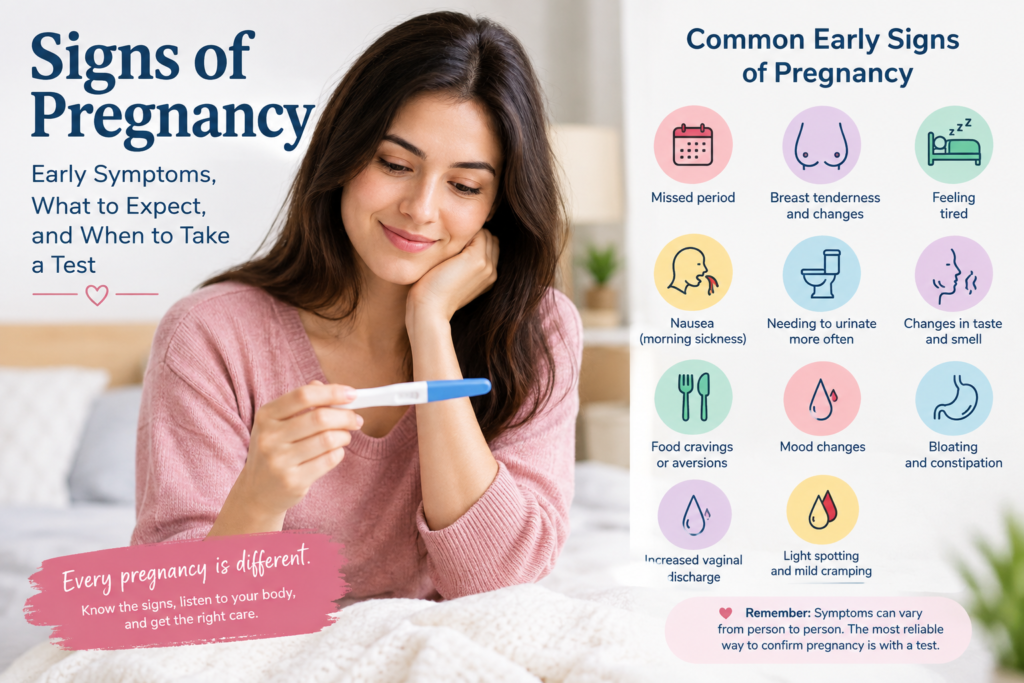
Pregnancy can begin with very subtle changes. Some people notice something feels different within a few weeks, while others experience almost no symptoms at first. That is one reason searching for the signs of pregnancy can lead to a lot of confusion. A missed period may be the first obvious clue, but it is not the only one.
Early pregnancy symptoms can overlap with premenstrual syndrome (PMS), stress, hormonal changes, illness, or other everyday conditions. Symptoms alone therefore cannot confirm pregnancy. A pregnancy test is the more reliable way to find out, particularly after a missed period.
This guide explains the most common early signs, when they can appear, how they differ from PMS, when pregnancy testing makes sense, and which symptoms deserve prompt medical attention.
What Are the Earliest Signs of Pregnancy?
One of the most commonly recognized early signs of pregnancy is a missed period. If your menstrual cycle is usually predictable and your period does not arrive when expected, pregnancy is one possible explanation, especially if you have had sex without reliable contraception.
However, a late period does not automatically mean pregnancy. Stress, changes in weight, illness, intense exercise, hormonal conditions, and naturally irregular cycles can all affect when menstruation occurs. This is why it is better to look at a missed period as a reason to test rather than as proof of pregnancy.
Other early symptoms can include breast tenderness, unusual tiredness, nausea, increased urination, bloating, constipation, changes in taste or smell, food cravings or dislikes, mood changes, and increased vaginal discharge. Not everyone experiences these symptoms, and their intensity can vary considerably from one pregnancy to another.
A Missed Period Can Be an Important Clue
For someone with regular menstrual cycles, a missed period may be the first sign that prompts a pregnancy test. The hormonal changes associated with pregnancy prevent the normal menstrual cycle from progressing in the usual way, so the expected period does not occur.
That said, menstrual cycles are not always perfectly predictable. If your periods are irregular, it may be difficult to know whether you are actually late. In that situation, counting from the date of possible conception or from the last time you had unprotected sex may be more useful when deciding when to test.
It is also possible to experience some bleeding during early pregnancy. Light spotting can sometimes occur around the time a period would normally be expected, which may make the situation confusing. Bleeding during pregnancy should not automatically be assumed to be implantation bleeding, however, particularly if it is heavy, painful, or accompanied by other concerning symptoms.
Breast Tenderness and Breast Changes
Breast changes are another common early pregnancy symptom. You may notice that your breasts feel fuller, heavier, swollen, or more sensitive than usual. Some people notice tenderness around the nipples or discomfort when wearing a bra.
These changes are linked to hormonal changes associated with pregnancy. Increased blood flow and preparation of breast tissue can contribute to the sensations you experience. For some people, the change is noticeable very early, while others barely notice anything different.
The tricky part is that sore breasts are also common before a period. PMS can produce almost identical sensations, so breast tenderness by itself is not a dependable way to determine whether you are pregnant. If it occurs alongside a missed period and other symptoms, however, it may be another reason to take a pregnancy test.
Feeling Extremely Tired
Unusual fatigue can be one of the early signs of pregnancy. You might feel exhausted after activities that normally would not leave you tired, or you may suddenly want to go to bed much earlier than usual.
Pregnancy involves major hormonal and physiological changes. Fatigue is particularly common during the first part of pregnancy, although tiredness can also occur later. MedlinePlus notes that many women experience fatigue during the first few months of pregnancy.
Still, tiredness has many possible causes. Poor sleep, stress, anemia, infection, emotional strain, changes in routine, and other medical conditions can all cause fatigue. Therefore, fatigue is best considered one possible clue rather than a pregnancy diagnosis.
Nausea and Morning Sickness
Nausea is one of the symptoms most strongly associated with pregnancy. Despite the popular name morning sickness, nausea and vomiting can occur at any time of day or night. Some people feel mildly queasy, while others experience more noticeable nausea and vomiting.
Pregnancy-related nausea commonly becomes noticeable during the early weeks. The NHS lists feeling or being sick among common early pregnancy symptoms and emphasizes that symptoms can vary from person to person.
Not experiencing nausea does not mean you are not pregnant. Some pregnant people have little or no morning sickness. Likewise, nausea by itself does not prove pregnancy because stomach infections, food-related illness, medication effects, anxiety, and many other conditions can cause it.
Needing to Urinate More Often
Another possible early sign is needing to pee more frequently than usual. You may notice yourself making additional bathroom trips even though you have not dramatically increased how much you drink.
Hormonal and circulatory changes during pregnancy can contribute to changes in urination. Increased urination is recognized as a common pregnancy symptom.
There is an important distinction, though. Frequent urination without pain can occur during pregnancy, but burning, pain, fever, unusual urine odor, or other urinary symptoms may suggest a urinary tract infection. MedlinePlus advises contacting a healthcare professional if urination becomes painful or there are noticeable changes in urine odor or color.
Changes in Taste and Smell
Some people notice that foods or smells suddenly seem different during early pregnancy. A familiar smell may become surprisingly strong or unpleasant. Foods you normally enjoy may suddenly seem unappealing.
A metallic taste in the mouth is another symptom reported during early pregnancy. Changes in taste and smell can also contribute to new food preferences, cravings, or food aversions.
These changes can feel very noticeable, but they are not unique to pregnancy. Illness, medications, changes in the senses, and other factors can also influence taste and smell. As with most symptoms, the overall pattern matters more than one isolated sensation.
Food Cravings and Food Aversions
Pregnancy may cause changes in appetite and food preferences. You might suddenly want a particular food, dislike something you previously enjoyed, or feel uncomfortable around certain smells.
Hormonal changes can influence taste and smell, which may help explain why foods seem different during pregnancy. Some people have strong cravings, while others experience mostly food aversions. There is no requirement to experience either one.
It is also worth paying attention to unusual cravings for non-food substances. The NHS notes that cravings for substances such as dirt can be associated with pica and may need discussion with a healthcare professional because nutritional deficiencies can sometimes be involved.
Mood Changes and Emotional Symptoms
Hormonal changes can affect how you feel emotionally. Some people notice increased irritability, tearfulness, sensitivity, or rapid changes in mood during early pregnancy.
However, mood changes are not a reliable pregnancy test. PMS, stress, lack of sleep, relationship problems, work pressure, and many other factors can produce similar emotional changes.
If you are wondering whether your mood changes are pregnancy-related, consider them alongside more objective clues such as a missed period and a pregnancy test. If emotional symptoms become severe or interfere significantly with daily life, speaking with a healthcare professional is appropriate regardless of whether you are pregnant.
Bloating and Constipation
Bloating can make your abdomen feel unusually full or uncomfortable. Some people describe a sensation similar to the bloating they experience before menstruation.
Constipation can also occur during pregnancy. Hormonal changes can affect the digestive system, and constipation is listed among possible early pregnancy symptoms.
The problem is that bloating and constipation are extremely common outside pregnancy. Diet, dehydration, changes in activity, stress, and the menstrual cycle can all contribute. These symptoms therefore should not be used alone to determine whether pregnancy has occurred.
Increased Vaginal Discharge
Pregnancy can cause an increase in vaginal discharge. Normal pregnancy discharge is generally not associated with irritation, severe discomfort, or an unpleasant odor.
Changes in discharge can be normal, but certain characteristics deserve medical attention. MedlinePlus recommends contacting a healthcare provider if discharge has a foul odor, becomes greenish, causes itching, or produces pain or soreness.
It is important not to assume that every change in discharge is a pregnancy symptom. Vaginal infections and other conditions can also change discharge. If you are uncertain, especially if you have discomfort or an unusual odor, medical advice is the safest approach.
Light Spotting and Mild Cramping
Some people experience light spotting around the time their period would normally arrive. The NHS notes that a small amount of bleeding or spotting can occur in early pregnancy and is sometimes referred to as implantation bleeding.
Mild cramping can also occur in early pregnancy and may feel similar to period cramps. This can understandably cause confusion because menstrual cramps and early pregnancy sensations can overlap.
Bleeding and abdominal pain should not automatically be dismissed as normal pregnancy symptoms. Heavy bleeding, significant pain, severe one-sided pelvic pain, dizziness, or fainting can require urgent assessment. If you are pregnant or think you might be pregnant and experience concerning bleeding or severe abdominal pain, seek medical care promptly.
When Do Signs of Pregnancy Usually Start?
Pregnancy symptoms do not necessarily begin immediately after conception. The NHS says that early symptoms usually start when someone is around 4 to 6 weeks pregnant, although the timing varies and some people have no symptoms at all.
Pregnancy is medically dated from the first day of the last menstrual period, rather than from the day of conception. This means that when someone is described as being four weeks pregnant, conception generally occurred more recently than four weeks ago.
At around five weeks, many people begin realizing they may be pregnant because their period is late and symptoms may start becoming more noticeable.
Signs of Pregnancy at Around Four Weeks
At approximately four weeks, you may not look or feel pregnant at all. Some people have no noticeable symptoms, while others begin experiencing subtle changes.
Possible symptoms include tiredness, breast tenderness, mild cramping, bloating, changes in taste or smell, or a missed period. Because many of these sensations resemble PMS, it can be difficult to know what is happening based on symptoms alone.
This is also around the point when a pregnancy test can become useful. Rather than trying to interpret every physical sensation, testing at the appropriate time provides a much clearer answer.
Signs of Pregnancy at Around Five to Six Weeks
By five or six weeks, symptoms may become more obvious for some people. A late period, tiredness, sore breasts, nausea, mood changes, increased urination, food changes, and heightened sensitivity to smells can occur.
The NHS describes several of these symptoms during weeks five and six, while also emphasizing that pregnancy experiences differ.
You may also still have very few symptoms. That is not necessarily concerning. Pregnancy symptoms vary considerably, and the absence of morning sickness or breast tenderness does not by itself indicate that something is wrong.
How Are Pregnancy Symptoms Different From PMS?
One of the biggest challenges is that early pregnancy and PMS can feel remarkably similar. Both can cause breast tenderness, fatigue, mood changes, bloating, food changes, and abdominal discomfort.
A missed period can make pregnancy more likely, particularly if your cycle is usually regular. But even a late period has other possible explanations, so symptoms cannot provide certainty.
The most practical difference is that pregnancy can be confirmed through testing. Instead of trying to decide whether a particular symptom “feels like pregnancy,” take a pregnancy test when it is appropriate and follow the instructions carefully.
When Should You Take a Pregnancy Test?
Home pregnancy tests are most reliable from the first day of a missed period, according to the NHS. If you do not know when your period is due, the NHS advises testing at least 21 days after the last time you had unprotected sex.
Pregnancy tests work by detecting human chorionic gonadotropin (hCG), a hormone produced during pregnancy. The hormone begins to be produced after fertilization and implantation, and levels increase as pregnancy progresses.
Testing too early can result in a negative result even when pregnancy has occurred. If your test is negative but your period still does not arrive and you continue to think you could be pregnant, repeating the test after several days can be reasonable. The NHS specifically notes that an early negative result is less reliable than a positive result.
How Accurate Are Home Pregnancy Tests?
When used correctly and at the appropriate time, home pregnancy tests can provide a reliable indication of pregnancy. A positive result is generally highly reliable, while a negative result can be less dependable if the test was taken too early or the instructions were not followed correctly.
Always read the instructions included with your particular test. Different brands can have different procedures, timing requirements, and ways of displaying results.
If you receive a negative result but still have no period, consider repeating the test. If repeated tests remain negative and your period does not arrive, speaking with a healthcare professional can help identify other possible causes.
What Should You Do After a Positive Pregnancy Test?
If your pregnancy test is positive, arranging appropriate medical care is an important next step. Prenatal care allows healthcare professionals to monitor your health and the developing pregnancy.
MedlinePlus recommends regular prenatal visits and notes that healthcare professionals can identify and address potential problems early. It also recommends discussing medicines with a healthcare professional because some medications may not be appropriate during pregnancy.
If you take prescription medicines for an ongoing condition, do not stop them suddenly without medical advice. Instead, tell your healthcare professional that you may be pregnant so they can help you decide what should happen next.
What If You Are Not Sure You Want to Be Pregnant?
A positive pregnancy test can bring many different emotions. You may feel happy, nervous, surprised, confused, or uncertain about what you want to do.
If the pregnancy is unexpected or you are unsure about continuing it, consider speaking confidentially with a qualified healthcare professional or an appropriate reproductive-health service. You do not have to figure everything out based on symptoms alone.
Getting accurate information early gives you more time to understand your health, your options, and the care available to you.
Symptoms That Should Not Be Ignored
Most early pregnancy symptoms are mild, but certain symptoms require medical attention. Vaginal bleeding accompanied by significant abdominal or pelvic pain is particularly important to take seriously.
An ectopic pregnancy, for example, can cause symptoms such as abnormal vaginal bleeding and pain in the lower abdomen, back, or pelvis. MedlinePlus notes that pain may sometimes occur on one side of the pelvis.
Seek urgent medical care if you experience severe or persistent abdominal pain, heavy bleeding, fainting, severe dizziness, or other symptoms that make you feel seriously unwell. If you believe you may be pregnant, tell the healthcare professional so pregnancy-related conditions can be considered.
What About Severe Vomiting?
Mild nausea and occasional vomiting can occur during pregnancy, but severe vomiting is different. If you cannot keep fluids down, become dehydrated, feel extremely weak, or are losing weight because of persistent vomiting, contact a healthcare professional.
Pregnancy-related nausea can sometimes become severe enough to require medical treatment. You should not feel that you simply have to tolerate severe symptoms because they are associated with pregnancy.
The goal is not just to identify whether a symptom is “normal.” It is also to recognize when a symptom has become significant enough to need professional evaluation.
Common Questions About Signs of Pregnancy
Can You Be Pregnant Without Symptoms?
Yes. Not everyone experiences noticeable early pregnancy symptoms. Some people may have several symptoms, while others may have very few or none during the early weeks.
This is one reason symptoms should not be used as the sole method of determining whether pregnancy has occurred. If pregnancy is possible, testing at the appropriate time is much more useful.
Is a Missed Period Always a Sign of Pregnancy?
No. Pregnancy is one possible reason for a missed period, but stress, illness, hormonal changes, weight changes, irregular cycles, and other factors can affect menstruation.
If you have had unprotected sex and your period is late, taking a pregnancy test is a practical next step.
Can You Have a Period While Pregnant?
True menstruation does not occur during pregnancy, but bleeding can happen. Light spotting may occur during early pregnancy, while heavier or painful bleeding needs medical evaluation.
Do not automatically assume that bleeding means you are not pregnant. If pregnancy is possible and you experience unexpected bleeding, consider taking a pregnancy test and seeking medical advice when appropriate.
Are Cramping and Back Pain Signs of Pregnancy?
Mild cramping can occur in early pregnancy, but cramps and back pain also have many other causes. Symptoms that are severe, persistent, or accompanied by bleeding deserve medical attention.
MedlinePlus advises seeking medical care for constant or severe abdominal pain, particularly when bleeding or fever is also present.
Can You Tell You Are Pregnant Without a Test?
You may suspect pregnancy based on symptoms, but you cannot reliably confirm it from symptoms alone. A pregnancy test detects hCG and provides a much more dependable answer.
If the first test is negative but your period remains absent, repeating the test after several days may help, especially if the initial test was taken early.
Final Thoughts on the Signs of Pregnancy
The signs of pregnancy can be exciting, confusing, or even stressful, particularly when symptoms overlap with PMS. A missed period, sore breasts, tiredness, nausea, frequent urination, bloating, constipation, food changes, mood changes, increased vaginal discharge, and sensitivity to smells are among the symptoms that may occur during early pregnancy.
At the same time, having one or more of these symptoms does not automatically mean you are pregnant. Likewise, having few or no symptoms does not necessarily mean you are not pregnant. Every pregnancy can develop differently.
If pregnancy is possible, the clearest next step is usually a properly timed pregnancy test. Home tests are generally most reliable from the first day of a missed period, or at least 21 days after unprotected sex when you do not know when your period was due.
Most importantly, pay attention to symptoms that feel unusually severe. Significant bleeding, severe abdominal or pelvic pain, fainting, serious dizziness, or persistent severe vomiting should not be dismissed as ordinary pregnancy symptoms. Professional medical advice is the safest way to understand symptoms and protect your health.
YOU MAY HAVE MISSED