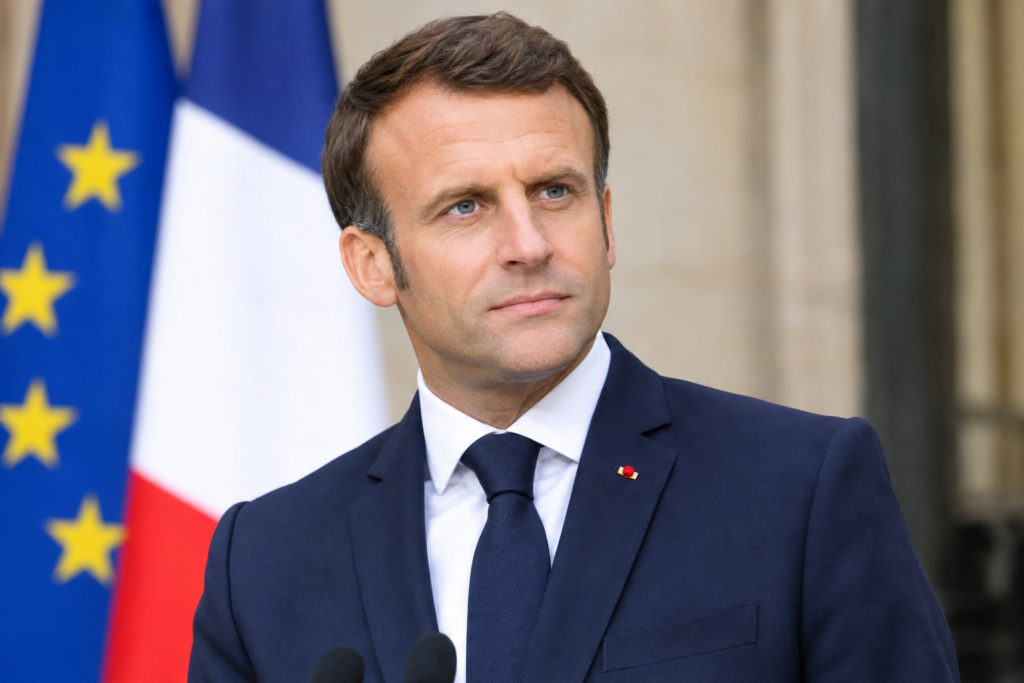
When people search for Macron, they are usually referring to Emmanuel Macron, the French president who became one of the most recognizable political figures in Europe during the 21st century. His rise to the presidency was unusual because he created a political movement from outside the traditional French party structure and reached the Élysée Palace at a relatively young age.
Emmanuel Macron has remained a major figure in French and European politics since his first presidential victory in 2017. He was re-elected in 2022, becoming one of the relatively small number of French presidents to win a second consecutive term under the current Fifth Republic system. The official Élysée biography identifies him as the eighth president of the Fifth Republic.
Macron’s political career has covered a wide range of subjects, including economic reform, European integration, climate policy, technology, national security, defense, and France’s international relationships. Understanding his background helps explain why his presidency has attracted so much attention both inside France and abroad.
Who Is Emmanuel Macron?
Emmanuel Macron was born in December 1977 in Amiens, in northern France. Before entering national politics, he studied philosophy and later graduated from France’s École Nationale d’Administration, commonly known as ENA, in 2004. His early professional experience included work with the French Inspectorate General of Finance.
His career then moved between public administration, finance, and government. This combination became an important part of his public profile because Macron entered politics with experience that was different from the conventional career path of many established party politicians. Before becoming president, he served as an adviser within the presidential administration and later became minister of Economy, Industry and Digital Affairs.
Macron’s political identity developed particularly quickly after he founded the movement En Marche! in 2016. Rather than building his campaign entirely around an established political party, he presented his movement as a new political force. That approach helped him distinguish himself from France’s traditional political organizations and eventually led to his victory in the presidential election of May 2017.
Macron’s Path to the French Presidency
Macron’s rise to the presidency was one of the defining political developments in France during the late 2010s. His movement, created in April 2016, sought to attract supporters from different parts of the political spectrum rather than functioning exactly like a traditional left- or right-wing party.
His campaign emphasized economic modernization, European cooperation, political renewal, and a more ambitious role for France within the European Union. The strategy appealed to voters who wanted an alternative to the established political parties. Macron won the presidential election on 7 May 2017, becoming the eighth president of France’s Fifth Republic.
At the time, Macron’s age also attracted considerable attention. He entered the presidency in his late thirties, making his arrival at the Élysée notably different from the careers of many previous French presidents. His first years in office were characterized by ambitious economic reforms, European initiatives, international diplomacy, and several major domestic political challenges.
Macron’s Second Presidential Term
Macron was re-elected as president on 24 April 2022. His second term placed him in a different political environment from his first because the French political landscape had become more fragmented and the government faced difficult questions involving the economy, social policy, energy, security, and international affairs.
The French presidency operates within the constitutional framework of the Fifth Republic. The president is directly elected for a five-year term and has significant responsibilities, including appointing the prime minister, chairing the Council of Ministers, promulgating laws, and serving as head of the armed forces. The president also has the constitutional power to dissolve the National Assembly under specified conditions.
Macron’s second term has therefore involved more than simply continuing the policies of his first administration. Domestic parliamentary dynamics, European developments, geopolitical instability, and France’s changing security environment have all shaped the political agenda. His administration has continued to emphasize France’s position as a major European and international power.
Macron and Economic Reform
Economic reform has been one of the most recognizable themes associated with Macron’s political career. His background in economics and public administration influenced his emphasis on employment, investment, business competitiveness, industrial policy, and modernization.
One example of this approach is the Choose France investment summit, launched in 2018. According to the Élysée, the summit had generated more than 230 investment decisions totaling close to €87 billion by 2026. At the ninth summit in June 2026, the presidency announced a further €93 billion in investment commitments.
Macron’s economic agenda has also focused increasingly on industrial capacity and technological development. Artificial intelligence, data centers, advanced manufacturing, energy, and strategic industries have become increasingly important areas of discussion. His government has presented these efforts as part of a broader goal of strengthening France’s economic resilience and reducing strategic dependencies.
Macron and the European Union
Europe has been central to Macron’s political vision from the beginning of his presidency. He has repeatedly argued that France’s influence is closely connected to the strength and independence of Europe as a whole.
His European approach has included discussions about strategic autonomy, defense cooperation, energy security, industrial policy, and the future of the European Union. The Élysée describes European policy as one of the major priorities of the presidency, alongside areas such as national security, employment, public services, and ecological planning.
Macron’s European position has become particularly significant as the continent has faced major security challenges. His administration has argued for greater European capacity to make independent decisions while maintaining cooperation among EU member states. This approach does not mean abandoning existing alliances; instead, it places greater emphasis on Europe’s ability to act collectively when its strategic interests are involved.
Macron and France’s Defense Policy
National defense has become increasingly important during Macron’s presidency. France is one of Europe’s major military powers and maintains an independent nuclear deterrent, making the French president an important participant in European and international security discussions.
In July 2026, Macron addressed French military personnel at the Hôtel de Brienne and discussed the changing strategic environment. He announced an additional €36 billion in planned defense spending for the 2026–2030 period, with priorities including ammunition stocks, operational readiness, air defense, drones, artificial intelligence, cyber capabilities, space, and other military technologies.
Macron has also linked French defense policy with the idea of European strategic autonomy. His stated position is that Europe should have greater capacity to protect its interests while individual member states retain their sovereign decision-making powers. The changing security situation in Europe has made these questions particularly prominent during the latter part of his presidency.
Macron’s International Diplomacy
Macron has maintained an active international diplomatic role throughout his presidency. France’s permanent seat on the United Nations Security Council, its nuclear capabilities, its membership in the European Union and NATO, and its historical relationships across Africa, the Middle East, and the Indo-Pacific give the French president a broad international agenda.
In September 2026, Macron traveled to New York for the 81st session of the United Nations General Assembly. According to the Élysée, he met with U.S. President Donald Trump during the visit and discussed the wars in Ukraine and the Middle East, as well as efforts related to energy markets and civilian infrastructure.
His diplomacy has also extended into the Middle East. In July 2026, Macron visited Syria and met with transitional president Ahmed al-Charaa. The French presidency described the trip as part of France’s effort to support a stable and sovereign Syria and to develop cooperation around reconstruction, security, and economic issues.
Macron and Climate and Environmental Policy
Environmental policy has been another important part of Macron’s political agenda. His administration has promoted ecological planning, decarbonization, clean energy, and climate-related investment while also attempting to balance environmental goals with industrial and economic priorities.
The Élysée currently lists ecological planning among the presidency’s major priorities. The administration presents this area as both a domestic policy issue and part of France’s international responsibilities.
Macron has also participated in international climate and environmental diplomacy. In 2026, France hosted the One Health Summit in Lyon, where the French presidency emphasized connections between human health, animal health, environmental degradation, climate change, biodiversity loss, and pollution. These initiatives illustrate how environmental policy has increasingly been treated as a broad strategic issue rather than simply a matter of energy consumption.
Macron and Technology
Technology has become increasingly prominent in Macron’s economic and political agenda. France has sought to position itself as a major European center for artificial intelligence, advanced technology, digital infrastructure, and innovation.
The 2026 Choose France summit highlighted major investment activity involving artificial intelligence and data centers. The presidency said that the announced investments included large projects connected with AI and digital infrastructure, alongside projects in areas such as steel and industrial electrification.
Macron has also addressed the social implications of technology. In September 2026, the French presidency announced a roadmap from a coalition focused on children’s rights and protection in the age of artificial intelligence. This reflects a broader policy question facing governments around the world: how to encourage technological innovation while also addressing safety, rights, education, and social consequences.
Macron’s Leadership Style and Public Image
Macron’s public image has developed considerably since 2017. Early in his presidency, he was often associated with political renewal, economic modernization, and a strongly pro-European outlook. Over time, his public role has increasingly included diplomacy, national security, defense, crisis management, and international negotiations.
His communication style is also distinctive. Macron frequently gives lengthy speeches on European affairs, defense, economics, and international relations. The Élysée maintains an extensive public archive of his speeches, meetings, visits, and official statements, allowing observers to examine his positions directly rather than relying only on commentary from political organizations or media outlets.
At the same time, Macron’s presidency has been politically contentious. French political debates around economic reform, pensions, taxation, public spending, environmental policy, immigration, and the distribution of political power have generated strong disagreement among different groups. Understanding Macron therefore requires looking at both his stated objectives and the political debates surrounding their implementation.
Macron’s Place in Modern French Politics
Macron occupies an unusual position in the history of the Fifth Republic because he built his political movement rapidly and successfully challenged France’s traditional party system. His first presidential campaign demonstrated that a relatively new political organization could become a major force in national politics.
His two presidential victories also make him an important figure in contemporary French political history. The French constitutional system allows a president to serve five-year terms, with the modern system limiting presidents to two consecutive terms. Macron’s second election in 2022 therefore marked a significant continuation of his political project.
The broader legacy of Macron’s presidency will ultimately depend on how historians assess developments across his full period in office. Economic reforms, European policy, defense spending, climate initiatives, diplomatic actions, and domestic political conflicts are all parts of that record. Different observers can reasonably place different weight on these areas, which is why Macron remains such a prominent subject of political discussion.
Macron’s Role in Europe in 2026
By 2026, European security had become an especially important part of Macron’s international agenda. Russia’s war against Ukraine, uncertainty surrounding international alliances, energy security, defense production, and Europe’s relationship with major global powers have all increased attention on the question of European strategic capacity.
Macron has argued that European countries need to strengthen their ability to act collectively while preserving the sovereignty of individual states. His 2026 defense speeches connected French military modernization with a wider European objective, including greater industrial and technological capabilities.
His international schedule in 2026 also demonstrates the breadth of France’s diplomatic role. From discussions about Ukraine and the Middle East at the United Nations to engagement with Syria and European security partners, Macron has continued to use the French presidency as a platform for international diplomacy. These activities are an important part of understanding why the keyword “Macron” extends far beyond French domestic politics.
What Makes Macron Significant?
The significance of Emmanuel Macron comes partly from the unusual route he took to the French presidency. He was not simply the latest leader of one of France’s two traditional governing parties. Instead, he created a new political movement and used it to win the presidency in 2017, then secured re-election in 2022.
His presidency has also coincided with an unusually complicated period in European politics. Economic uncertainty, technological transformation, climate concerns, the war in Ukraine, changes in global power relationships, and debates over Europe’s strategic independence have all shaped the environment in which Macron has governed.
For anyone researching Macron, it is useful to look beyond individual headlines and examine the larger picture. His biography, political movement, economic agenda, European policies, defense strategy, environmental initiatives, technology policies, and international diplomacy together provide a much clearer understanding of his role in modern France.
Frequently Asked Questions About Macron
Who is Macron?
Emmanuel Macron is the president of France. He first won the French presidency in May 2017 after creating the En Marche! movement and was re-elected in April 2022. He previously served as France’s minister of Economy, Industry and Digital Affairs.
When was Macron born?
Emmanuel Macron was born in December 1977 in Amiens, France. He studied philosophy before attending the École Nationale d’Administration and subsequently working in public administration and finance.
When did Macron become president?
Macron became president of France after winning the presidential election on 7 May 2017. He was subsequently re-elected in 2022.
What political movement did Macron create?
Macron founded En Marche! on 6 April 2016. The movement later became the political foundation for his successful presidential campaign.
What is Macron known for?
Macron is widely associated with economic modernization, European integration, strategic autonomy, climate policy, technological investment, and an active international diplomatic role. His presidency has also involved major domestic political debates over economic and social reforms.
What is Macron’s role in European politics?
As president of France, Macron participates in major European policy discussions involving defense, economics, energy, technology, climate policy, and foreign affairs. He has repeatedly advocated stronger European capacity to act strategically while maintaining cooperation among member states.
What is Macron doing in 2026?
In 2026, Macron has continued to focus on European and international diplomacy, French defense policy, investment, technology, environmental issues, and France’s global relationships. Recent official activities include participation in the United Nations General Assembly in New York and diplomatic engagement concerning Ukraine, the Middle East, and Syria.
How long is a French presidential term?
The French presidential term is five years. The current constitutional system replaced the previous seven-year term following a 2000 constitutional reform.
Conclusion
Emmanuel Macron has become one of the defining political figures of contemporary France. His journey from philosophy student and public servant to economics minister and eventually president represents an unusual political trajectory, particularly because he created a new movement rather than relying solely on an established party structure.
Since taking office in 2017, Macron has dealt with economic reform, European integration, environmental policy, technology, defense, and international diplomacy. His re-election in 2022 extended his presidency into a second term, while the changing geopolitical environment has placed even greater emphasis on France’s military capabilities and Europe’s strategic position.
In 2026, Macron remains an active participant in international affairs. His recent diplomatic engagements, investment initiatives, defense announcements, and European policy discussions show how broad the responsibilities of the French presidency can be. Whether someone is researching French politics, European affairs, international relations, economics, or modern political history, understanding Macron provides useful context for understanding France’s position in the world today.
YOU MAY HAVE MISSED