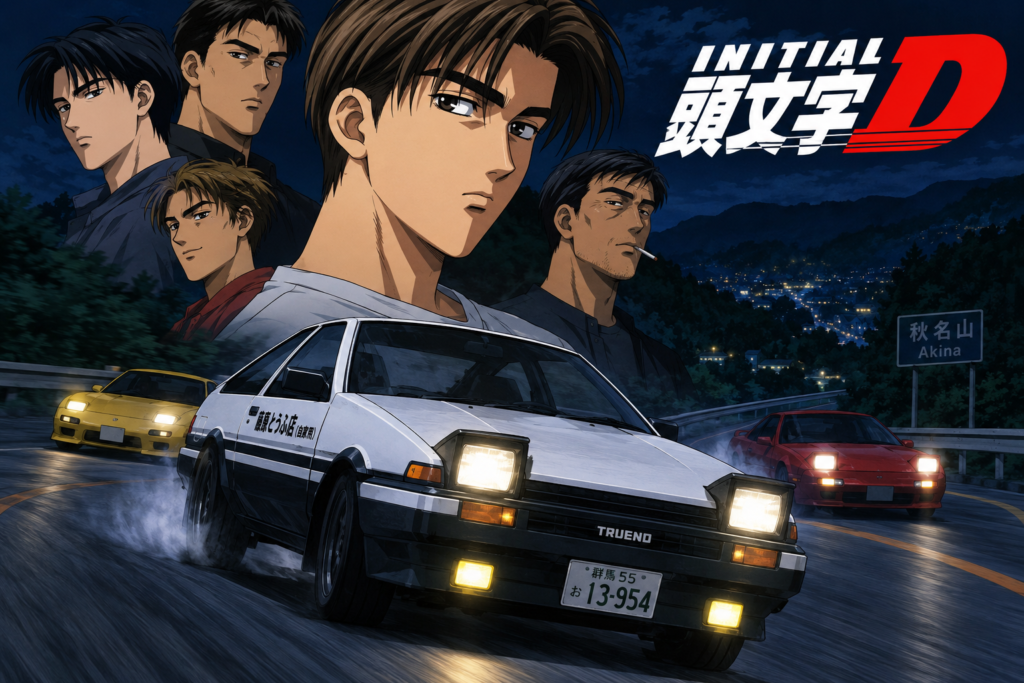
Introduction to Initial D
Initial D is one of those rare Japanese series that managed to turn a relatively simple idea—young drivers racing cars on mountain roads—into a worldwide phenomenon. Created by Shuichi Shigeno, the series combines street racing, driving techniques, friendships, rivalries, personal growth, and an unmistakable love for automobiles. While racing is at the heart of the story, Initial D is much more than a collection of fast cars and dramatic downhill battles.
The story follows Takumi Fujiwara, a quiet teenager from Gunma who spends his nights delivering tofu for his father’s business. What makes Takumi unusual is that he has developed extraordinary driving skills without actively trying to become a professional racer. Years of driving his father’s Toyota AE86 Trueno through winding mountain roads have given him instincts that experienced drivers struggle to understand.
What makes Initial D particularly memorable is the way it presents driving as a combination of technique, confidence, timing, and mechanical understanding. The series does not simply ask which car is faster. Instead, it repeatedly explores how a talented driver can use a road, understand an opponent, and make the most of a machine’s strengths. That approach helped Initial D become a defining title in automotive anime and manga.
What Does Initial D Mean?
The title Initial D has generated plenty of discussion among fans over the years. The “D” has been interpreted in several ways throughout the story, with ideas involving driving, dreams, and other themes connected to Takumi’s journey. Rather than functioning as a straightforward description, the title becomes increasingly meaningful as the series develops.
At first, the title sounds mysterious because Takumi himself is not introduced as someone chasing fame or competitive racing. He is simply a teenager doing deliveries and attending school. His natural ability behind the wheel becomes apparent gradually, which makes the meaning behind the title feel like something the audience discovers alongside him.
The ambiguity also fits the overall personality of the series. Initial D frequently avoids making everything obvious from the beginning. Characters reveal their motivations over time, driving styles become clearer through races, and Takumi’s own ambitions evolve naturally. The title therefore works not only as a name but also as a reflection of the uncertainty surrounding Takumi’s future.
The Story of Initial D
The central story begins with Takumi Fujiwara, who lives in Gunma Prefecture and helps his father, Bunta Fujiwara, operate a tofu shop. Every morning and night, Takumi drives an AE86 Trueno down Mount Akina to deliver tofu. His father has him drive quickly and carefully, and this routine continues for years.
The important detail is that Takumi never treats these drives as racing practice. For him, the mountain road is simply part of his daily life. He becomes extremely comfortable with the corners, changes in elevation, road conditions, and rhythm of the route. As a result, his driving becomes remarkably precise without the ego that often accompanies talented racers.
Eventually, local street racers begin encountering a mysterious AE86 that seems capable of defeating significantly more powerful cars. This creates the legend of the “Akina 86.” Takumi is initially uninterested in the reputation surrounding his car, but repeated challenges force him into the world of competitive street racing.
Takumi Fujiwara and His Development
Takumi Fujiwara is the heart of Initial D. Unlike many traditional racing protagonists, he does not begin with an overwhelming desire to become the best driver in the world. He is quiet, observant, somewhat detached, and often confused by the attention his driving attracts. His lack of arrogance is one of the reasons audiences connect with him.
Takumi’s greatest strength is his ability to remain calm under pressure. He does not need to constantly boast about his skills or intimidate opponents. Instead, he studies what is happening on the road and reacts accordingly. His driving becomes a natural extension of his understanding of the mountain rather than a performance designed to impress spectators.
As the story progresses, Takumi becomes more aware of his own potential. He encounters increasingly skilled drivers and realizes that natural talent alone cannot carry him forever. His experiences force him to think about vehicle setup, racing strategy, competition, and his own ambitions. His development is therefore as much about discovering himself as it is about winning races.
Bunta Fujiwara: The Man Behind Takumi’s Skills
Bunta Fujiwara is one of the most fascinating characters in Initial D. He is Takumi’s father and the owner of the tofu shop, but he is also an exceptionally skilled driver. His calm personality and casual attitude often hide just how experienced he is behind the wheel.
Bunta is largely responsible for Takumi’s unusual driving background. Instead of formally teaching him racing theory, Bunta puts him behind the wheel from a young age and gives him demanding delivery routes. Over time, Takumi develops the ability to drive quickly while maintaining control and protecting the tofu.
Bunta’s own reputation among experienced drivers adds another layer to the story. Characters who understand driving quickly realize that Takumi’s abilities did not appear from nowhere. His father created the environment that allowed those instincts to develop. Bunta therefore represents the quiet foundation beneath Takumi’s remarkable talent.
The Legendary Toyota AE86
The Toyota AE86 Trueno is arguably the second main character of Initial D. In the real automotive world, the AE86 became famous for its lightweight design, rear-wheel-drive layout, balanced handling, and tuning potential. Initial D transformed that reputation into pop-culture mythology.
Takumi’s white-and-black AE86 is not presented as the most powerful car on the mountain. In fact, many opponents have machines with substantially greater horsepower. This contrast is essential to the series because it reinforces the idea that performance is not determined by engine power alone.
The AE86’s lightweight construction and responsive handling make it especially suitable for technical mountain roads. Takumi uses those characteristics to maintain speed through corners, exploit narrow sections, and capitalize on mistakes made by more powerful opponents. The car’s limitations also make every victory more satisfying.
Why Cars Matter So Much in Initial D
Cars in Initial D are not simply transportation. Each vehicle reflects something about its driver. A high-powered turbocharged machine might suit an aggressive driver, while a lightweight car may reward precision and commitment. The differences between vehicles help establish personality before a character even says much.
The series also makes mechanical details part of the storytelling. Engine characteristics, drivetrain layouts, tires, suspension, weight, gearing, and modifications all affect how races unfold. This gives automobile enthusiasts plenty to analyze while keeping the races understandable for casual viewers.
Perhaps most importantly, Initial D demonstrates that there is no universally perfect car. A vehicle that dominates on one road may struggle somewhere else. A driver who understands a machine’s strengths can sometimes overcome disadvantages. That philosophy remains one of the strongest ideas running through the entire franchise.
The Importance of Mountain Roads
Mountain roads are essentially the stadiums of Initial D. Instead of traditional racetracks with predictable surfaces and large run-off areas, the characters race through winding public roads filled with elevation changes, tight corners, narrow sections, and changing conditions.
Mount Akina, the fictionalized mountain associated with Takumi, becomes especially important. Its corners are not merely scenery. They are part of Takumi’s knowledge base. He knows the road so intimately that he can anticipate its rhythm almost instinctively.
Different roads also force drivers to adapt. A course that rewards a lightweight, agile vehicle might expose weaknesses elsewhere. This prevents the races from becoming repetitive and allows different characters to shine under different circumstances.
Racing Techniques in Initial D
Initial D introduced many viewers to concepts associated with performance driving. Cornering lines, braking points, weight transfer, throttle control, traction, and vehicle balance are repeatedly incorporated into the story. The explanations are often simplified for entertainment, but they help communicate why certain driving decisions matter.
One of the most recognizable techniques associated with the series is the gutter run, in which a driver uses the drainage channel along the inside of a corner to influence the car’s trajectory. The technique became strongly associated with Initial D because of the dramatic way it is presented during races.
The series also emphasizes momentum. A driver does not necessarily need to accelerate harder than an opponent if they can carry more speed through corners. This creates races where tiny differences in technique become decisive. It also explains why Takumi can challenge cars with substantially more horsepower.
Keisuke Takahashi and the Evolution of the Rivalries
Keisuke Takahashi is one of Takumi’s most important rivals. As a member of the RedSuns and later Project D, Keisuke represents a very different kind of driver. He is ambitious, competitive, technically minded, and determined to improve.
His relationship with Takumi gradually becomes more interesting than a simple rivalry. Both drivers push one another to improve, but they approach driving differently. Keisuke’s competitive personality contrasts with Takumi’s naturally calm approach.
Their rivalry also helps demonstrate one of Initial D’s major themes: talent can take you far, but improvement requires deliberate effort. Takumi may possess exceptional instincts, while Keisuke actively studies his weaknesses and works to eliminate them. Their different approaches make their encounters particularly engaging.
Ryosuke Takahashi and the Strategic Side of Racing
Ryosuke Takahashi is another central figure in the series and arguably one of its most analytical characters. Unlike Takumi, who often relies heavily on instinct, Ryosuke approaches racing through observation, planning, and technical analysis.
His ability to study opponents makes him a valuable strategist. He pays attention to vehicle specifications, driver behavior, road conditions, and racing patterns. This analytical approach eventually becomes crucial to the formation and philosophy of Project D.
Ryosuke’s role expands Initial D beyond individual races. He represents the idea that driving can be studied as a discipline. Speed is important, but understanding why a car behaves the way it does can be equally valuable.
Project D and the Bigger Challenge
Project D represents a major shift in the story. Instead of Takumi and his teammates simply responding to local challenges, the group takes on a much broader mission involving racing against skilled drivers across different regions.
The project is designed around specialization. Takumi becomes associated with downhill racing, while Keisuke focuses on uphill competition. Ryosuke provides strategic guidance and analysis. This structure allows each member to concentrate on their strengths while continuing to develop.
Project D also changes the scale of the narrative. Earlier races establish reputations within relatively small communities. Later competitions demonstrate how Takumi and the others perform against increasingly experienced drivers. The journey becomes less about proving that Takumi is talented and more about determining how far that talent can actually take him.
Initial D and the Soundtrack
The soundtrack is one of the most recognizable aspects of Initial D. Eurobeat music became deeply connected with the franchise, especially during high-speed racing sequences. The energetic songs helped create a distinctive atmosphere that remains strongly associated with the series.
The contrast between fast electronic music and mountain driving became part of Initial D’s identity. Rather than simply serving as background music, the soundtrack often changes the emotional rhythm of a race. A tense cornering sequence can suddenly feel much more intense when the music accelerates alongside the action.
This musical identity also helped Initial D reach audiences outside Japan. Many viewers who may not have initially been interested in Japanese animation discovered the series through its racing clips, soundtrack, or automotive culture.
Initial D’s Influence on Car Culture
Initial D had a significant impact on car enthusiasts, particularly among younger audiences who discovered Japanese performance cars through the series. Vehicles such as the Toyota AE86, Mazda RX-7, Nissan Skyline, Mitsubishi Lancer Evolution, Subaru Impreza, and Honda models gained additional cultural visibility through their appearances.
The series also introduced the concept of Japanese mountain racing to viewers around the world. Even people unfamiliar with motorsports could understand the appeal of a lightweight car challenging a much more powerful machine on a difficult road.
Its influence extends beyond anime. The visual identity of the AE86, the popularity of eurobeat edits, and countless fan-created videos demonstrate how deeply Initial D became embedded in automotive internet culture. The franchise helped establish a bridge between anime fandom and car culture that remains strong today.
Initial D Manga and Anime Adaptations
The Initial D manga began before the anime adaptation and established the foundation for the entire story. Shuichi Shigeno’s work gradually developed the characters, races, vehicles, and philosophy that would later become recognizable to a much larger audience.
The anime brought those ideas to life with sound, motion, music, and dramatic racing sequences. For many fans, the anime became their introduction to Initial D, while manga readers appreciated the additional details and pacing available in the original source material.
Different stages of the anime used different animation approaches and technologies. This evolution is noticeable when comparing earlier episodes with later installments. Although visual styles changed, the central focus on racing and character development remained consistent.
Why Initial D Still Has a Dedicated Fanbase
One reason Initial D remains popular is that its core themes are easy to understand. The story is about competition, self-improvement, friendship, confidence, and discovering what you are capable of doing. Cars provide the setting, but those themes can appeal even to people who are not serious automotive enthusiasts.
The characters also have distinct personalities. Takumi is quiet and instinctive, Keisuke is ambitious, Ryosuke is analytical, and Bunta is relaxed but intimidatingly skilled. Their interactions make the series more than a sequence of races.
Nostalgia plays a role as well. Fans who discovered Initial D years ago often return to it because the combination of music, cars, animation, and memorable races is difficult to reproduce. New audiences continue discovering it because the basic concept remains remarkably entertaining.
What Makes Initial D Different From Other Racing Stories?
Many racing stories focus primarily on winning championships or becoming the fastest driver. Initial D takes a different approach by placing much of its emphasis on mountain roads and individual matchups. Each race feels like a puzzle with its own combination of driver, car, road, and conditions.
The series also spends considerable time showing preparation and learning. Characters discuss vehicle setup, analyze opponents, repair cars, and think about mistakes. This creates the impression that racing is a process rather than simply an act of pressing the accelerator.
Another difference is Takumi himself. He does not fit the traditional image of a loud, ambitious racing hero. His understated personality makes his driving ability more surprising. Watching other characters realize that the seemingly ordinary tofu delivery driver is an extraordinary racer becomes one of the series’ recurring pleasures.
The Legacy of Initial D
The legacy of Initial D extends far beyond its original manga and anime releases. It influenced automotive anime, inspired countless fan projects, and helped introduce Japanese car culture to international audiences.
The AE86 in particular became strongly associated with the series. While the car had an important reputation before Initial D, the franchise introduced it to an entirely new generation. The image of a white-and-black Trueno attacking mountain corners became one of the most recognizable visuals in automotive anime.
Initial D also demonstrated that a specialized subject such as Japanese street racing could support a compelling long-running story. Its success opened the door for other works that combined vehicles with character-driven storytelling.
Initial D in Modern Popular Culture
Even years after its original peak, Initial D continues to appear in online discussions, racing games, memes, videos, merchandise, and fan communities. References to Takumi, the AE86, eurobeat, and mountain racing remain recognizable to many internet users.
The series also benefits from the continuing popularity of Japanese automotive culture. Modern enthusiasts frequently revisit older performance cars, manual transmissions, lightweight sports cars, and tuning culture. These interests align naturally with the philosophy presented in Initial D.
At the same time, the series has become a nostalgic symbol of an earlier era of car culture. Its emphasis on analog driving, mechanical knowledge, and driver skill feels particularly distinctive in an automotive world increasingly shaped by advanced electronics and driver-assistance technology.
Lessons You Can Take From Initial D
Although Initial D is primarily entertainment, the story contains several useful lessons. One of the biggest is that natural talent is only a starting point. Takumi’s abilities are impressive, but his greatest improvements happen when he encounters people who expose his weaknesses.
Another lesson is the importance of understanding your tools. Initial D repeatedly demonstrates that knowing a machine’s strengths and limitations can matter more than simply owning something powerful. The same idea applies outside driving: understanding how to use your resources effectively is often more valuable than simply having better resources.
The series also shows why experience matters. Takumi’s countless trips down mountain roads give him knowledge that cannot be gained instantly. His instincts are the product of repetition. The story therefore reinforces a familiar principle: consistent practice can turn difficult actions into natural ones.
Is Initial D Worth Watching Today?
For anyone interested in cars, racing, anime, or character-driven competition, Initial D is still worth exploring. Its age may be visible in some of the animation and presentation, but those characteristics are also part of its charm.
New viewers should not worry about understanding every technical detail immediately. The story generally provides enough context to understand what is happening, and the technical explanations become more interesting as familiarity with the characters and cars grows.
The biggest reason to watch is the atmosphere. The mountain roads, engine sounds, eurobeat soundtrack, rivalries, and quiet personality of Takumi create an experience that feels different from most modern racing series. It has a very specific identity, and that identity is a major part of its enduring appeal.
Frequently Asked Questions About Initial D
What is Initial D about?
Initial D follows Takumi Fujiwara, a teenager who becomes involved in mountain street racing after years of delivering tofu in his father’s Toyota AE86. His natural driving ability attracts increasingly skilled competitors, forcing him to improve while discovering what he wants from racing.
The series combines automobile culture with character development, rivalry, friendship, and technical driving concepts. Although racing is the central activity, the story is ultimately about growth and self-discovery.
Who is the main character in Initial D?
The main character is Takumi Fujiwara. He is initially portrayed as a quiet teenager who does not actively seek recognition as a racer.
His extraordinary ability comes from years of driving his father’s AE86 through difficult mountain roads. As the story develops, Takumi gradually becomes more aware of his talent and begins taking racing more seriously.
What car does Takumi drive?
Takumi is famous for driving a Toyota AE86 Sprinter Trueno, commonly recognized by its distinctive two-tone appearance. The lightweight rear-wheel-drive car becomes an important part of his identity.
The AE86 is not the most powerful vehicle in the series. Its effectiveness comes from its handling characteristics and Takumi’s ability to exploit them.
Why is the AE86 so famous in Initial D?
The AE86 became closely associated with Initial D because Takumi uses one to challenge much more powerful vehicles. The contrast between the car’s modest power and Takumi’s extraordinary driving ability became one of the defining ideas of the series.
The anime also helped introduce the AE86 to audiences who might never have encountered the car otherwise.
Who is the best driver in Initial D?
There is no simple answer because different characters have different strengths. Takumi is an exceptional natural driver, while Ryosuke is highly analytical and experienced, and other competitors possess their own specialized abilities.
The series deliberately avoids making driving ability a simple ranking. Road conditions, vehicle setup, experience, strategy, and personal style all influence the outcome of a race.
Is Initial D only for car enthusiasts?
No. Car knowledge can certainly make the series more enjoyable, but it is not required. The story also focuses on friendships, rivalries, personal confidence, ambition, and growth.
Viewers who know little about cars can still appreciate the characters and understand the basic tension of each race.
What makes Initial D’s music so memorable?
The eurobeat soundtrack became one of the franchise’s trademarks. Its fast tempo and energetic style complement the intensity of the racing scenes.
Over time, the music became inseparable from the Initial D experience and helped the series develop a recognizable identity among international audiences.
What is Project D?
Project D is a racing team formed around Ryosuke Takahashi’s plan to challenge skilled drivers across different regions. Takumi and Keisuke serve as the team’s primary drivers, focusing on different types of competition.
The project represents a major stage in the story because it expands the characters’ ambitions beyond their local mountain roads.
Did Initial D influence real car culture?
Yes. Initial D became highly influential within Japanese automotive fandom and international car culture. Its portrayal of the AE86 and other Japanese performance cars introduced many viewers to vehicles, tuning concepts, and mountain racing culture.
The series also contributed to the popularity of automotive content combining Japanese cars, anime, and eurobeat music.
Why is Initial D still popular?
Initial D remains popular because its combination of memorable characters, exciting races, distinctive cars, music, and themes of self-improvement continues to work. Its premise is simple, but the execution gives each race a different personality.
Its influence on internet car culture and anime fandom has also kept the series visible to new generations.
Conclusion
Initial D is much more than a story about cars racing down mountain roads. It is a story about discovering talent, learning from competition, understanding your strengths, and continuing to improve when someone exposes your weaknesses. Takumi Fujiwara’s journey works because his development feels gradual rather than forced.
The Toyota AE86, mountain roads, dramatic rivalries, technical discussions, and unforgettable eurobeat soundtrack give the series its unmistakable personality. Every element contributes to an atmosphere that is difficult to duplicate.
Most importantly, Initial D understands that speed alone does not make someone a great driver. Knowledge, experience, control, confidence, preparation, and adaptability all matter. That message is one reason the series has remained relevant long after its original debut.
For anime fans, Initial D is an influential classic. For car enthusiasts, it is a celebration of driving culture. And for newcomers, it is an entertaining story about a quiet teenager who discovers that something he considered ordinary may actually be an extraordinary talent. That combination is what has allowed Initial D to remain one of the most recognizable racing series in popular culture.
YOU MAY HAVE MISSED