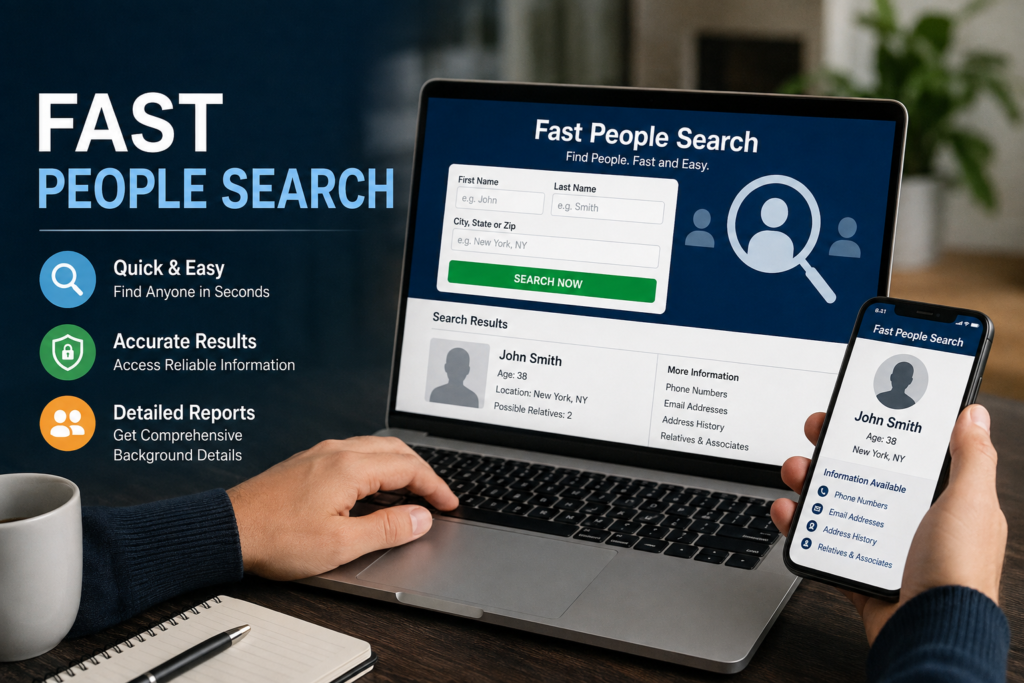
What Is Fast People Search?
Fast people search is a general term used for online tools and services designed to help users locate information about a person using details such as a name, phone number, email address, or general location. Instead of checking dozens of websites manually, these services attempt to organize publicly available information into one searchable place. The idea is simple: enter the information you already have, review possible matches, and determine whether one of the results belongs to the person you are trying to find.
People search tools can be useful in many everyday situations. Someone may be trying to reconnect with an old classmate, confirm the correct spelling of a person’s name, locate a former business contact, or research publicly available professional information. In other cases, people simply want to understand what information about them may be available online. A fast search can sometimes provide a convenient starting point, although the results should always be treated carefully.
The word “fast” is important because modern people-search services focus heavily on convenience. Traditional research might involve searching social networks, public directories, search engines, and other databases separately. A people-search platform may combine several categories of information into a single interface. However, speed should not be confused with accuracy. A result appearing quickly does not necessarily mean it is current, complete, or associated with the correct person.
How Fast People Search Services Work
Most people-search services begin with an identifying detail. A full name is one of the most common starting points, but names alone can create significant ambiguity. For example, thousands of people may share the same first and last name. Adding a city, state, approximate age, phone number, or another non-sensitive identifying detail can help narrow down the results and reduce the chance of confusing two different individuals.
Behind the scenes, people-search platforms may organize information from various public and commercially available sources. Depending on the service and the jurisdiction, these sources can include public directories, property-related records, business information, professional listings, and other publicly accessible data. The exact sources and collection methods vary from one provider to another, so users should read a service’s terms and privacy information rather than assuming every platform uses the same database.
Search systems generally try to match different pieces of information to create a possible profile. A name might be connected with an old address, while another record may contain a phone number or business listing. Algorithms then attempt to determine whether these records likely belong to the same individual. Because databases can contain outdated information, duplicates, and errors, a generated profile should be viewed as a collection of possible matches rather than an unquestionable biography.
Why People Use Fast People Search
One of the biggest reasons people use fast people search tools is reconnecting with people from the past. Friends lose contact after moving to another city, changing jobs, graduating from school, or simply becoming busy with life. A search tool can sometimes help locate a public-facing profile or provide clues that make reconnecting easier. For many users, the appeal is less about detailed information and more about finding a legitimate way to reach someone again.
People may also use search services for basic identity clarification. If several contacts have similar names, a user might want to distinguish between them using publicly available professional or geographic information. This can be especially useful for freelancers, small-business owners, recruiters, and professionals who regularly communicate with new contacts. Even then, responsible users should avoid assuming that two records belong to the same person simply because the names match.
Another common reason is personal information awareness. Searching your own name can reveal what information appears publicly online. This type of self-search can be useful for improving personal privacy habits. You might discover an outdated directory entry, an old professional profile, or a public listing you did not realize was still accessible. Understanding your digital footprint gives you an opportunity to decide what information should remain public and what information you may want to request be removed where removal options are available.
What Information Can Appear in a People Search?
The information displayed by a people-search service varies considerably. A basic result might show a person’s name and a general location, while another service may present additional public-record information. Possible categories can include previous locations, professional associations, publicly listed phone numbers, business details, or links to other publicly accessible records.
Some platforms may also show possible relatives or associates. This information should be treated particularly carefully because relationships can be complicated, records can be outdated, and automated systems can make incorrect connections. A shared surname or address does not automatically establish a meaningful relationship between two people.
The most important point is that a people-search result is not necessarily a complete or verified profile. Information can become outdated quickly when people move, change phone numbers, update their professional roles, or remove online accounts. Some databases may also contain duplicated records. Therefore, users should consider the information as a lead for legitimate research rather than as definitive proof.
Searching by Name
Searching by name is usually the easiest way to begin. If you know the person’s full name, entering it exactly as commonly used can produce a list of possible matches. However, common names can return a large number of results, making additional context extremely useful.
A location can be one of the simplest ways to narrow a search. If you know that someone previously lived in a particular city or worked in a certain area, that information may help separate one person from another. Similarly, a middle initial or alternate spelling can sometimes make a significant difference.
It is wise to compare multiple pieces of information before deciding that a result is correct. A matching name alone is weak evidence. When several independent details line up, confidence increases, but users should still avoid making sensitive decisions about someone based solely on automated search results.
Searching With a Phone Number
Phone-number searches can be helpful when you have an unfamiliar number and want to determine whether it has a public association. Businesses sometimes publish telephone numbers online, and individuals may have numbers appearing in public directories or other accessible records.
However, phone numbers are not permanent identifiers. People change carriers, replace numbers, use family plans, or stop using old numbers. A database can continue displaying an old association long after the number has changed hands. This is one reason reverse phone searches should never be treated as absolute proof of identity.
There is also an important privacy consideration. If a search produces personal information, that does not mean the information should be copied, published, or used to pressure someone. Responsible use means respecting boundaries and using information only for legitimate purposes.
Searching by Email Address
Email searches can be useful for identifying whether an address has a public connection to a business, website, professional profile, or other online presence. This is particularly relevant when dealing with professional contacts or verifying that a publicly advertised contact method appears consistent across different sources.
As with phone numbers, email addresses can change. People may have separate personal and professional addresses, and old accounts may remain visible long after they stop being actively used. A search result associated with an email address therefore needs context before it can be interpreted correctly.
Users should also be cautious about suspicious messages. If an unknown email address appears in a communication, a people-search service should not be treated as a security verification system. When financial information, passwords, payments, or sensitive documents are involved, use stronger verification methods and official contact channels instead of relying on a directory result.
Accuracy and Reliability of Fast People Search Results
Accuracy is one of the most important issues to understand. People-search databases are not perfect, and no responsible user should expect them to be. Information may be collected at different times, stored in different formats, and updated at different speeds.
False matches are particularly common when people have common names. An algorithm might connect two records because they share a name and geographic area even though they belong to different individuals. Similarly, old addresses can remain attached to profiles even after someone has moved away.
For that reason, search results are best treated as starting points. If the information matters for a significant decision, it should be verified through appropriate primary sources. A people-search report can help you discover where to look, but it should not automatically become the final authority.
Fast People Search and Privacy
Privacy is a major consideration whenever personal information is searched online. Public availability does not automatically make information appropriate to redistribute. There is an important difference between finding information for a legitimate personal purpose and collecting someone’s information to harass, intimidate, monitor, or otherwise invade their privacy.
People should also understand their own digital footprint. Searching your own name can reveal how much information is available through public directories and other online sources. If you find information that concerns you, check whether the relevant service offers an opt-out, correction, or removal process.
Privacy practices also extend to the information you enter into search services. Before submitting personal details, review the platform’s privacy policy and terms. Understand what information the service collects, how it uses search queries, and whether information may be retained or shared.
How to Use People Search Responsibly
Responsible use starts with having a legitimate reason for conducting the search. Reconnecting with someone, researching your own digital footprint, confirming publicly available professional information, or locating a business contact can be reasonable purposes. The same tools can become problematic when used for stalking, harassment, intimidation, or unwanted surveillance.
It is also important to avoid making major judgments based on incomplete records. A person-search profile can contain outdated addresses, incorrect associations, or information belonging to another person. Treating such material as fact can lead to unfair conclusions.
Finally, respect the person’s boundaries. Finding someone’s public information does not create an obligation for that person to respond to you. If someone does not want contact, the appropriate response is to respect that decision rather than continuing to search for additional ways to reach them.
Fast People Search for Reconnecting With Old Friends
Reconnecting with an old friend is one of the more positive uses of people-search technology. People naturally lose touch over the years, and a simple search can sometimes provide enough information to find a current professional profile or another public method of contact.
If you decide to reach out, keep the first message friendly and low-pressure. Explain who you are and why you believe you have found the right person. Giving them an easy opportunity to respond—or not respond—is a respectful approach.
It is also worth considering social and professional networks before relying heavily on people-search databases. An old friend may already have a public profile that provides a much more direct and transparent way to reconnect.
Fast People Search for Business and Professional Research
Businesses sometimes need to verify basic professional information about contacts, vendors, consultants, or potential partners. Public business directories and professional profiles can be useful in this context, particularly when someone represents a company or operates a public-facing business.
However, professional research should remain focused on information relevant to the business relationship. Collecting unnecessary personal information is rarely useful and can create privacy concerns.
For formal employment, financial, housing, insurance, or other regulated decisions, organizations should follow applicable laws and use appropriate authorized background-check processes. A general people-search website should not automatically be treated as an adequate substitute for a legally compliant screening service.
How to Evaluate a People Search Website
Before using a people-search service, look at how transparent the website is. A reputable platform should provide clear information about its terms, privacy practices, pricing, and the general nature of the data it provides.
Pay attention to claims that sound too good to be true. No legitimate database can guarantee that every person will be found or that every piece of information will be perfectly current. Search quality depends heavily on the available records and the accuracy of the matching process.
It is also useful to understand the difference between a free search and a paid report. Some services allow you to search basic information without charge but require payment for additional details. Read the pricing information carefully so you know what you are paying for and whether the service uses subscriptions or recurring billing.
Common Mistakes to Avoid
One common mistake is assuming that the first result is automatically the correct person. Search engines and databases rank results using their own systems, but ranking does not prove identity. Always compare relevant details before drawing conclusions.
Another mistake is ignoring outdated information. An address, phone number, or professional association may have been accurate years ago but no longer reflect the person’s current situation. Treat dates and historical information carefully.
A third mistake is sharing search results without considering privacy. Even when information is publicly accessible, reposting someone’s personal details can cause unnecessary harm. If you do not need to share the information, keeping it private is usually the better choice.
Is Fast People Search Free?
Some people-search websites provide limited information without requiring payment, while others charge for expanded reports or additional search features. The exact pricing structure varies between providers and can change over time.
A free result may be enough for basic research, particularly if you only need to confirm a name or general public information. More detailed reports may involve fees, but users should carefully evaluate whether the additional information is actually necessary.
Before entering payment information, check whether the service uses one-time charges or recurring subscriptions. Understanding the billing model can prevent unpleasant surprises and helps you compare services fairly.
How to Search More Effectively
Start with the information you already know rather than entering excessive personal details. A full name combined with a broad location may be enough to identify useful results. If the results are too broad, add another relevant piece of context.
Next, compare results across multiple legitimate sources. A professional website, company directory, public business listing, or social profile can sometimes provide useful confirmation. Independent sources are generally more valuable than several pages that appear to repeat the same underlying information.
Most importantly, slow down when the information matters. The whole point of a fast search is convenience, not careless decision-making. Spending a few extra minutes verifying a result can prevent mistakes that would otherwise be difficult to undo.
What to Do If Your Information Appears Online
If you search for yourself and discover personal information you would prefer not to have publicly displayed, do not panic. First, identify where the information comes from and whether the website provides a privacy, opt-out, correction, or removal procedure.
Keep in mind that removing information from one website does not necessarily remove it from the entire internet. The same information may appear in multiple directories or public sources. You may need to submit separate requests to different services.
It is also helpful to review your broader online presence. Check old social profiles, public posts, professional pages, business listings, and other accounts. Reducing unnecessary public information at the source can be more effective than repeatedly trying to remove copies later.
The Future of Fast People Search
People-search technology will likely continue becoming faster and more sophisticated. Better data organization and improved matching systems can make it easier to locate relevant public information, but technological improvements do not eliminate the need for human judgment.
Privacy expectations are also changing. Consumers increasingly want to know what information companies collect and how it is used. Regulations and industry practices continue to evolve in different regions, which means people-search companies may face increasing pressure to provide transparency and meaningful privacy controls.
The future of people search will therefore involve a balance between convenience and responsibility. Users want quick answers, while individuals also deserve reasonable control over their personal information. The services that handle this balance well are more likely to earn long-term trust.
Final Thoughts on Fast People Search
Fast people search can be a useful starting point when you need to locate publicly available information about a person or understand your own online footprint. Its biggest advantage is convenience: instead of searching many sources individually, users can sometimes find several relevant clues through one platform.
At the same time, speed should never replace verification. People-search databases can contain outdated information, duplicate records, and incorrect matches. A responsible user understands these limitations and checks important information before relying on it.
Ultimately, the best way to use fast people search is with a combination of curiosity, common sense, and respect for privacy. Whether you are reconnecting with an old friend, researching a public professional profile, or checking what information about yourself is online, the goal should be useful information—not unnecessary intrusion.
YOU MAY HAVE MISSED