Introduction: Why GrowthSEO Matters in Modern Digital Marketing
Getting noticed online sounds simple until you actually try to do it. Millions of websites compete for attention every day, and businesses are constantly looking for better ways to appear in search results, attract qualified visitors, generate leads, and turn those visitors into paying customers. This is where search engine optimization and broader digital marketing strategies become important. GrowthSEO is positioned around that exact idea: helping businesses improve online visibility while focusing on meaningful business outcomes rather than traffic alone.
GrowthSEO describes itself as a digital marketing agency focused on helping businesses grow through search engine optimization, content marketing, paid advertising, website-related services, and email marketing. Its stated approach emphasizes visibility, targeted traffic, leads, and sales rather than simply chasing rankings. That distinction is worth paying attention to because a website can attract thousands of visitors and still struggle to generate revenue if the visitors are not relevant or the site does not give them a clear reason to take action.
The broader lesson behind GrowthSEO is that modern SEO should not operate as an isolated marketing activity. Technical optimization, useful content, keyword research, website structure, paid advertising, conversion optimization, and measurement can all work together. A business that treats SEO as part of a larger growth system can make better decisions than one that simply publishes articles and hopes Google will reward them.
This comprehensive guide explores GrowthSEO, its services, the principles behind modern SEO, content strategy, technical optimization, local search, paid advertising, analytics, AI-assisted marketing, common mistakes, and practical ways businesses can think about organic growth. Whether you are completely new to SEO or already familiar with digital marketing, the goal is to provide a useful and realistic understanding of what an SEO-centered growth strategy can actually involve.
What Is GrowthSEO?
GrowthSEO can be understood in two related ways. First, it is the name of a digital marketing agency operating through growthseo.net. Second, the name represents a broader marketing philosophy: using SEO and related digital channels to create sustainable business growth. The agency says its work centers on increasing visibility, attracting the right type of traffic, and converting that attention into leads and sales.
That positioning separates the idea of growth from vanity metrics. Website traffic is useful, but traffic by itself is not the final destination. A business owner generally cares about inquiries, purchases, appointments, subscriptions, registrations, or another measurable outcome. Good SEO should therefore connect visibility with business intent.
The GrowthSEO website lists services including search engine optimization, content marketing, digital advertising, and pay-per-click advertising. Its SEO offering includes small-business SEO, local SEO, technical SEO, on-page SEO, and content optimization. This combination reflects how complicated search visibility has become. Ranking a website is no longer simply a matter of inserting a keyword into an article a certain number of times.
Modern SEO requires an understanding of how websites are discovered, crawled, indexed, interpreted, ranked, and experienced by users. It also requires understanding the audience behind the search query. Someone searching “best accounting software” has a different intent from someone searching “how to create an invoice.” Treating both searches exactly the same would create weak content and an inefficient marketing strategy.
The Core Philosophy Behind GrowthSEO
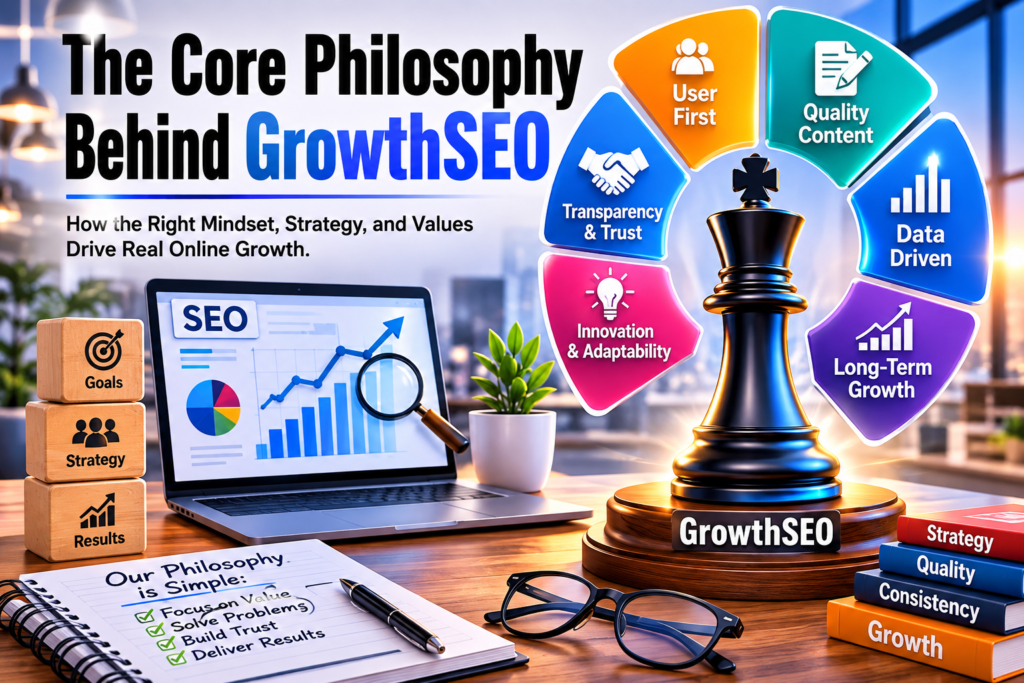
One of the most important ideas associated with GrowthSEO is that SEO should contribute to measurable business growth. The agency explicitly describes its goal as driving revenue rather than simply ranking. That philosophy is particularly useful for businesses that have invested in SEO before but never understood how rankings translated into actual commercial results.
Imagine a local service business ranking number one for a keyword that receives almost no qualified searches. The ranking may look impressive in a monthly report, but it does not necessarily create meaningful business value. Now imagine another business ranking slightly lower for several highly relevant commercial searches and receiving consistent calls and quote requests. The second situation could be much more valuable.
This is why intent matters. SEO professionals should ask what users actually want when they search. Informational queries often need educational content. Commercial queries may require comparisons or service pages. Transactional queries need clear conversion paths. Local queries may need location information, business details, reviews, and strong local relevance.
A growth-focused SEO strategy connects those different stages. It can introduce a potential customer through educational content, build trust through detailed resources, guide that person toward a relevant service page, and eventually encourage a conversion. That is much more sophisticated than simply publishing articles around random keywords.
GrowthSEO Services Explained
GrowthSEO presents a range of services designed to support different parts of online marketing. Its service pages describe SEO, content optimization, PPC advertising, and digital advertising as key parts of its offering.
The advantage of combining these services is that businesses do not necessarily have to think about search visibility, advertising, content, and conversion as completely separate activities. Data from one channel can inform another. For example, a paid search campaign may reveal that a particular keyword converts exceptionally well. That information can influence organic content and landing-page strategy.
Likewise, organic search data can reveal which topics attract highly qualified users. Those insights can be used to develop advertising campaigns, email content, social media posts, or new website pages. The best digital marketing strategies often create this kind of feedback loop.
However, combining services does not automatically guarantee success. The quality of the strategy still matters. Businesses need clear objectives, accurate tracking, realistic timelines, strong creative work, and ongoing optimization. Marketing channels are tools; the strategy determines how effectively those tools are used.
Search Engine Optimization With GrowthSEO
SEO is one of the central services presented by GrowthSEO. The agency describes its approach as improving rankings, visibility, traffic, and sales through SEO strategies.
Search engine optimization includes several different disciplines. Technical SEO deals with the infrastructure and accessibility of a website. On-page SEO focuses on content, headings, page structure, titles, internal links, and related elements. Local SEO helps businesses compete for geographically relevant searches. Content optimization makes pages more useful and aligned with search intent.
A good SEO campaign usually combines all of these areas. Fixing technical problems while publishing weak content will not solve every problem. Creating excellent articles on a website that search engines cannot properly crawl can also limit results. Likewise, attracting traffic without improving conversion paths can leave the business wondering why its rankings are increasing but revenue is not.
SEO is therefore best viewed as a system rather than a single task. Each part supports the others.
Small Business SEO
Small businesses often face a unique SEO challenge. They may have fewer resources than large companies, yet they still compete for the same searchers. GrowthSEO specifically lists SEO services for small businesses, describing them as strategies designed to improve visibility and sales while working with more limited budgets.
For a small business, prioritization is incredibly important. Trying to rank for every possible keyword can waste time and money. A better strategy is to identify searches that have a strong connection to the products or services being sold.
Long-tail keywords can be particularly useful because they often reveal clearer intent. Instead of targeting an enormous phrase such as “marketing,” a small agency might target something more specific such as “SEO for dentists in [city]” or “technical SEO consultant for Shopify.” The exact opportunity depends on the business and market, but specificity can make competition more manageable.
Small businesses can also benefit from creating strong service pages, answering customer questions, publishing genuinely useful resources, and building local authority. SEO does not always require a huge publishing operation. It requires the right priorities.
Local SEO and GrowthSEO
Local SEO is especially important for businesses that depend on customers in specific geographic areas. GrowthSEO lists local SEO optimization among its services and explains that this work is intended to improve visibility in local search and map results.
Local search has a different dynamic from broad informational SEO. When someone searches for a nearby service, they may care about location, availability, reviews, opening hours, services, contact information, and proximity. A local SEO strategy therefore needs to consider more than website keywords.
The website should clearly communicate where the business operates and what it offers. Location-specific service pages can help when they provide genuinely useful information rather than simply repeating city names. Business information should remain accurate and consistent across important platforms.
Reviews also play an important role in how potential customers evaluate local businesses. A company with strong search visibility but poor customer feedback may struggle to convert that visibility into revenue. Local SEO and reputation management therefore often work together.
Technical SEO: The Foundation of a Website
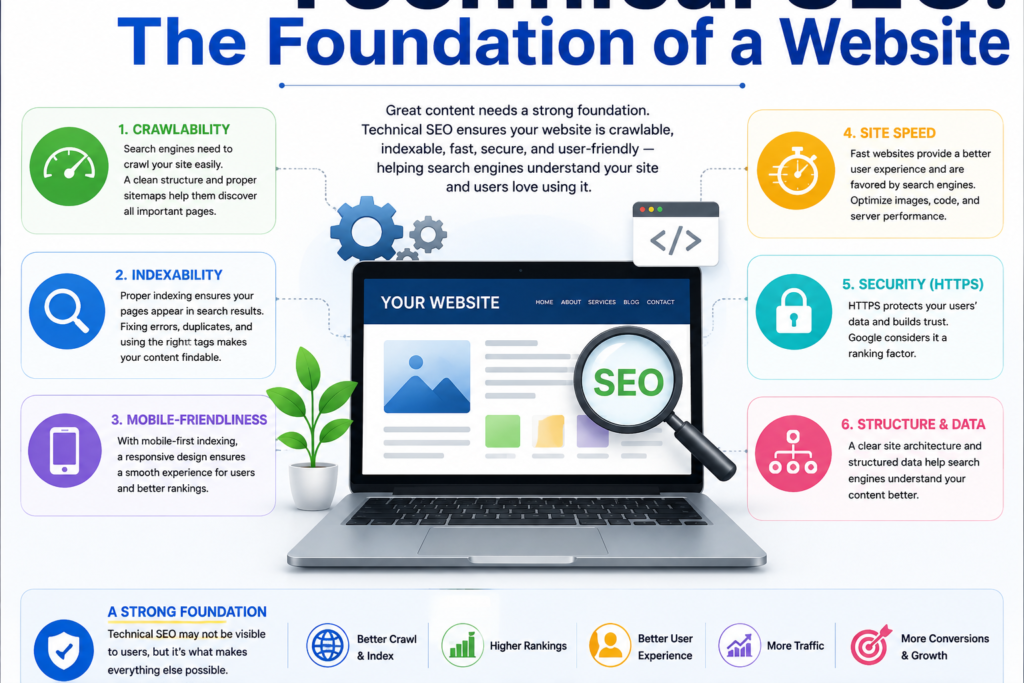
Technical SEO is easy to overlook because users do not always see it directly. They may not know whether a website has a clean sitemap, efficient code, proper canonicalization, mobile-friendly design, or crawlable architecture. Search engines, however, need to access and interpret websites effectively.
GrowthSEO describes technical SEO as addressing issues that can affect rankings, including website speed, indexing, mobile-friendliness, and crawl errors. These elements form part of the basic infrastructure that allows content to perform.
A technically healthy website is easier to manage and easier for search engines to understand. Pages should load efficiently, important content should be accessible, links should work, and unnecessary technical barriers should be removed.
Technical SEO is not about making a website complicated. In many cases, good technical SEO actually makes a website simpler. Clear architecture, logical navigation, fast pages, clean URLs, appropriate redirects, and well-organized content can benefit both users and search engines.
Why Website Speed Matters
People are impatient online. If a website takes too long to load, visitors may leave before they even see the content. This creates a problem that SEO alone cannot solve.
Website speed can influence user experience, engagement, and conversion rates. Slow pages can also make mobile browsing frustrating, particularly for people using weaker connections or older devices.
Improving performance might involve compressing images, reducing unnecessary scripts, improving hosting, optimizing caching, and removing technical elements that do not contribute meaningful value. The exact solution depends on the website, so performance work should begin with measurement rather than random changes.
The important point is simple: SEO should bring users to a website that deserves their attention. Getting the click is only the beginning.
On-Page SEO
On-page SEO is one of the most visible parts of optimization. GrowthSEO describes its on-page service as optimizing website content, structure, and keywords to improve search visibility and user experience.
Good on-page optimization begins with understanding the purpose of a page. Every important page should have a clear topic and a clear user. The title should accurately describe the content. Headings should organize the information. Paragraphs should answer the questions users actually have.
Keyword usage still matters, but modern SEO should not be reduced to keyword repetition. Search engines can understand related terminology, concepts, entities, and context. A well-written article naturally discusses the important subtopics around its main subject.
The best on-page SEO often becomes almost invisible to the reader. The content simply feels organized, relevant, easy to navigate, and useful.
Content Optimization With GrowthSEO
GrowthSEO identifies content optimization as another part of its SEO service. The stated activities include improving keyword usage, content structure, search intent, readability, titles, descriptions, and internal linking.
Content optimization is valuable because older content often contains unrealized potential. A page may already rank on the second page but fail to reach stronger positions because the information is incomplete, outdated, poorly organized, or poorly aligned with user intent.
Optimization can involve rewriting sections, improving headings, answering missing questions, adding useful examples, strengthening internal links, and making the page easier to scan.
However, optimization should not mean changing content merely for the sake of changing it. Every update should have a reason. If a page already performs well and satisfies users, unnecessary edits can create new problems.
Content Marketing as a Growth Strategy
Content marketing gives businesses a way to demonstrate knowledge before asking customers to buy something. Instead of immediately pushing a product or service, a company can answer questions, explain problems, compare approaches, and teach potential customers how to make better decisions.
GrowthSEO includes content marketing among the broader ways it helps brands grow. This fits naturally with SEO because useful content can attract searchers at different stages of the buying journey.
A strong content strategy begins with audience problems rather than a list of random keywords. What questions are customers asking? What mistakes do they make? What information do they need before buying? What objections prevent them from taking action?
Answering those questions creates a library of resources that can support organic visibility and brand trust simultaneously.
Search Intent: The Missing Piece in Many SEO Campaigns
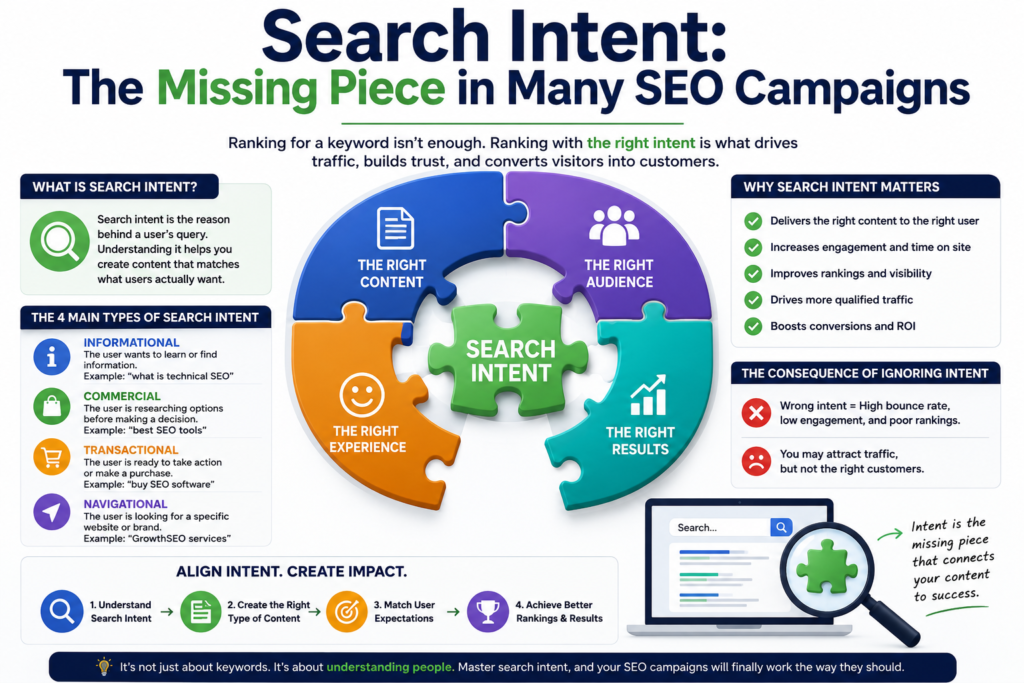
Search intent is the reason behind a query. Understanding it can completely change how a page should be written.
Someone searching “what is technical SEO” probably wants an explanation. Someone searching “technical SEO agency pricing” is much closer to a commercial decision. Someone searching for the name of a specific service provider may simply want navigational information.
If a business creates a sales-heavy landing page for a purely informational query, it may disappoint visitors. Conversely, if someone is ready to purchase and lands on a 3,000-word beginner tutorial without a clear service option, the business may lose the opportunity.
GrowthSEO’s content optimization service explicitly mentions matching content to search intent. That is an important principle because the strongest SEO content is not merely relevant to a keyword; it is relevant to the reason someone searched that keyword.
Keyword Research for Growth
Keyword research is often treated as a spreadsheet exercise, but its real purpose is strategic discovery. Keywords reveal how people describe problems, products, services, brands, and solutions.
A strong keyword strategy considers search intent, competition, relevance, commercial value, topical relationships, and the current authority of the website. Search volume is useful, but it should never be the only metric.
A keyword with enormous volume may be too broad to convert effectively. Meanwhile, a smaller keyword may bring visitors who are much more likely to become customers.
The smartest strategy is often to build groups of related keywords rather than creating one page for every minor variation. This creates stronger topical coverage and a more coherent website structure.
Building Topic Clusters
A topic cluster is a group of connected pages organized around a central subject. The central page provides a broad overview, while supporting pages address specific questions.
For example, an SEO website might have a primary guide about technical SEO supported by pages covering crawling, indexing, redirects, structured data, Core Web Vitals, XML sitemaps, and JavaScript SEO.
This structure makes the site easier to navigate. It also creates natural internal-linking opportunities.
GrowthSEO’s own published material discusses building topical authority by mapping related subtopics, creating content layers, and connecting search-intent chains. The underlying idea is useful for almost any content-heavy website: depth and organization generally beat random publishing.
Internal Linking and Website Structure
Internal links are links connecting pages on the same website. They help users discover related resources and help search engines understand relationships between pages.
Imagine an article explaining beginner SEO. Within that article, relevant links could lead to separate guides about keyword research, technical SEO, local SEO, and content optimization. Each link provides additional value to someone who wants to learn more.
Internal linking also helps distribute attention throughout a website. Important pages should not be isolated from the rest of the site.
The key is relevance. Adding dozens of unrelated internal links can make an article look artificial. A smaller number of genuinely useful links is usually more valuable.
Digital Advertising and PPC
SEO is not the only way GrowthSEO approaches digital visibility. Its services also include digital advertising and PPC advertising. The agency says its advertising work focuses on reaching the right audiences, generating leads, and improving campaign performance through ongoing optimization.
Paid search has one obvious advantage: speed. Organic SEO often requires time to build authority and visibility, while advertising can put a relevant offer in front of searchers much more quickly.
However, PPC can become expensive when campaigns are poorly structured. Businesses need accurate targeting, useful landing pages, strong ad copy, sensible bidding strategies, and careful conversion tracking.
Paid and organic search can complement each other. A business might use PPC for immediate visibility while building organic pages that gradually reduce reliance on paid traffic for important searches.
How SEO and PPC Can Work Together
SEO and PPC are sometimes treated as competing channels, but they can provide valuable data for each other.
For example, PPC can identify keywords that produce strong conversions. Those keywords may become candidates for organic landing pages or long-term content. Similarly, SEO data can reveal topics that consistently attract qualified visitors, which can help inform advertising campaigns.
There is also a strategic benefit to appearing in both paid and organic results. When users repeatedly encounter a brand across search results, it can strengthen visibility and familiarity.
The ideal balance depends on the business. Some companies may rely heavily on organic search, while others need paid advertising because of competitive markets, seasonal demand, or short-term campaigns.
Measuring GrowthSEO Performance
One of the biggest mistakes in digital marketing is measuring activity instead of outcomes. Publishing twenty articles is an activity. Ranking improvements are an outcome. Qualified leads and revenue are even closer to the ultimate business objective.
GrowthSEO states that its approach focuses on measurable results and meaningful business growth. That principle should influence reporting.
Useful SEO metrics can include organic clicks, impressions, rankings, click-through rates, conversion rates, qualified leads, revenue, indexed pages, and engagement behavior.
The right metrics depend on the business. An ecommerce store may care heavily about revenue and transactions. A local service business may care more about calls and quote requests. A publisher may focus on organic traffic, subscriptions, and engagement.
Google Search Console and SEO Measurement
Google Search Console is one of the most useful tools for understanding organic search performance. It can reveal queries, impressions, clicks, average positions, indexing information, and other search-related signals.
The important part is knowing what to do with the data. Seeing that a page receives impressions but few clicks could suggest a title or search-intent problem. Seeing a page rank around positions eight through fifteen could reveal an optimization opportunity.
Data becomes useful when it leads to decisions. A report that simply lists numbers is not necessarily a strategy.
Businesses should therefore review performance regularly and ask practical questions: Which pages are growing? Which are declining? Which queries are appearing unexpectedly? Where are conversions coming from? Which topics deserve more investment?
AI and Modern SEO
Artificial intelligence has become increasingly important in digital marketing. GrowthSEO’s blog discusses AI-assisted SEO workflows, automation, content quality, fact-checking, and generative engine optimization.
AI can help marketers with repetitive work such as organizing data, generating content outlines, summarizing large datasets, identifying patterns, creating first drafts, and supporting research workflows.
But automation does not remove the need for expertise. AI-generated material can contain factual errors, generic language, outdated information, or unsupported claims. Human review remains essential when accuracy and trust matter.
The best use of AI is often to increase productivity while keeping strategic decisions and quality control in human hands.
Why AI-Generated Content Needs Human Oversight
Publishing automatically generated content at scale may look attractive because it is fast. The problem is that speed does not equal usefulness.
Search users want information that answers their questions clearly and accurately. They also want original insights, real examples, trustworthy explanations, and content that does not feel like a generic rewrite of everything already available online.
GrowthSEO’s recent blog content specifically emphasizes fact-checking AI content before publication. This reflects an increasingly important reality: AI can accelerate production, but it cannot replace editorial responsibility.
A strong workflow might use AI for brainstorming, outlining, research organization, or repetitive tasks, while humans handle verification, expertise, editing, examples, positioning, and final approval.
GrowthSEO and Generative Search
Search behavior is changing. Users are increasingly encountering AI-generated answers and conversational search interfaces alongside traditional search engines.
GrowthSEO’s blog has addressed generative engine optimization and the changing search landscape. This means businesses need to think beyond the classic ten-blue-links model.
The fundamentals remain important: clear information, strong technical foundations, useful content, credible sources, and understandable website architecture.
At the same time, content should be structured so that important information is easy to identify. Clear definitions, concise explanations, useful comparisons, original data, and direct answers can make content more valuable across different discovery environments.
Building Trust Through Content
Trust is one of the most important assets a business can build online. A website should make visitors feel that the company understands the subject and can deliver what it promises.
Trust can come from many sources: accurate information, transparent business details, author expertise, customer reviews, case studies, useful explanations, clear policies, and consistent branding.
GrowthSEO’s blog has also discussed building trust signals on websites, emphasizing that visitors can form negative impressions when a site lacks credibility or clear ways to connect with a real organization.
Good SEO attracts attention. Trust helps turn attention into action.
User Experience and SEO
SEO and user experience are deeply connected. Search engines want users to find useful results, and users naturally prefer websites that are easy to understand and navigate.
A page can rank well and still perform poorly if it has confusing navigation, overwhelming layouts, slow loading times, intrusive elements, or unclear calls to action.
Good UX does not require an extravagant design. Often, it means doing the basics extremely well: readable text, logical headings, clear navigation, responsive design, useful visuals, fast performance, and straightforward next steps.
The best SEO strategies consider the entire journey rather than stopping at the search result.
Conversion Optimization
Getting visitors is only one part of digital marketing. Conversion optimization focuses on what happens after visitors arrive.
A conversion might be a purchase, contact form submission, phone call, newsletter registration, appointment booking, demo request, or another meaningful action.
Small improvements can have significant effects. A clearer headline, better explanation of benefits, stronger proof, simpler forms, more visible contact options, or a more relevant call to action can improve results.
This is why SEO and conversion optimization should work together. Increasing traffic without improving the destination can limit the value of SEO.
Common SEO Mistakes Businesses Should Avoid
One common mistake is expecting instant results. SEO usually requires time because search engines need to discover, process, and evaluate changes, while websites gradually build authority and content depth.
Another mistake is targeting keywords without understanding intent. A keyword may look attractive in a research tool but be completely wrong for the business.
Thin content is another recurring problem. Publishing short pages that say almost nothing useful rarely creates sustainable authority.
Businesses should also avoid keyword stuffing, copied content, manipulative link schemes, broken technical foundations, and publishing huge volumes of low-quality AI-generated articles.
Finally, many companies fail because they stop measuring. Without data, SEO becomes guesswork.
How Long Does SEO Take?
There is no universal SEO timeline. Results depend on the website’s age, competition, technical condition, content quality, authority, market, search demand, and implementation speed.
New websites may take longer because they have little historical visibility and limited authority. Established websites can sometimes see quicker gains when they already have strong content and only need strategic improvements.
GrowthSEO’s published guidance for new websites emphasizes patience and notes that meaningful organic growth can develop over several months rather than appearing instantly.
The right mindset is to treat SEO as a compounding investment. A page that becomes a useful search result today may continue attracting visitors months or years later.
GrowthSEO for New Websites
Launching a website without an SEO strategy can create unnecessary problems later. Architecture, URLs, page hierarchy, internal links, metadata, content structure, and technical settings are easier to establish correctly from the beginning than to repair after hundreds of pages exist.
GrowthSEO’s technical SEO material argues that SEO should be considered part of the website’s foundation rather than something added at the very end.
New sites should establish a clear niche, identify realistic keyword opportunities, create useful core pages, and build supporting content around meaningful topics.
They should also make sure search engines can crawl and index important pages properly.
Creating a Strong SEO Content Calendar
A content calendar gives a business structure. Instead of asking every week what to publish, the team can plan topics based on business priorities and search demand.
A useful calendar can include pillar articles, supporting guides, service pages, comparison content, FAQs, case studies, and updates to older pages.
The goal is not simply to publish frequently. Quality and relevance matter more than an arbitrary publishing target.
A smaller website with twenty excellent, strategically connected pages can be more valuable than a website containing hundreds of shallow posts.
Evergreen Content vs. Trending Content
Evergreen content remains useful for a long period. Examples include beginner guides, definitions, tutorials, checklists, and foundational explanations.
Trending content responds to current developments. It can attract short-term attention but may become less relevant quickly.
A strong content strategy can combine both. Evergreen pages create a stable foundation, while timely content gives the brand opportunities to participate in current conversations.
The right mix depends on the industry. News publishers need frequent updates, while service businesses may benefit more from evergreen educational resources.
Link Building and Authority
Backlinks remain an important part of SEO, but quality matters more than collecting large numbers of random links.
A useful backlink is typically relevant, editorially earned, and connected to a website that has its own credibility. Businesses can earn links by producing original research, useful tools, expert resources, compelling studies, or genuinely valuable content.
Trying to manipulate rankings through artificial link schemes can create long-term risks.
A better approach is to create assets people actually want to reference. When a page contains useful information, original data, strong explanations, or a genuinely helpful resource, outreach becomes more natural.
Brand Building and SEO
SEO can contribute to brand awareness even when users do not immediately convert.
Someone may discover a company through an educational article, return later through another search, see the brand mentioned elsewhere, and eventually become a customer.
This is why SEO should not be evaluated only through last-click attribution. Organic search can influence multiple stages of the customer journey.
Strong branding can also improve search performance indirectly because people may begin searching for the brand itself. As awareness grows, branded demand can become another source of organic traffic.
GrowthSEO for E-Commerce Websites
E-commerce SEO introduces additional challenges because online stores can contain thousands of products, categories, filters, and URLs.
The biggest priority is making sure important products and categories are discoverable while preventing unnecessary pages from creating indexation problems.
Category pages should provide useful information rather than acting only as collections of product links. Product pages should clearly explain features, benefits, specifications, availability, and other information shoppers need.
Internal linking is also important. Strong category architecture can help both users and search engines navigate the store.
GrowthSEO for Service Businesses
Service businesses need a slightly different strategy. Instead of optimizing hundreds of product pages, they often focus on core services, locations, customer questions, and commercial-intent searches.
A strong service page should explain what the service is, who needs it, how the process works, what makes the provider different, and how a potential customer can take the next step.
Supporting educational content can answer questions people ask before contacting the business.
Local optimization can then connect those service pages with geographic demand when the business operates in specific areas.
Mobile SEO
Mobile optimization is no longer optional. Many users discover businesses through smartphones, and a poor mobile experience can quickly push them toward competitors.
A mobile-friendly website should have readable text, accessible navigation, responsive layouts, appropriately sized buttons, and efficient loading.
Forms deserve special attention. A form that is easy to complete on a desktop may become frustrating on a phone.
The same principle applies to calls to action. Mobile visitors should not have to hunt for the next step.
Website Architecture and SEO
Website architecture determines how information is organized. A logical structure helps users find what they need and helps search engines understand the relationships between pages.
A typical structure might include the homepage, major service or category pages, supporting subpages, and educational resources.
Important pages should not be buried several clicks deep without a good reason.
Clear architecture also makes internal linking easier. When the site has a logical hierarchy, content naturally connects to related pages.
SEO Audits
An SEO audit provides a structured review of a website’s current condition.
A comprehensive audit can examine technical accessibility, indexation, page speed, content quality, internal linking, metadata, keyword targeting, backlinks, mobile usability, and conversion paths.
The goal should not be to produce a giant list of problems with no priorities. The most useful audit identifies what matters most and explains what should happen next.
For example, fixing a major indexation issue may be more important than rewriting twenty meta descriptions.
GrowthSEO and Data-Driven Decision Making
GrowthSEO emphasizes data-driven marketing as part of its positioning. This is important because digital marketing produces enormous amounts of information.
But data can become overwhelming. The solution is not to measure everything equally. Businesses should define the metrics that actually connect to their goals.
If the objective is lead generation, the team should understand which pages generate leads, which queries produce qualified visitors, and where users abandon the conversion process.
The point of analytics is not to create impressive dashboards. It is to make better decisions.
What Makes an SEO Strategy Sustainable?
Sustainable SEO is built around usefulness, relevance, technical quality, and consistent improvement.
It does not depend on one trick. Search algorithms evolve, competitors change, and customer behavior shifts. A strategy that works only because of one temporary tactic is fragile.
A sustainable strategy creates valuable resources, improves existing pages, builds genuine authority, maintains technical quality, and continuously learns from performance data.
That approach takes more effort than chasing shortcuts, but it is far more likely to produce lasting value.
The Role of Expertise in SEO Content
Expertise matters because users can often recognize shallow content.
An expert article does not have to use complicated language. In fact, the best experts often explain difficult concepts simply.
Useful expertise can appear through examples, original frameworks, practical warnings, industry-specific details, first-hand observations, data interpretation, and clear explanations of trade-offs.
This is particularly important in competitive industries where dozens of websites already publish similar generic advice.
How to Evaluate an SEO Agency
Businesses considering GrowthSEO or another SEO provider should ask practical questions.
What exactly will be delivered? Which pages will be optimized? How will success be measured? How often will reporting occur? Who creates the content? How are technical issues handled? What happens if rankings do not improve?
A good agency should be able to explain its process clearly.
Businesses should also be cautious about promises of guaranteed number-one rankings. SEO involves search systems, competitors, market behavior, and variables that no agency completely controls.
Transparency is much more valuable than exaggerated promises.
GrowthSEO vs. Generic SEO Services
The difference between a growth-oriented approach and generic SEO often comes down to objectives.
Generic SEO may focus heavily on rankings, keywords, and traffic.
A growth-oriented approach asks what happens after the traffic arrives.
Does the visitor become a lead? Does the lead become a customer? Which pages contribute to revenue? Which marketing channels support each other?
That broader perspective can make SEO more commercially meaningful.
Why Content Quality Matters More Than Content Volume
There is a temptation to believe that publishing more automatically produces more traffic. In reality, a website can become less useful when it is overloaded with repetitive pages.
Content should exist for a reason. Each page should answer a distinct need, support a business objective, or provide useful information.
Before publishing a new article, ask whether it adds something meaningful that the existing site does not already provide.
If the answer is no, improving an existing page may be a better investment.
Updating Existing Content
Content optimization does not stop after publication. Search results change, facts become outdated, competitors publish better resources, and user expectations evolve.
Regular content reviews can identify pages that are declining.
A refresh might include updated statistics, clearer examples, new sections, better internal links, improved formatting, or stronger answers to common questions.
The objective should always be to make the page more useful than it was before.
SEO Reporting That Business Owners Can Understand
SEO reports should not overwhelm clients with dozens of technical metrics.
A useful report explains what changed, why it matters, what was done, and what will happen next.
For example, instead of saying “organic impressions increased by 35%,” a stronger report might explain which pages generated the increase and whether those impressions resulted in qualified visits or leads.
This turns reporting into a business conversation rather than a monthly spreadsheet exercise.
The Future of GrowthSEO and Digital Marketing
The future of SEO will probably involve even more integration between traditional search, AI-powered discovery, content, analytics, paid advertising, and conversion optimization.
Search engines are becoming more sophisticated at interpreting meaning and intent. AI tools are making content production faster. Users are discovering information through more platforms.
That means businesses cannot rely on outdated tactics indefinitely.
The fundamentals, however, remain surprisingly stable: understand your audience, create genuinely useful information, maintain a technically sound website, establish credibility, measure performance, and keep improving.
Final Thoughts on GrowthSEO
GrowthSEO represents an approach to digital marketing that places SEO within a larger business-growth framework. Its website describes services spanning SEO, content marketing, digital advertising, PPC, and related optimization work, with an emphasis on attracting the right traffic and turning visibility into measurable business outcomes.
The most important lesson is that SEO should never be treated as a magic button. Rankings are not the final objective. Traffic is not the final objective. Even visibility is not the final objective.
The real goal is to connect the right people with the right business at the right moment.
That requires technical foundations, useful content, search-intent research, strong website architecture, local optimization where appropriate, thoughtful advertising, accurate measurement, and consistent improvement.
For businesses exploring GrowthSEO, the smartest approach is to evaluate the specific strategy being proposed rather than focusing only on the label. Look at the objectives, deliverables, reporting process, technical work, content quality, and conversion strategy.
SEO works best when it is treated as a long-term growth system. Done properly, it can create an asset that continues producing visibility and opportunities long after an individual campaign or article has been published.
Frequently Asked Questions About GrowthSEO
What is GrowthSEO?
GrowthSEO is the name of a digital marketing agency operating through growthseo.net. The company describes its services around SEO, content marketing, digital advertising, PPC, and related digital growth activities.
The broader concept behind the name is also straightforward: use search visibility and digital marketing to attract relevant audiences and turn that attention into measurable business outcomes.
What services does GrowthSEO provide?
GrowthSEO lists search engine optimization, content marketing, digital advertising, and pay-per-click advertising among its services. Its SEO services include small-business SEO, local SEO, technical SEO, on-page SEO, and content optimization.
The exact mix of services a business needs depends on its goals, industry, competition, website condition, and available resources.
Is GrowthSEO suitable for small businesses?
Small-business SEO is specifically listed among GrowthSEO’s services.
Small businesses can benefit from SEO when campaigns are focused on realistic opportunities rather than trying to compete for every broad keyword. Local search, service-specific queries, long-tail content, and strong conversion pages can all be useful depending on the market.
How long does SEO take to work?
SEO does not have a guaranteed timeline. New websites generally need more time to establish visibility, while established websites may see faster improvements when existing authority and content can be optimized.
Businesses should evaluate progress through trends in visibility, qualified traffic, conversions, and revenue rather than expecting instant results.
Does GrowthSEO offer local SEO?
Yes. GrowthSEO lists local SEO optimization as part of its SEO services and says the service focuses on improving rankings for local search, map results, and local keywords.
Local SEO can be particularly valuable for businesses whose customers are concentrated in specific cities or service areas.
What is technical SEO?
Technical SEO focuses on the underlying structure and accessibility of a website. It can involve crawling, indexing, page speed, mobile-friendliness, site architecture, redirects, and other technical elements.
GrowthSEO specifically identifies technical SEO as a service for resolving technical issues that can affect search performance.
Is SEO better than PPC?
Neither is universally better. SEO can provide long-term organic visibility, while PPC can provide faster exposure for targeted searches.
Many businesses benefit from using both. PPC can provide immediate demand capture while SEO builds longer-term organic assets.
Why is search intent important?
Search intent explains what someone is trying to accomplish with a search query. Understanding intent helps businesses create pages that actually satisfy users.
A page designed for the wrong intent can struggle even when it contains the correct keyword.
Does AI replace SEO professionals?
AI can automate parts of SEO, but it does not eliminate the need for strategy, expertise, judgment, verification, and quality control.
AI can be useful for repetitive work and initial content production, while humans remain responsible for accuracy, originality, context, and final decisions.
What should a business measure in SEO?
Useful measurements can include organic clicks, impressions, rankings, click-through rates, qualified leads, conversion rates, transactions, and revenue.
The most important metrics depend on the business model. A strong SEO report connects search performance with actual business objectives.
Conclusion
GrowthSEO provides a useful example of how modern SEO can be positioned as more than a ranking exercise. The emphasis on SEO, content, paid advertising, technical optimization, local visibility, and measurable growth reflects the reality that successful digital marketing requires several connected disciplines.
The businesses most likely to benefit from SEO are not necessarily those that publish the most content or chase the largest keywords. They are the ones that understand their customers, solve real problems, build useful websites, measure meaningful outcomes, and improve consistently.
That is ultimately what makes SEO powerful. It is not just about being visible. It is about becoming visible for the searches that matter, delivering a strong experience after the click, and creating enough value that visibility turns into genuine business growth.