Introduction to John F Kennedy Jr.
John F Kennedy Jr. remains one of the most recognizable names in modern American history. Born into one of the country’s most famous political families, he attracted public attention from the moment he entered the world. His father, John F. Kennedy, became the 35th president of the United States, while his mother, Jacqueline Kennedy, was already a major cultural and public figure. Because of his family background, John F Kennedy Jr. grew up surrounded by politics, history, media attention, and an extraordinary level of public interest.
Despite being born into privilege, his life was not simply a story about being the son of a president. John F Kennedy Jr. developed interests and ambitions of his own. He pursued education, worked in law, entered publishing, and eventually became closely associated with George, a political magazine that attempted to present politics through a more modern and popular-culture-oriented lens. His career showed that he was interested in shaping his own identity rather than remaining permanently defined by his father’s presidency.
His life was also marked by tragedy. The assassination of President John F. Kennedy when his son was still a child became one of the defining events of American history. Decades later, John F Kennedy Jr. died in a plane crash in 1999, creating another national tragedy associated with the Kennedy family. His relatively short life therefore combined privilege, ambition, public fascination, personal loss, and an enduring cultural legacy.
Early Life and the Kennedy Family
John Fitzgerald Kennedy Jr. was born on November 25, 1960, in Washington, D.C. His birth came only a few weeks after his father was elected president. This timing made him a particularly symbolic figure from the beginning. The young Kennedy became part of a presidential family that was already attracting enormous public attention, and photographs of the Kennedy family quickly became familiar to people throughout the United States and around the world.
Growing up in the White House created an unusual childhood environment. John F Kennedy Jr. was not simply the child of a powerful family; he was the son of a sitting president during a period of intense political and international activity. Images of him playing around the White House became part of the public memory of the Kennedy presidency. His childhood was frequently photographed, although his parents also attempted to provide some degree of normal family life.
The assassination of President Kennedy on November 22, 1963, dramatically changed the family’s life. John Jr. was only two years old when his father was killed in Dallas. One of the most famous images from the funeral showed the young boy saluting his father’s coffin as it passed. That photograph became an enduring symbol of the Kennedy tragedy and helped shape the public’s emotional connection to John Kennedy Jr.
Growing Up After His Father’s Assassination
After President Kennedy’s death, Jacqueline Kennedy focused heavily on protecting her children from excessive media attention while also managing the enormous responsibilities associated with being the widow of a president. John Jr. and his sister, Caroline, grew up under circumstances that were extraordinary by almost any standard. They had access to elite educational opportunities, but they also lived with the constant knowledge that their family was unusually visible.
The Kennedy family remained an important part of American public life throughout John Jr.’s childhood. His uncle Robert F. Kennedy became a prominent political figure and later suffered his own assassination in 1968. Another uncle, Edward Kennedy, served for decades in the U.S. Senate. As a result, politics was never far from John Jr.’s surroundings, even when he was not personally pursuing a political career.
John Jr.’s upbringing also taught him something about the difficulties of public life. He saw firsthand how political families could become subjects of intense media coverage. This experience likely contributed to the careful balance he later tried to maintain between celebrity and personal independence. Although photographers and reporters followed him for much of his adult life, he often attempted to establish a professional identity separate from the Kennedy name.
Education and Personal Development
Education played a significant role in John F Kennedy Jr.’s development. He attended private schools before eventually studying at Brown University. At Brown, he developed interests beyond politics and earned a degree in American studies. His education gave him an opportunity to explore American culture and history while also building a life among peers outside the immediate world of Washington politics.
After Brown, Kennedy attended New York University School of Law. His path toward becoming a lawyer was not especially easy. He struggled with the New York bar examination before eventually passing it on a later attempt. The experience became an interesting part of his public image because it showed that, despite his famous family name, he could experience ordinary professional setbacks.
His legal education also gave him a practical foundation for understanding government, institutions, and public affairs. However, law did not become the defining career of his life. Instead, his interests eventually moved toward journalism, publishing, and media. This transition would become particularly important because it allowed him to engage with politics without formally becoming a politician.
John F Kennedy Jr. and His Legal Career
John F Kennedy Jr. worked as an assistant district attorney in New York City after completing his legal education. The position placed him in a demanding professional environment where his family name did not automatically determine his daily responsibilities. Working within the criminal justice system gave him practical experience and allowed him to establish a professional identity separate from the White House.
His legal career was relatively brief compared with the careers of many attorneys. Nevertheless, it demonstrated that he was interested in doing work that had a tangible public impact. He was not simply interested in being a social celebrity. His decision to pursue law required substantial education and professional preparation, even though his family background ensured that his career would always attract attention.
Over time, however, Kennedy became increasingly interested in publishing and public communication. His ability to understand politics, combined with his familiarity with media culture, eventually led him toward a very different professional path. Rather than standing behind a courtroom desk or entering electoral politics, he began exploring how political ideas could be presented through popular media.
The Creation of George Magazine
One of the most important chapters in John F Kennedy Jr.’s professional life began with the creation of George magazine. Launched in the 1990s, the publication attempted to combine politics with popular culture, celebrity, entertainment, and sophisticated visual presentation. Its central concept was unusual for its time because it treated politicians as personalities while also presenting politics as part of broader American culture.
Kennedy became the magazine’s most recognizable public figure, but the project was larger than his personal celebrity. George aimed to attract readers who might not normally read traditional political publications. Instead of relying entirely on conventional political journalism, the magazine used celebrities, photography, humor, and cultural commentary to make political subjects more accessible.
The publication reflected Kennedy’s belief that politics did not have to be presented in a dry or overly formal manner. He understood that public attention was increasingly shaped by television, entertainment, and celebrity culture. In that sense, George anticipated some of the ways modern political communication would later blend with entertainment and lifestyle media.
The Philosophy Behind George Magazine
The title George was itself a clever reference to George Washington, the first president of the United States. By choosing that name, the magazine connected America’s political history with its modern media culture. The concept suggested that political figures could be examined not only through legislation and elections but also through personality, fashion, celebrity, communication, and cultural influence.
Kennedy’s approach was different from traditional political journalism. Rather than presenting politics exclusively as a battle between political parties, George tried to make political personalities interesting to a wider audience. This helped the magazine stand out in an increasingly crowded media landscape.
The publication also featured high-profile personalities and visually distinctive covers. Kennedy understood the importance of presentation and branding, something that became increasingly important throughout the 1990s. His experience with George demonstrated that he possessed entrepreneurial instincts as well as an understanding of journalism and popular culture.
John F Kennedy Jr. and His Relationship With the Media
Media attention followed John F Kennedy Jr. throughout his life. His family history made him newsworthy even when he was doing ordinary things. As an adult, however, he became increasingly aware of the tension between public fascination and private life. He was frequently photographed in New York, at social events, and alongside other well-known figures.
Unlike a politician seeking votes, Kennedy did not need to maintain constant public visibility. In fact, he often seemed to prefer controlling how much of his private life entered the public conversation. His position was unusual because he was famous without holding national political office.
His relationship with the media also reflected a larger change in American celebrity culture. By the 1990s, public figures were increasingly followed not only for their professional achievements but also for their relationships, clothing, friendships, and lifestyles. Kennedy became one of the most recognizable examples of this phenomenon.
Marriage to Carolyn Bessette
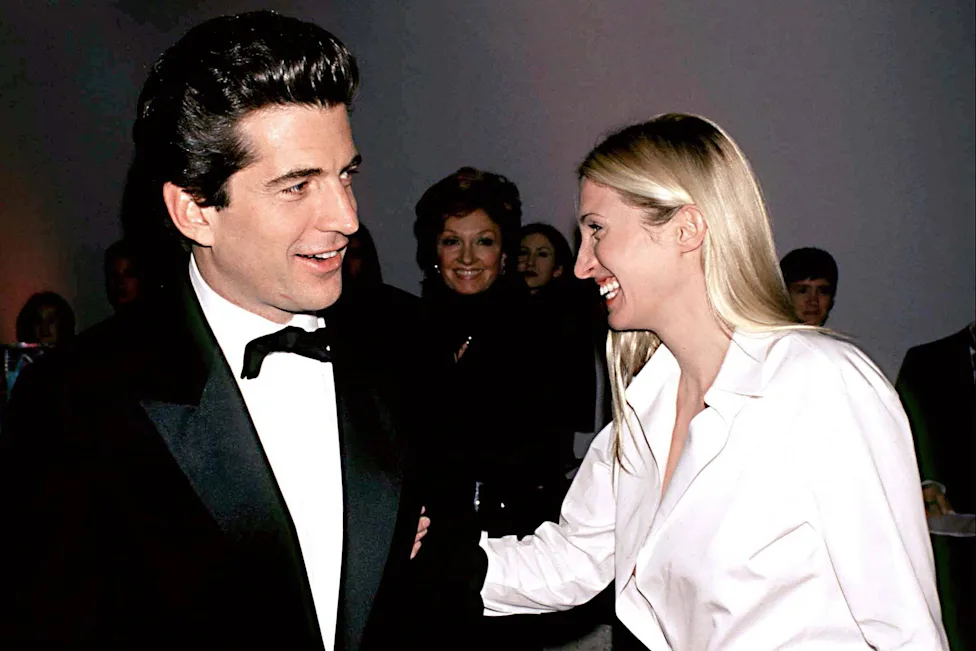
John F Kennedy Jr.’s relationship with Carolyn Bessette attracted enormous public interest. The couple married in 1996 in a private ceremony on Cumberland Island, Georgia. Their wedding was intentionally intimate, reflecting their desire to keep at least part of their personal lives away from constant media attention.
Carolyn Bessette was already familiar with the world of fashion and public relations, having worked for Calvin Klein. Her sophisticated style and reserved personality made her an especially interesting figure to the media. Together, Kennedy and Bessette became one of the most photographed couples of the 1990s.
Their relationship was not always easy under the pressure of public attention. Like many couples living under intense scrutiny, they faced challenges that were amplified by the media. Nevertheless, their marriage remains an important part of the story of John F Kennedy Jr., particularly because both died together in the plane crash of 1999.
John F Kennedy Jr. as a Public Figure
There was something unusual about John F Kennedy Jr.’s public identity. He was famous because of his family, but he also attempted to build a reputation based on his own work. This distinction is important when examining his legacy. He could easily have entered politics and relied on the Kennedy name, yet he chose a different route.
His public image was often associated with youth, style, intelligence, and charisma. Magazine covers and photographs contributed to the perception of Kennedy as an unusually photogenic member of America’s political dynasty. He became a symbol of a younger generation of Kennedys even though he never held elected office.
At the same time, public fascination sometimes overshadowed his professional achievements. Discussions about his appearance, relationships, and family history could dominate coverage of his work. This is one reason George was significant: it gave Kennedy an opportunity to demonstrate his ideas about politics and media rather than simply appearing as a celebrity.
Did John F Kennedy Jr. Plan to Become President?
One of the most persistent questions surrounding John F Kennedy Jr. is whether he intended to enter presidential politics. The Kennedy family had already produced a president, senators, ambassadors, and other influential public figures, so speculation about a future political career was almost inevitable.
However, there is a difference between public expectations and documented personal plans. Kennedy did not hold elected office before his death, and there was no presidential campaign underway. His work in publishing suggested that he was interested in politics and public affairs, but interest does not automatically mean that he intended to seek the presidency.
The speculation nevertheless became part of his mythology. Because he died relatively young, people naturally wondered what he might have accomplished later in life. Counterfactual questions about a person’s unrealized future are impossible to answer with certainty, but they contribute significantly to the continuing public fascination with Kennedy.
His Interest in Politics Without Becoming a Politician
Kennedy’s career demonstrated that political influence does not always require elected office. Through George, he created a platform for discussing political figures and issues while using the tools of journalism and popular culture. This allowed him to participate in public conversations without committing himself to a traditional political career.
His approach was particularly interesting because he understood that political engagement could be shaped by personality and presentation. Politics was increasingly becoming something people encountered through television, magazines, entertainment programs, and eventually the internet. Kennedy’s magazine reflected that changing environment.
In retrospect, his approach appears particularly relevant to modern media. Today, political figures routinely interact with entertainment, social media, branding, and celebrity culture. George was created before many of these trends became dominant, but it was clearly interested in the relationship between politics and popular culture.
The Final Flight
On July 16, 1999, John F Kennedy Jr. piloted a Piper Saratoga aircraft from New Jersey toward Massachusetts. He was traveling with his wife, Carolyn Bessette Kennedy, and her sister, Lauren Bessette. They were heading toward Martha’s Vineyard, with plans connected to a family wedding.
The flight took place at night, and weather conditions contributed to difficult visibility. The aircraft disappeared from radar and crashed into the Atlantic Ocean near Martha’s Vineyard. There were no survivors.
The accident shocked the United States and received extensive international coverage. The death of John F Kennedy Jr. was particularly emotional because of the Kennedy family’s history of tragedy. For many Americans, his death felt like another painful chapter in a family already associated with some of the most famous losses in American public life.
What Happened in the Plane Crash?
Investigators concluded that the crash resulted from pilot error associated with spatial disorientation during a descent over water at night. The National Transportation Safety Board determined that Kennedy failed to maintain control of the aircraft during the flight.
Nighttime flying over water can create serious challenges because visual references are limited. Pilots can experience spatial disorientation when their inner-ear sensations conflict with the information available through their instruments. Without reliable visual references, a pilot may mistakenly believe an aircraft is level when it is actually turning or descending.
The investigation did not establish a mysterious conspiracy as the cause of the crash. Over the years, however, numerous theories have circulated online and in popular culture. These theories often receive attention because of the Kennedy family’s long history of political tragedies, but the official investigation attributed the accident to factors associated with the flight and Kennedy’s loss of control.
The Kennedy Family and a History of Tragedy
The Kennedy family’s history contains a number of extraordinary tragedies, which has contributed to the idea of a so-called “Kennedy curse.” President John F. Kennedy was assassinated in 1963. Robert F. Kennedy was assassinated in 1968. Other family members experienced serious accidents, illnesses, and personal difficulties.
John F Kennedy Jr.’s death added another devastating event to this history. Because he was the son of an assassinated president, his death naturally generated comparisons with the earlier tragedy. The emotional impact was intensified by the fact that his mother had died only a few years earlier, in 1994.
The idea of a Kennedy curse is more cultural than scientific. It is a way people have attempted to describe an unusually concentrated series of tragedies affecting a prominent family. Historians generally approach the subject more cautiously, focusing on documented events rather than treating the tragedies as evidence of a supernatural force.
John F Kennedy Jr.’s Legacy
John F Kennedy Jr.’s legacy is complicated because his career was still developing when he died. He had already established himself as a lawyer, publisher, and public figure, but he had not yet reached the age at which many people make their most significant professional contributions.
His legacy therefore contains both achievements and possibilities. The creation of George remains one of his clearest professional accomplishments. The magazine demonstrated his willingness to experiment with the relationship between politics and entertainment, and it gave him an independent platform.
His public image has also survived through photographs, documentaries, books, archival footage, and continued interest in the Kennedy family. For many people, he represents an intriguing “what if” chapter in American history: what might he have done if he had lived another several decades?
Why People Still Search for John F Kennedy Jr.
Interest in John F Kennedy Jr. has remained remarkably persistent because his story combines several subjects that naturally attract public attention. He was connected to one of America’s most famous political families, had a career in media, was married to a highly recognizable fashion figure, and died under tragic circumstances.
Search interest is also fueled by renewed interest in the Kennedy family itself. Every generation discovers the Kennedy story through books, documentaries, historical programs, and digital media. John Jr. occupies a unique position because he belongs simultaneously to the history of the Kennedy presidency and the celebrity culture of the 1990s.
Another reason is the unfinished nature of his story. He died at only 38 years old. People are naturally curious about what he could have accomplished later in life. Unlike historical figures who lived long careers, Kennedy’s adult life ended while many possible paths were still open.
John F Kennedy Jr. and American Celebrity Culture
Kennedy became a major celebrity before social media transformed public life. During his lifetime, magazines, television programs, newspapers, and paparazzi photography were the main channels through which celebrities reached mass audiences.
His popularity showed how the public could become interested in someone even without an official position of power. He was not president, senator, or governor, yet his family background and personal charisma made him a constant subject of media attention.
In many ways, his experience anticipated the modern relationship between public figures and celebrity culture. Today, political families and political candidates routinely interact with entertainment media and personal branding. Kennedy’s career at George reflected an early attempt to understand that changing relationship.
Separating Historical Facts From Myths
Because John F Kennedy Jr. is such a famous figure, numerous myths and rumors have developed around his life. Some focus on supposed political plans, while others concern his relationships, career, or the circumstances of his death.
A responsible examination of his life requires distinguishing documented evidence from speculation. Historical records, official investigations, contemporary reporting, and biographies provide a much stronger foundation than unsupported internet claims.
This distinction is especially important when discussing the plane crash. The Kennedy name has inspired countless conspiracy theories, but repetition does not turn speculation into evidence. The available official findings provide a clear explanation for the accident, while alternative theories remain unsubstantiated.
The Enduring Appeal of the Kennedy Name
The Kennedy family continues to occupy an unusual place in American culture. Few political families have achieved the same combination of power, glamour, tragedy, and historical importance. President Kennedy’s administration has been studied extensively, while Jacqueline Kennedy remains an important cultural figure.
John F Kennedy Jr. inherited the public fascination associated with the family but lived in a very different era. He came of age during the rise of television celebrity and entered adulthood as political journalism was beginning to evolve toward a more entertainment-oriented model.
His story therefore connects two generations. He was the child of the Kennedy presidency but also a representative of a new media environment. That combination helps explain why his life remains interesting to historians, journalists, and the general public.
Lessons From John F Kennedy Jr.’s Life
One lesson from Kennedy’s life is the difficulty of creating an individual identity inside a famous family. From childhood, he carried a name that came with enormous expectations. Rather than simply entering electoral politics, he explored law, journalism, and publishing.
Another lesson concerns the relationship between fame and privacy. Kennedy’s life demonstrates that celebrity can create opportunities while also placing enormous pressure on personal relationships and ordinary activities. His marriage, career, and lifestyle were frequently examined by the public.
Finally, his story reminds us how unpredictable life can be. Kennedy was only 38 when his life ended. His professional career was still developing, and many possible futures remained open. That unfinished quality is a major reason his name continues to inspire curiosity.
Frequently Asked Questions About John F Kennedy Jr.
Who was John F Kennedy Jr.?
John F Kennedy Jr. was the son of President John F. Kennedy and Jacqueline Kennedy. Born in 1960, he became a lawyer, publisher, and prominent public figure. He was best known professionally for co-founding and serving as a leading figure associated with George magazine.
When did John F Kennedy Jr. die?
John F Kennedy Jr. died on July 16, 1999, when the small aircraft he was piloting crashed into the Atlantic Ocean near Martha’s Vineyard. His wife, Carolyn Bessette Kennedy, and her sister, Lauren Bessette, also died in the accident.
Was John F Kennedy Jr. a politician?
No. Although he came from one of America’s most prominent political families and had a strong interest in public affairs, he did not hold elected office. His professional career included law and publishing rather than a formal political position.
What was George magazine?
George was a political magazine launched in the 1990s and associated closely with John F Kennedy Jr. The publication combined political journalism with celebrity, entertainment, fashion, photography, and popular culture. Its approach was intended to make political subjects more accessible to a broad audience.
Who was John F Kennedy Jr.’s wife?
John F Kennedy Jr. was married to Carolyn Bessette Kennedy. They married in September 1996 in a private ceremony on Cumberland Island, Georgia. Bessette became widely known for her sophisticated fashion style and her connection to the Kennedy family.
Did John F Kennedy Jr. have children?
John F Kennedy Jr. and Carolyn Bessette Kennedy did not have children.
How old was John F Kennedy Jr. when he died?
John F Kennedy Jr. was 38 years old when he died in the 1999 plane crash.
What caused John F Kennedy Jr.’s plane crash?
The official investigation concluded that the crash was caused by the pilot’s failure to maintain control of the aircraft during a descent over water at night. Spatial disorientation and limited visual references were important factors in the accident.
Why is John F Kennedy Jr. still famous?
His continuing fame comes from several factors, including his status as President John F. Kennedy’s son, his connection to the Kennedy family, his work in publishing, his marriage to Carolyn Bessette, and the tragic circumstances of his death.
Conclusion: Remembering John F Kennedy Jr.
John F Kennedy Jr. occupies a distinctive place in American history because his life existed at the intersection of politics, journalism, celebrity, and family legacy. He was born into extraordinary circumstances, experienced profound tragedy as a child, and later worked to create an identity of his own.
His professional achievements should not be overlooked simply because of his famous surname. His legal career demonstrated a willingness to work within a demanding profession, while George showed his creativity and interest in changing the way Americans interacted with political subjects. He was interested in politics without necessarily wanting to become a traditional politician.
His death in 1999 ended his life far too early and left many questions about what he might have accomplished in later decades. Yet his legacy remains more substantial than speculation about an unrealized political future. John F Kennedy Jr. represents a fascinating chapter in the history of one of America’s most famous families and in the evolution of American celebrity culture.
Ultimately, the enduring interest in John F Kennedy Jr. comes from the combination of a famous name and a life that was uniquely his own. He inherited a remarkable family history, but he also attempted to build something independent through law, journalism, publishing, and public life. That balance between inherited legacy and personal ambition is what continues to make his story compelling decades after his death.
YOU MAY HAVE MISSED