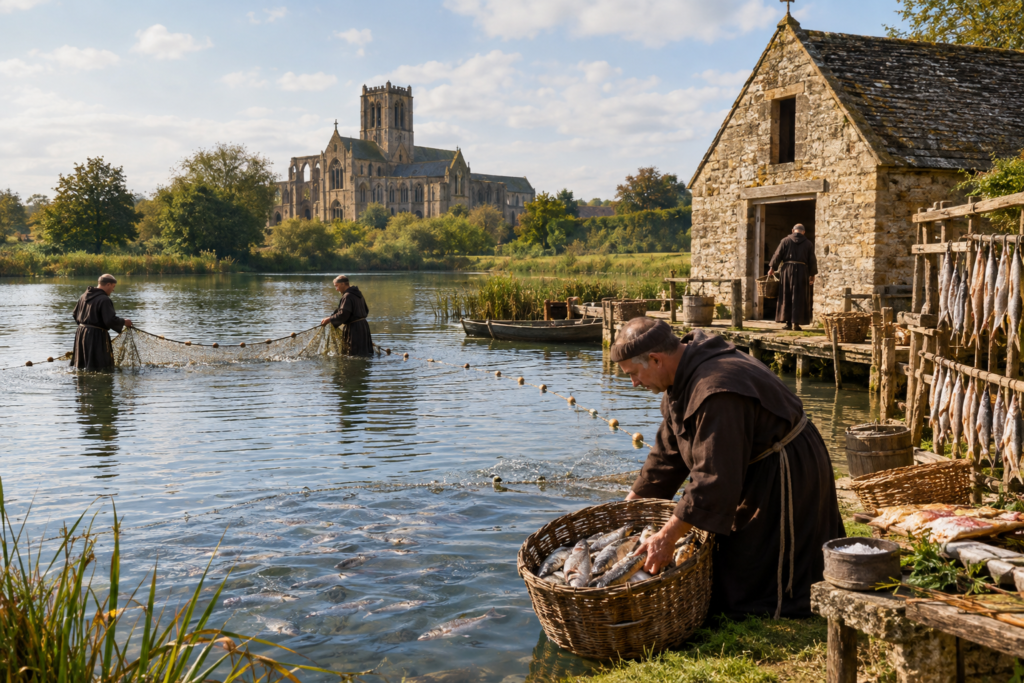
When people hear the phrase monks fishery, they might imagine a quiet pond beside an old monastery, with a few monks patiently catching fish for dinner. While that picture is not completely wrong, the real story is much more interesting. Fishing was an important part of medieval monastic life, and monasteries across Britain and Europe developed ponds, riverside fisheries, fish traps, and other carefully managed systems to provide food and, in some cases, generate income.
For religious communities, fish were especially valuable because medieval Christian rules restricted the eating of meat on many fasting and religious days. Fish offered an important alternative, allowing monks to maintain their dietary practices while still getting a reliable source of protein. This made fisheries more than simple recreational spaces. They became carefully managed parts of monastic estates.
The history of monks fishery also tells us something larger about medieval society. Monasteries were not isolated buildings occupied only by people praying. Many were sophisticated agricultural and economic centers that managed farmland, mills, livestock, woodland, water resources, markets, and fisheries. In places such as Meare, Fleet, Abbotsbury, and other historic monastic sites, fishing became closely connected with the wider economic life of the religious community.
What Does “Monks Fishery” Mean?
The term monks fishery generally refers to a fishery that was owned, managed, operated, or historically associated with a monastery or other religious house. A fishery could take several forms. It might be a natural river section, a lake, a pond, an estuary, a constructed watercourse, or a series of artificial ponds designed specifically for raising and storing fish.
Unlike modern fishing, medieval monastic fishing was often based on management rather than simply going out and catching whatever happened to be available. Monks and their workers could stock ponds, maintain dams, manage water levels, repair fishing equipment, and harvest fish at appropriate times. This created a more predictable food supply.
Historical evidence shows that fisheries could also become valuable economic assets. Some religious houses received fishing rights through grants or land donations. Others developed fisheries on their own estates. In some cases, fish were consumed by the religious community, while surplus catches could be sold or exchanged. This combination of food production and economic value made fisheries particularly useful to monasteries.
Why Did Monks Need Fish?
One of the biggest reasons fish became important to medieval monks was religious practice. Christian fasting traditions often restricted the consumption of meat on Fridays, during Lent, and on other designated days. Fish therefore became an important part of the diet of many religious communities.
A monastery with a dependable fishery could avoid relying entirely on outside suppliers. This was especially valuable when roads were poor, markets were distant, or fresh food was difficult to transport. A pond close to the monastery provided a convenient source that could be harvested when needed.
Fish also offered nutritional benefits. Medieval diets varied considerably depending on location, wealth, season, and availability, but fish provided protein and fat and could be prepared in numerous ways. Eels, salmon, pike, carp, tench, roach, and other species appear in historical discussions of medieval fisheries. At Meare, for example, the fishery associated with Glastonbury Abbey was particularly famous for its eels.
How Monastic Fisheries Were Organized
A monks fishery was not necessarily a single pond with a simple fishing arrangement. Large monasteries could have several water resources serving different purposes. Some ponds were used for growing fish, while rivers and lakes could be used for catching wild fish. Dams and channels could also control water movement.
Managing these resources required practical knowledge. Water levels had to be monitored, ponds needed maintenance, and fish populations had to be protected from excessive harvesting. Workers might repair banks, clear vegetation, maintain traps, and prepare equipment for fishing seasons.
This management system demonstrates how closely medieval religious life was connected to practical land management. Monks might spend part of their day in prayer and religious duties, while lay workers, tenants, servants, or specialist fishermen handled many of the physical tasks connected with the estate. A successful fishery therefore depended on a wider network of people.
Medieval Fish Ponds and Artificial Fisheries
Artificial fish ponds were among the most useful forms of monastic fishery. Instead of depending completely on unpredictable river catches, monasteries could create ponds where fish were stocked and managed. These ponds could then be harvested when fish were needed.
Historical research into Fleet Pond in Hampshire, for example, indicates that medieval ponds were stocked with fish and managed as an important food resource. The Fleet fishery is associated with the medieval estate of the Bishop of Winchester, and records from the fourteenth century describe the “great fishery” of Fleet Ponds.
Creating such ponds was not a small undertaking. Dams had to be constructed, waterways controlled, and embankments maintained. The work could change the local landscape permanently. Some historic ponds that began as medieval food-production systems still influence the appearance and ecology of their surrounding areas today.
The Famous Fishery at Meare
One of the best-known examples connected with monks fishery is the fishery at Meare in Somerset. Meare was associated with Glastonbury Abbey, one of England’s most historically significant religious institutions. Fishing there was important enough to support dedicated facilities and personnel.
The most famous surviving structure is Meare Fish House, a medieval building associated with the abbey’s fishery. English Heritage describes it as the only surviving monastic fishery building in England. It served as the residence of the official responsible for the nearby lake and fishery and also provided facilities for salting and drying fish.
The scale of the fishery helps explain why such a building was necessary. Historical accounts indicate that Meare Pool supported substantial catches, including thousands of eels in a typical year. Fish were particularly valuable to Glastonbury Abbey because the abbey required supplies for Fridays, fast days, and Lent.
Eels and the Medieval Monastic Diet
Eels deserve special attention when discussing monks fishery. Today, eels might not be the first food people associate with monasteries, but they were highly useful in medieval England. They could be caught in large quantities and were suitable for preservation.
The Somerset wetlands around Glastonbury were particularly favorable for eel fishing. Historical material on the region describes managed fisheries that produced substantial numbers of eels, while records connected with Muchelney also indicate the importance of eel production.
Eels could be salted, dried, or otherwise preserved, making them useful beyond the exact day they were caught. This was an important advantage in a world without refrigeration. A monastery that successfully managed an eel fishery could turn a seasonal natural resource into a dependable food reserve.
Fishery Rights Were Valuable Property
A medieval fishery was not simply a place where anyone could fish. Fishing rights could be treated as valuable property. Land grants, charters, leases, and agreements sometimes specifically mentioned fisheries or fishing rights.
This is important because control over water could have considerable economic value. A river crossing an estate could provide fish, water power, transport opportunities, and other resources. A monastery with recognized fishing rights could protect that resource from unauthorized use.
Medieval records demonstrate this clearly. A ninth-century grant associated with Louis the Pious, for example, transferred a fishery on the River Weser to the monastery of New Corvey along with people connected to its operation. The example shows that fisheries could be formally recognized as economic assets rather than informal sources of food.
Monks Fishery and the Economics of a Monastery
Monasteries needed money. Religious communities required food, clothing, building materials, tools, books, repairs, and countless other necessities. Even a community focused heavily on religious life had to operate within the economy around it.
A fishery could contribute to that economy in several ways. It could reduce the amount of food a monastery needed to purchase, provide surplus fish for sale, and sometimes generate direct income through leases or fishing rights. A well-managed fishery therefore had both practical and financial value.
The fisheries could also form part of larger estate-management systems. A monastery might control farmland, pasture, woodland, mills, orchards, and water resources at the same time. Fishing was one component of a broader strategy for making an estate productive.
Fishing Technology Used in Medieval Fisheries
Medieval fishermen were skilled at using the materials and technology available to them. Nets, traps, baskets, hooks, weirs, boats, and other equipment could all play a role depending on the local environment.
Fish traps were particularly useful in rivers and tidal environments. In the Severn Estuary, for example, traditional putcher fishing involved woven baskets arranged in large ranks to intercept fish moving with the tide. The technique has deep historical roots, and fisheries such as Goldcliff were already associated with medieval religious communities.
Such systems demonstrate that historical fishing was not primitive in the sense of being unorganized. Fishermen understood currents, fish behavior, seasons, tides, water levels, and local geography. The effectiveness of a fishery depended heavily on that practical knowledge.
The Role of Rivers in Monks Fishery
Rivers were natural highways for fish, making them especially valuable to monasteries located near waterways. Salmon, eel, trout, and other species could move through rivers at different stages of their life cycles.
Controlling access to a productive section of river could therefore be extremely valuable. A monastery might use nets or traps, maintain weirs, or receive legal rights to fish in a particular section. These arrangements could sometimes create disputes with neighboring landowners or religious institutions.
Historical evidence from places such as Glastonbury and the Severn region shows that fisheries could become significant enough to generate conflicts over rights and access. Where fish were abundant, controlling the resource could mean controlling an important source of food and income.
Salmon and the Monastic Economy
Salmon was another highly valuable fish in medieval Britain. Rivers that supported salmon runs could become economically important, and monasteries with access to those rivers could benefit substantially.
Historical accounts of the salmon fisheries of northern England describe monks selling salmon produced by their fisheries. Records concerning the Priory of Finchale near Durham indicate that the monks supplied their own needs and also sold salmon, with later records showing substantial quantities of preserved salmon.
This gives us a useful picture of the monks fishery as more than a food source. Fish could become a trade commodity. Preserved fish could travel beyond the immediate monastery, connecting religious estates to wider local and regional markets.
The Fish House: More Than a Simple Building
A dedicated fish house shows how important fishing could become. Meare Fish House is particularly significant because it survives as physical evidence of the infrastructure surrounding a medieval monastic fishery.
The building was not merely a place where someone happened to store fish. It was connected to the management of the fishery and included facilities for preserving catches. Fish salting and drying were crucial because fresh fish had a limited shelf life.
Preservation transformed the value of the catch. Instead of needing to eat everything immediately, the monastery could keep fish for later consumption. In an age before modern refrigeration, techniques such as salting and drying were essential to effective food management.
Monks, Workers, and Professional Fishermen
It is easy to imagine monks doing all the fishing themselves, but the reality was usually more complicated. Monasteries were large institutions, and many had servants, tenants, laborers, craftsmen, and specialist workers.
Fishing could require specialized knowledge, especially on large rivers or tidal waters. Experienced fishermen understood where fish traveled and which equipment worked best. Monasteries could therefore rely on people whose expertise was specifically connected with fishing.
The distinction between religious and practical work is important. Monastic communities were often supported by an entire estate economy. The monks provided spiritual leadership and religious services, while many ordinary workers contributed to farming, construction, fishing, food preparation, and other activities.
Monks Fishery and Fasting Traditions
The relationship between fish and fasting is probably the most recognizable part of the story. Medieval religious calendars included many days when meat was restricted or prohibited for members of religious communities.
Fish provided a practical dietary alternative. This does not mean every monk ate fish constantly, nor did every monastery have an enormous fishery. Local geography mattered enormously. A monastery near a productive river or wetland had very different opportunities from one located far inland.
Still, where water resources were available, fisheries could make religious dietary requirements easier to manage. The fishery became part of the rhythm of monastic life, with catches and preservation methods connected to the religious calendar.
The Environmental Impact of Monastic Fisheries
Monastic fisheries also changed landscapes. Building ponds required dams and embankments, while maintaining fisheries could involve clearing vegetation, redirecting water, or constructing channels.
Some of these changes created new habitats. Medieval ponds could support fish, amphibians, birds, insects, and aquatic plants. Even after their original economic purpose disappeared, historic ponds sometimes remained important parts of local ecosystems.
At the same time, intensive fishing could put pressure on fish populations. The long-term health of a fishery depended on maintaining enough fish to reproduce. Medieval managers may not have used modern ecological terminology, but practical experience encouraged them to understand seasonal patterns and avoid destroying the resource on which they depended.
Famous Examples of Monastic Fisheries
Meare is perhaps the clearest surviving example in England because its medieval fish house remains standing. It provides an unusually tangible connection between a religious institution and the practical business of fishing.
Abbotsbury provides another interesting example. Historical information from Abbotsbury explains that Benedictine monks maintained the fishery on the Fleet, alongside farming and other estate activities. The same community also operated a swannery, showing how diverse medieval monastic food production could be.
Other examples include fisheries connected with ponds, rivers, and religious estates across England and Wales. Historical records from Cleeve Abbey, for instance, contain references to grants involving fisheries, illustrating how fishing rights could be formally transferred to religious houses.
What Happened to Monks Fishery After the Dissolution?
The English Reformation dramatically changed the future of monastic fisheries. When monasteries were dissolved under Henry VIII, their lands and properties were transferred, sold, or granted to new owners.
That included fisheries. Resources that had previously supported monks could become private estates, leased properties, or commercial assets. In some places, fishing traditions continued even though the religious community that originally managed them had disappeared.
The history of Goldcliff is a good illustration. Its fishery had been associated with a medieval priory, but after the Dissolution it passed into other ownership and continued for centuries. The fishery eventually declined as fish stocks changed and regulations became stricter.
Why Monks Fishery Still Matters Today
The history of monks fishery matters because it challenges the idea that medieval monasteries were simply quiet religious buildings. They were often complex institutions that managed land, labor, food, water, and money.
Studying fisheries also helps historians understand medieval diets. Written records, buildings, archaeological remains, and landscape features can reveal what people ate and how they obtained it. A fish pond may look ordinary today, but it can represent centuries of economic and social history.
There is also an environmental lesson. Historic fisheries show how earlier communities interacted with rivers, wetlands, lakes, and ponds. Some old water-management systems remain visible today, allowing modern visitors to see traces of medieval resource management in the landscape.
Monks Fishery as a Window Into Medieval Life
Perhaps the most fascinating aspect of monks fishery is that it connects everyday life with major historical themes. Food, religion, economics, technology, land ownership, and environmental management all come together in one subject.
A fish pond tells us about engineering. A preserved fish tells us about diet. A charter tells us about property rights. A fish house tells us about food processing. A dispute over a river tells us about the economic value of natural resources.
In that sense, the monks fishery is much more than a story about catching fish. It is a window into how medieval communities organized themselves and made use of the world around them.
How Monastic Fishing Shaped Local Communities
Monastic fisheries did not exist separately from the communities around them. Fishing operations required labor, equipment, transportation, maintenance, and sometimes markets. Local people could therefore become connected to the monastery through employment, tenancy, trade, or fishing rights.
In areas where monasteries controlled large estates, the fishery could become part of the local economy. Fishermen might supply the religious house, while other workers repaired nets, maintained ponds, transported fish, or prepared catches for storage.
This relationship could also create tension. When valuable fishing rights were restricted, neighboring communities or competing landowners might challenge the monastery’s claims. Such conflicts remind us that natural resources were contested long before the modern era.
The Legacy of Monks Fishery Today
Today, many medieval fisheries have disappeared physically, but their legacy remains in place names, ponds, archaeological sites, historic buildings, and written records. Some modern landscapes still follow boundaries or water systems established centuries ago.
Historic sites such as Meare Fish House offer visitors a direct connection with this forgotten side of medieval life. The survival of the building is especially valuable because so much of medieval fishing infrastructure has vanished or been altered over time.
The continuing interest in these places also reflects a wider appreciation for traditional food systems and sustainable resource management. Modern aquaculture is technologically very different from a medieval fish pond, but the basic idea of carefully managing aquatic resources for food has a surprisingly long history.
Final Thoughts on Monks Fishery
The story of monks fishery is a fascinating combination of religion, food, economics, technology, and environmental history. Medieval monks needed dependable food supplies, particularly during periods when religious rules restricted meat. Fisheries provided one practical answer to that challenge.
From artificial ponds stocked with fish to productive rivers and enormous eel fisheries, monasteries developed sophisticated ways of using water resources. Some fisheries supplied only the religious community, while others produced enough surplus to support trade and generate income. Buildings such as Meare Fish House show just how organized these operations could become.
Most importantly, monks fishery reminds us that medieval monasteries were working institutions. Their inhabitants prayed and studied, but they also had to eat, maintain buildings, manage property, preserve food, and interact with the surrounding economy. Fishing was one of the many practical systems that helped keep these communities functioning for centuries.
The next time an old pond, riverbank, or historic fish house appears beside a medieval religious site, it may be worth looking at it differently. What seems like an ordinary piece of landscape could once have been a carefully managed source of food, income, and power. The quiet waters may preserve a surprisingly rich chapter of medieval history.
YOU MAY HAVE MISSED