Introduction to the House of the Dragon Cast
House of the Dragon brought the Targaryen dynasty back to the screen with a cast that had to carry a story filled with family conflict, political ambition, complicated relationships, and, of course, dragons. The series is based on George R. R. Martin’s Fire & Blood and takes place roughly 200 years before the events of Game of Thrones. Rather than following a huge collection of unrelated families, the show focuses heavily on the Targaryen succession crisis that eventually develops into a devastating civil war.
One of the most interesting things about the House of the Dragon cast is how the actors make characters from the same family feel completely different. Some are calm and diplomatic, some are impulsive, and others are driven almost entirely by power. The performances are particularly important because the story often depends on facial expressions, tense conversations, and political manipulation rather than constant action.
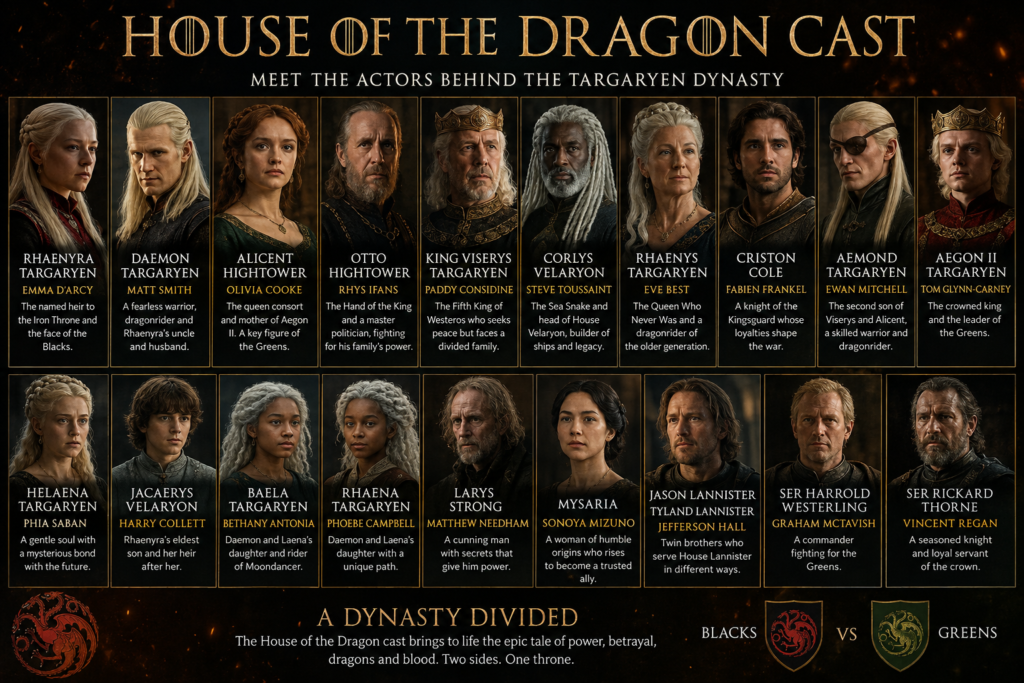
The main cast includes Emma D’Arcy as Rhaenyra Targaryen, Matt Smith as Daemon Targaryen, Olivia Cooke as Alicent Hightower, Rhys Ifans as Otto Hightower, Steve Toussaint as Corlys Velaryon, Eve Best as Rhaenys Targaryen, Fabien Frankel as Criston Cole, Ewan Mitchell as Aemond Targaryen, Tom Glynn-Carney as Aegon II, and several other performers who became closely associated with the world of Westeros.
Emma D’Arcy as Rhaenyra Targaryen
Emma D’Arcy plays one of the central figures in House of the Dragon, Rhaenyra Targaryen. Rhaenyra is the first-born child of King Viserys I Targaryen and is named as his heir. Her position becomes increasingly complicated as the royal family changes and questions about succession begin to dominate the political landscape.
D’Arcy gives Rhaenyra a performance that changes naturally as the character faces greater responsibility. Early on, Rhaenyra can appear confident and rebellious, but the pressure of being a monarch and a parent gradually gives the character more emotional weight. Her story is not simply about wanting a crown; it is also about surviving a political system that constantly questions her legitimacy.
The performance works particularly well because D’Arcy avoids making Rhaenyra feel like a traditional fantasy hero. She can be stubborn, emotional, thoughtful, angry, and politically calculating depending on the situation. That complexity makes her one of the most important performances in the entire series. HBO’s season-two character information describes Rhaenyra as the named heir whose claim has been challenged by her younger half-brother Aegon II.
Matt Smith as Daemon Targaryen
Matt Smith brings a very different energy to the series as Prince Daemon Targaryen. Daemon is Viserys’s younger brother, an experienced warrior, and a dragonrider. He is also one of the show’s most unpredictable personalities, which makes him fascinating to watch.
Smith’s portrayal balances Daemon’s confidence with his dangerous impulsiveness. He often behaves as though he is already certain of his place in history, but his decisions can create serious problems for the people around him. At the same time, the character has genuine emotional connections that reveal a more vulnerable side.
Daemon’s relationship with Rhaenyra is especially important to the story. Their connection mixes family loyalty, romance, political strategy, and personal ambition. Smith manages to make Daemon charismatic without removing the character’s darker qualities, which is a major reason the role became so memorable. HBO describes Daemon as a peerless warrior and dragonrider whose personality can be erratic and difficult to predict.
Olivia Cooke as Alicent Hightower
Olivia Cooke plays Alicent Hightower, a character whose life becomes closely connected to the struggle for the Iron Throne. Alicent begins the story as a close companion of the young Rhaenyra, but political circumstances eventually place the two women on opposite sides of a growing conflict.
Cooke’s performance is one of the show’s strongest examples of character development. Alicent is not presented as someone who simply wakes up one morning and decides to become an enemy. Instead, her beliefs, fears, family pressures, and understanding of duty gradually influence her choices.
Alicent is also deeply affected by her father Otto Hightower and by her relationship with King Viserys. Cooke portrays her as someone who can be caring and compassionate while also becoming increasingly rigid when she believes that her family’s future is at risk. HBO describes Alicent as possessing courtly grace as well as political intelligence, qualities that Cooke brings together throughout the series.
Rhys Ifans as Otto Hightower
Rhys Ifans plays Otto Hightower, one of the most influential political figures in the story. Otto serves as Hand of the King and spends much of the series thinking about succession, political alliances, and the future of his family.
Ifans gives Otto a controlled and calculating personality. He rarely needs to shout to make his influence felt. Instead, the character often uses carefully chosen words and quiet pressure to guide other people toward decisions that benefit House Hightower.
Otto’s relationship with Alicent is particularly complicated. He clearly cares about his daughter, but he also views her position within the royal family through a political lens. That mixture of family loyalty and ambition makes Otto one of the series’ most effective political players. HBO identifies him as a Hand who strongly supports Aegon II’s claim to the throne during the second season.
Paddy Considine as King Viserys Targaryen
Paddy Considine portrays King Viserys I Targaryen, whose reign forms the foundation for much of the show’s central conflict. Viserys is generally portrayed as a kind-hearted man who genuinely wants peace within his family and kingdom.
The problem is that being a good person does not automatically make someone a successful political leader. Considine’s performance emphasizes Viserys’s desire to avoid unnecessary conflict, but it also shows how difficult it can be for him to control the people around him.
As the story progresses, Viserys becomes one of the show’s most tragic characters. His physical decline mirrors the deterioration of his family’s political unity. HBO’s official character description calls him warm, kind, and decent while also emphasizing the difficulty of turning those qualities into effective kingship.
Steve Toussaint as Corlys Velaryon
Steve Toussaint plays Lord Corlys Velaryon, famously known as the Sea Snake. Corlys is one of the most powerful lords in Westeros and the head of House Velaryon, a family whose wealth and naval strength give it enormous political importance.
Toussaint presents Corlys as proud, ambitious, and determined to improve his family’s position. Corlys does not simply want his house to survive; he wants House Velaryon to be remembered as one of the greatest families in Westerosi history.
His relationship with Rhaenys and their children also gives the character an emotional dimension. Political decisions constantly collide with family concerns, creating some of the show’s most interesting conflicts. Corlys’s importance continues into the second season, where he becomes closely connected to Rhaenyra’s side of the civil war.
Eve Best as Rhaenys Targaryen
Eve Best plays Princess Rhaenys Targaryen, another major member of the royal family. Rhaenys has her own complicated history with succession because she was passed over in favor of Viserys during the Great Council.
Best gives Rhaenys a calm but powerful presence. She often seems to understand the political situation better than the people around her, and her experience allows her to recognize the consequences of decisions before others do.
Rhaenys is also a dragonrider and the wife of Corlys Velaryon. Her character therefore connects several important elements of the story: Targaryen blood, Velaryon ambition, royal succession, and the wider question of how women are treated in Westerosi politics. HBO included Eve Best among the principal returning cast for season two.
Fabien Frankel as Criston Cole
Fabien Frankel plays Ser Criston Cole, a skilled warrior whose personal relationships become closely tied to the political divisions surrounding the royal family. Criston begins as a member of the Kingsguard and becomes an increasingly important figure at court.
Frankel’s performance shows how personal disappointment can influence political decisions. Criston is not simply a soldier following orders. His feelings, pride, and beliefs increasingly affect the choices he makes.
His relationship with Rhaenyra is an important part of his character arc, but the consequences of that relationship reach much further than either character initially expects. By the second season, Criston has become a major figure among the Greens and is involved in the military conflict surrounding the succession crisis.
Ewan Mitchell as Aemond Targaryen
Ewan Mitchell plays Prince Aemond Targaryen, one of the most visually distinctive characters in the series. Aemond is the second son of Viserys and Alicent and grows into a formidable warrior and dragonrider.
Mitchell gives Aemond an intimidating presence without relying entirely on dialogue. His posture, expressions, and controlled manner communicate a great deal about the character. Aemond’s relationship with his family is also complicated by years of rivalry and resentment.
The character becomes particularly important as the conflict between the Greens and Blacks grows. His actions demonstrate how quickly personal rivalries can become part of a much larger war. HBO’s official character information identifies Aemond as Viserys’s second-born son and Rhaenyra’s nephew.
Tom Glynn-Carney as Aegon II Targaryen
Tom Glynn-Carney portrays Aegon II Targaryen, whose claim to the Iron Throne becomes the center of the Green faction’s political campaign. Aegon’s position is complicated because his father previously named Rhaenyra as heir.
Glynn-Carney plays Aegon as a deeply flawed young man who is not always prepared for the enormous responsibility placed on him. His behavior often contrasts sharply with the expectations attached to the title of king.
The role becomes more interesting as Aegon experiences the consequences of becoming involved in a war for the throne. Rather than portraying him as a straightforward villain, the performance allows viewers to see insecurity, recklessness, fear, and occasional vulnerability. The season-two cast information lists Glynn-Carney among the returning principal actors as Aegon II.
Phia Saban as Helaena Targaryen
Phia Saban plays Helaena Targaryen, the daughter of Viserys and Alicent and sister to Aegon and Aemond. Helaena is different from many members of her family because she is less interested in political competition and more fascinated by unusual details and creatures.
Saban’s performance gives Helaena a distinctive quality without turning her into a simple comic or mysterious character. Her quiet observations can feel disconnected from the political conversations happening around her, yet they sometimes carry greater meaning than the other characters realize.
Helaena’s position also demonstrates how royal family members can become trapped by political expectations. Her marriage and family connections are influenced by the larger struggle over the throne, even when she herself is not driving that conflict. HBO lists Saban among the returning cast for the second season.
Harry Collett as Jacaerys Velaryon
Harry Collett plays Jacaerys Velaryon, usually called Jace, the eldest son of Rhaenyra. As the eldest child on Rhaenyra’s side, Jace has to grow up quickly and understand the political responsibilities attached to his position.
Collett portrays Jace as a young man who is gradually moving from adolescence toward leadership. He must represent his mother’s interests while also dealing with the complicated realities of his family background.
Jace’s role becomes increasingly important as the conflict escalates. He is expected to negotiate, communicate with powerful houses, and understand the seriousness of the succession crisis. HBO’s season-one character information identifies him as Rhaenyra’s eldest son, while he remains part of the returning cast in season two.
Bethany Antonia and Phoebe Campbell as Baela and Rhaena
Bethany Antonia and Phoebe Campbell portray Baela and Rhaena Targaryen, the daughters of Laena Velaryon and Daemon Targaryen. The sisters are important members of the younger generation surrounding the main political conflict.
Baela is associated with the dragon Moondancer, while Rhaena’s story develops differently. Their presence adds another layer to the complicated family relationships that define the series.
The two characters also demonstrate that the consequences of the Targaryen succession dispute extend beyond the main claimants. They are young members of a powerful family who must grow up in a world increasingly shaped by political rivalry and war. Both actresses returned for the second season.
Matthew Needham as Larys Strong
Matthew Needham plays Larys Strong, one of the show’s most mysterious political figures. Larys is not a warrior in the traditional sense, but his ability to gather information and manipulate events makes him extremely dangerous.
Needham’s performance is deliberately restrained. Larys often watches rather than speaks, and when he does speak, his words can have consequences far beyond the immediate conversation.
His character demonstrates an important idea within House of the Dragon: power does not always come from swords or dragons. Information can be just as valuable. Larys understands secrets, fears, and weaknesses, allowing him to influence people from behind the scenes.
Sonoya Mizuno as Mysaria
Sonoya Mizuno portrays Mysaria, a character who comes from outside the traditional noble families of Westeros. Her journey is one of survival, adaptation, and gaining influence in a society where she initially has very little power.
Mysaria develops a close relationship with Daemon and becomes an important source of information. Unlike many aristocratic characters, she understands the lives of ordinary people and recognizes how events at court affect those living far away from the royal family.
Mizuno gives Mysaria a composed and intelligent presence. The character’s ability to build networks and collect information makes her a valuable player in the political world of the series. HBO’s official description emphasizes Mysaria’s difficult beginnings and her rise to become an unlikely ally of Daemon.
Jefferson Hall as Jason and Tyland Lannister
Jefferson Hall has the unusual task of playing two characters: the Lannister twins Jason Lannister and Tyland Lannister. Although they look alike, their personalities and responsibilities are different.
Jason is a lord and political figure, while Tyland becomes involved in the financial and administrative side of the royal government. Hall uses small changes in manner and attitude to help distinguish the two characters.
The double role is a fun detail within the wider House of the Dragon cast. It also reflects the show’s interest in the political families of Westeros, where even seemingly minor noble houses can become important during a succession crisis. HBO’s character information lists Hall as both Jason and Tyland Lannister.
New Faces Added to the Season 2 Cast
Season two expanded the world of House of the Dragon by introducing several new characters. Among the additions were Abubakar Salim as Alyn of Hull, Gayle Rankin as Alys Rivers, Freddie Fox as Ser Gwayne Hightower, Simon Russell Beale as Ser Simon Strong, Clinton Liberty as Addam of Hull, Kieran Bew as Hugh, Tom Bennett as Ulf, Tom Taylor as Lord Cregan Stark, and Vincent Regan as Ser Rickard Thorne.
These new performers are important because the story becomes much larger once the Targaryen civil war begins. The conflict can no longer remain inside the Red Keep or within the immediate royal family. Different regions, houses, soldiers, and ordinary people become involved.
Adding new actors also gives the series the opportunity to explore parts of Westeros that were not as prominent during the first season. Their characters help make the civil war feel like a genuine political crisis rather than a disagreement limited to a handful of royals.
Why the House of the Dragon Cast Works So Well
The biggest strength of the House of the Dragon cast is the way the actors handle complicated characters. Very few people in the story are completely innocent or completely evil. Even characters who make terrible decisions usually have motivations that viewers can understand.
Another strength is the chemistry between the performers. The scenes between Rhaenyra and Alicent are particularly effective because their relationship changes dramatically over time. Similarly, the interactions between Viserys, Daemon, Otto, and the younger generation help establish the family tensions that eventually explode into open conflict.
The cast also has to handle the show’s time jumps and changing relationships. Several characters are played by younger and older actors at different points in the story, which requires the audience to accept significant changes in appearance and personality while still recognizing the same character.
The Importance of the Younger Generation
The younger actors in House of the Dragon are more than supporting players. Characters such as Jacaerys, Lucerys, Aegon, Aemond, Helaena, Baela, and Rhaena represent the next generation of the royal family.
Their lives are shaped by decisions made by their parents and grandparents. They inherit political problems that they did not create, and their relationships with one another are often affected by years of family tension.
This makes the younger generation especially important to the show’s long-term story. As the older generation struggles for control, their children are gradually forced into roles they may not have chosen for themselves.
House of the Dragon Cast and the Targaryen Civil War
At its heart, House of the Dragon is a story about succession. Rhaenyra believes she has the legitimate claim because Viserys named her heir, while the Greens support Aegon II. Once Aegon is crowned, the disagreement becomes a full political and military conflict.
The cast makes this conflict compelling because each side contains people with different motivations. Rhaenyra’s supporters are not identical, just as Aegon’s supporters do not all think alike. Some are motivated by family loyalty, others by ambition, duty, revenge, fear, or personal beliefs.
The official HBO material for season two describes the story as a fracture within House Targaryen and presents the Greens and Blacks as competing sides of the same succession struggle.
The Cast’s Connection to the World of Westeros
Although House of the Dragon is a prequel, its cast has the difficult job of making Westeros feel familiar while also giving the series its own identity. The audience recognizes concepts such as the Iron Throne, noble houses, royal succession, and dragonriders, but the political circumstances are completely different.
The performers help establish that difference. Their characters belong to an earlier period when House Targaryen still possesses a large collection of living dragons and remains firmly established at the center of Westerosi politics.
The result is a world that feels connected to Game of Thrones without simply repeating the same story. The actors are a major part of that success because they make the Targaryen family feel like a real dynasty with generations of history behind it.
Final Thoughts on the House of the Dragon Cast
The House of the Dragon cast is one of the biggest reasons the series works as more than a traditional fantasy spectacle. The dragons and battles may attract viewers, but the emotional core comes from the people involved in the struggle.
Emma D’Arcy, Matt Smith, Olivia Cooke, Rhys Ifans, Steve Toussaint, Eve Best, Fabien Frankel, Ewan Mitchell, Tom Glynn-Carney, and the rest of the ensemble give the series a wide range of personalities. Each performance adds another piece to the complicated story of House Targaryen. HBO’s official cast information confirms the central ensemble and the expanded group of performers introduced for season two.
Ultimately, the phrase “House of Dragon cast” covers much more than a list of actors and character names. It represents an ensemble that brings an entire dynasty to life. From Rhaenyra’s struggle for recognition to Daemon’s unpredictable loyalty, Alicent’s divided loyalties, Otto’s political calculations, and the ambitions of the younger generation, every major performance contributes to the larger story.
That combination of strong acting, complicated relationships, and a richly developed fantasy world is what makes House of the Dragon so engaging. The cast gives the Targaryen civil war its emotional weight, turning a battle for the Iron Throne into a deeply personal family tragedy.
YOU MAY HAVE MISSED