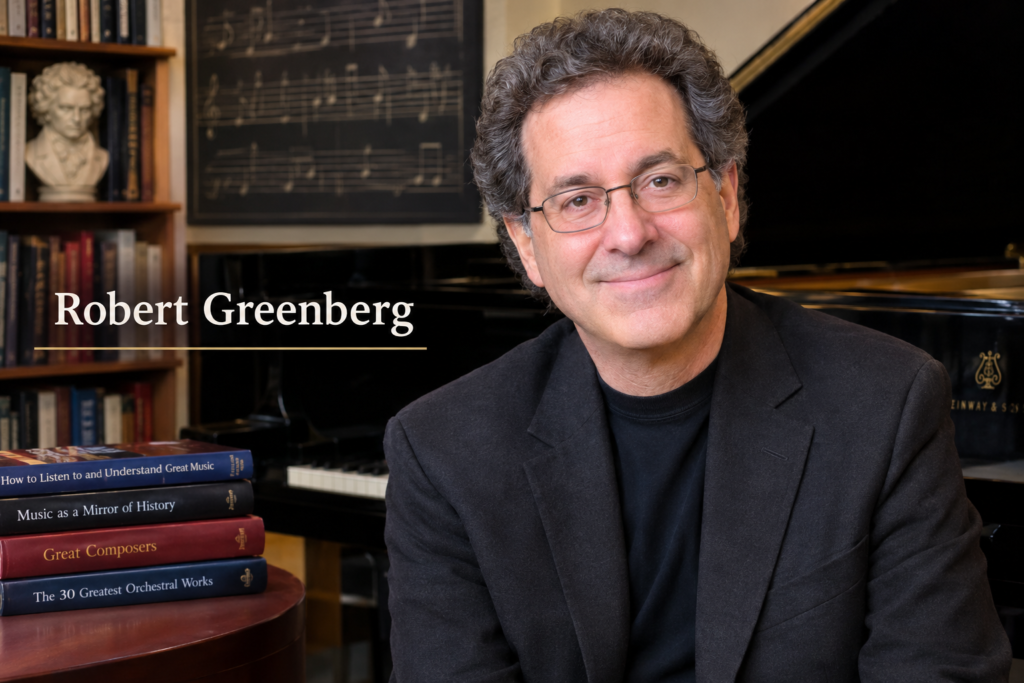
Robert Greenberg is one of those rare music educators who can discuss a complicated symphony, an influential composer, or centuries of music history without making the subject feel intimidating. For many people interested in Western concert music, opera, composers, and music appreciation, his name has become closely associated with engaging lectures that combine scholarship, storytelling, humor, and genuine enthusiasm.
Over the course of his career, Robert Greenberg has worked as a composer, pianist, professor, lecturer, author, and music historian. His educational background includes a degree in music from Princeton University and a Ph.D. in music composition from the University of California, Berkeley. He has also served on academic faculties and built a long career explaining music to audiences ranging from university students to lifelong learners.
What makes Robert Greenberg particularly interesting is that his work is not limited to simply describing famous compositions. He approaches music as something connected to people, politics, history, culture, personality, technology, and social change. A symphony is not merely a collection of notes in his approach; it is also the product of a particular human being living at a particular moment in history.
Who Is Robert Greenberg?
Robert Greenberg is an American composer, pianist, author, professor, and music historian best known for his ability to make the history and structure of music accessible to broad audiences. Born in Brooklyn, New York, in 1954, he later established much of his professional life in the San Francisco Bay Area, where he developed a significant career in teaching, composition, and public music education.
His academic training provided him with a strong foundation in both musical creativity and musical analysis. Greenberg earned a Bachelor of Arts degree in music from Princeton University and later completed his Ph.D. in music composition at the University of California, Berkeley. This combination of composition and analytical study became one of the defining strengths of his professional identity.
For listeners, however, academic credentials are only part of the story. Robert Greenberg became widely recognized because he developed an unusual ability to communicate expert knowledge in an entertaining way. He can move from a technical discussion of musical form to an amusing story about a composer without losing the attention of his audience.
Robert Greenberg’s Early Life and Musical Education
Growing up in Brooklyn gave Robert Greenberg an early connection to one of America’s most culturally diverse urban environments. His eventual path into professional music led him toward formal academic study, where he developed interests that extended beyond performance alone. He became deeply involved with composition, analysis, music history, and the broader intellectual traditions surrounding Western music.
At Princeton University, Greenberg studied music and graduated with a Bachelor of Arts degree in 1976. His education exposed him to serious musical analysis and composition while also helping him develop the intellectual tools that would later become central to his teaching and lecturing career.
He continued his education at the University of California, Berkeley, where he completed a Ph.D. in music composition in 1984. This advanced training is particularly important when considering his career because Greenberg is not simply a commentator observing music from the outside. He is also a practicing composer who understands many of the creative decisions involved in constructing musical works.
Robert Greenberg as a Composer
Although many people first encounter Robert Greenberg through his lectures, composition has been an important part of his professional life. His biography notes that he has composed more than fifty works for a variety of instrumental and vocal ensembles, with performances taking place in the United States and internationally.
Being a composer gives Greenberg a perspective that differs from that of a historian who studies music only through documents and recordings. When he explains why a composer might make a particular structural decision, he can draw upon practical experience with the challenges of writing music. This makes his commentary feel grounded in both scholarship and creative experience.
His compositions have been associated with performances in major cultural centers, including New York, San Francisco, Chicago, and Los Angeles, as well as several European countries. His professional work has also earned commissions and recognition from important musical organizations.
The Academic Career of Robert Greenberg
Robert Greenberg has spent a significant part of his career in education. He has served on the faculties of the University of California, Berkeley, California State University East Bay, and the San Francisco Conservatory of Music. His work in these institutions reflects his long-standing commitment to both formal music education and public outreach.
At the San Francisco Conservatory of Music, Greenberg held important academic responsibilities, including leadership roles connected to music history and literature. His academic career allowed him to teach students about composers, musical styles, historical periods, and the development of Western musical traditions.
However, Robert Greenberg’s influence eventually extended far beyond the traditional classroom. He became especially well known for speaking to audiences who were not necessarily professional musicians. This broader educational mission helped transform him from a university professor into one of the most recognizable public educators in the field of music appreciation.
Robert Greenberg and The Great Courses
For many listeners, the name Robert Greenberg is immediately connected with The Great Courses. His lecture series introduced large audiences to subjects that might otherwise appear difficult, including music theory, opera, symphonic music, composers, and the history of Western musical traditions.
Greenberg’s relationship with The Great Courses began in the early 1990s. One of his best-known lecture series, How to Listen to and Understand Great Music, developed into a major introduction to the history and appreciation of Western music. The course spans a broad historical range and is designed to help listeners develop more active and informed listening habits.
Over the years, Greenberg recorded hundreds of lectures for The Great Courses on composers and musical subjects. His work covers a remarkably broad range of topics, from introductory music appreciation to detailed studies of specific composers and genres.
How to Listen to and Understand Great Music
Among Robert Greenberg’s best-known educational works is How to Listen to and Understand Great Music. The title itself reveals an important aspect of his teaching philosophy. Music appreciation, in his view, is not necessarily about memorizing dates or recognizing obscure terminology. It is about learning how to hear what is happening.
Many people listen to classical music passively. They may enjoy a melody or recognize a famous passage, but they may not understand how the composition is organized. Greenberg’s teaching encourages listeners to become more conscious of repetition, contrast, rhythm, harmony, orchestration, and musical development.
The result is that familiar music can begin to sound new again. A listener may hear a Beethoven symphony dozens of times, but understanding its structure can reveal relationships and details that previously went unnoticed. The Great Courses describes the series as using musical examples to help audiences explore major composers and understand their works more deeply.
Robert Greenberg’s Teaching Style
One of the biggest reasons for Robert Greenberg’s popularity is his teaching style. He does not approach music education as a test of intellectual superiority. Instead, his lectures often feel like conversations with an extremely knowledgeable person who happens to be excited about the subject.
Humor is an important part of his presentation. Historical figures are not treated as distant statues placed on museum pedestals. Composers are presented as human beings with ambitions, rivalries, weaknesses, relationships, and sometimes spectacularly complicated personalities.
At the same time, Greenberg does not sacrifice intellectual depth for entertainment. His lectures can include sophisticated discussions of musical structure and historical context, but he generally explains technical concepts rather than assuming that every listener already understands them.
Making Classical Music More Accessible
The word “classical” can sometimes create a psychological barrier for new listeners. People may assume that the music is too complicated, too formal, or only intended for experts. Robert Greenberg’s career has been important because much of his work challenges this assumption.
His approach suggests that people do not need advanced musical training to appreciate serious music. What they need is context, guidance, and repeated exposure. Once listeners understand what to listen for, many compositions become more approachable.
This accessibility is especially valuable in an era when audiences have almost unlimited access to recorded music. The challenge is no longer finding a symphony or an opera. The challenge is knowing where to begin and how to make sense of what one hears. Greenberg’s lectures provide a framework for that process.
Robert Greenberg and Music History
Robert Greenberg is not only interested in what music sounds like. He is also interested in why it sounds the way it does. This naturally leads to history.
Musical styles do not develop in isolation. They are influenced by political changes, religious traditions, economic conditions, technology, social structures, and the personalities of individual artists. Greenberg frequently places compositions within these larger historical environments.
His course Music as a Mirror of History explores this relationship directly. The course examines the ways music can reflect historical events and cultural developments, connecting major compositions with the worlds in which they were created.
Music as a Reflection of Society
One of the most interesting ideas associated with Robert Greenberg’s educational work is that music can serve as a historical document. A composition may not describe an event in the way a newspaper article does, but it can reveal something about the cultural environment in which it was created.
Changes in musical style can reflect changing ideas about religion, individual identity, power, emotion, nationalism, and artistic freedom. The development of new instruments and performance spaces can also influence what composers create.
By connecting music to these broader developments, Greenberg helps audiences understand that musical history is part of human history. A symphony does not emerge from an empty room. It emerges from a world filled with social pressures, artistic traditions, technological possibilities, and personal experiences.
Robert Greenberg’s Work on Famous Composers
A large portion of Robert Greenberg’s educational work focuses on individual composers. His lectures have explored the lives and music of figures such as Bach, Mozart, Beethoven, Brahms, Wagner, Verdi, and many others.
The advantage of this approach is that listeners can study a composer in depth rather than encountering only a few famous pieces. Greenberg often examines how a composer’s personality, education, professional relationships, and historical circumstances influenced their artistic development.
This combination of biography and musical analysis makes composers feel more understandable. Instead of viewing Beethoven as simply a legendary genius, audiences can explore the challenges, ambitions, conflicts, and creative decisions that shaped his career.
The Importance of Storytelling in Music Education
Facts alone rarely make a lecture memorable. Robert Greenberg understands that audiences remember stories.
A composer may have written a technically important work, but the story surrounding its creation can help listeners connect with it emotionally. Personal rivalries, financial struggles, romantic relationships, artistic failures, and public controversies all provide context.
Storytelling also helps explain why certain musical decisions mattered. A dramatic change in style becomes more meaningful when listeners understand what the composer was experiencing at the time.
Greenberg’s ability to combine storytelling with scholarship is therefore one of his greatest strengths. He can explain musical history without turning it into a list of dates and names.
Robert Greenberg and Opera
Opera is another major area of Robert Greenberg’s educational work. For newcomers, opera can appear particularly intimidating because it combines music, drama, literature, visual performance, history, and sometimes foreign languages.
Greenberg’s lectures help break opera into understandable components. He explores how musical forms support dramatic storytelling and how composers use voices and orchestras to create character and emotion.
His work includes broad introductions to opera as well as studies of important composers and traditions. This allows listeners to approach the subject gradually, beginning with general concepts before moving toward more specialized material.
The Role of Humor in Robert Greenberg’s Lectures
Humor is not always associated with serious music education, but it plays a significant role in Robert Greenberg’s public style.
Classical composers are often presented in an overly formal manner. Portraits show them staring seriously into the distance, and biographies can sometimes reinforce the impression that they belonged to a world completely disconnected from modern life.
Greenberg’s lectures often challenge this image. By discussing composers as real people with flaws and personalities, he makes the material easier to connect with.
Humor also helps audiences remain engaged during complex discussions. A well-timed joke can provide a moment of relief before a lecturer moves into a more demanding explanation of harmony, form, or historical context.
Why Robert Greenberg Appeals to Lifelong Learners
Robert Greenberg’s audience is not limited to university students. Much of his popularity comes from lifelong learners who want intellectually serious content without enrolling in a formal degree program.
These learners may already have careers, families, and other responsibilities. They may not have time to attend traditional classes, but they still want opportunities to explore history, art, literature, and music.
Recorded lecture courses provide flexibility. People can learn at home, revisit difficult material, and explore subjects according to their own interests.
Greenberg’s extensive catalog is especially suitable for this audience because it offers both introductory and advanced topics. A beginner can start with general music appreciation, while a more experienced listener can move toward specialized studies of composers and genres.
Robert Greenberg as a Public Music Educator
Public education is one of the central themes of Robert Greenberg’s career. His work demonstrates that expert knowledge does not need to remain confined to universities and specialist journals.
Through lectures, recordings, books, and public presentations, he has brought music history to audiences outside traditional academic institutions.
His role as Music Historian-in-Residence with San Francisco Performances is another example of this public-facing approach. He has also lectured for major cultural organizations, connecting scholarship with audiences interested in the performing arts.
This work is important because cultural education often depends on translators: people capable of taking specialized knowledge and communicating it clearly to broader audiences. Robert Greenberg has built much of his career around performing this role.
Awards, Recognition, and Professional Achievements
Robert Greenberg’s career has included recognition for both his creative and educational work. His professional biography lists honors and commissions connected with composition, including recognition from major musical organizations.
He has also been designated a Steinway Artist, reflecting his professional relationship with one of the world’s best-known piano makers. His compositional work has received awards and commissions that demonstrate his standing within the contemporary music community.
At the same time, his greatest public recognition may come from his role as an educator. His lectures have reached audiences far beyond a single university or concert hall.
What Makes Robert Greenberg Different?
There are many music historians, professors, and performers. What makes Robert Greenberg distinctive is the combination of skills he brings together.
He is trained as a composer, which gives him practical insight into the creative process. He is also a historian who understands the importance of context. He is a pianist and musician capable of discussing performance, and he is an experienced lecturer who understands how to communicate with non-specialist audiences.
This combination allows him to move comfortably between different levels of discussion. He can explain a technical musical concept while also discussing the historical environment that produced it.
Perhaps most importantly, his work communicates enthusiasm. Knowledge becomes far more persuasive when the person presenting it clearly believes that the subject is worth exploring.
Robert Greenberg’s Influence on Music Appreciation
The influence of an educator can be difficult to measure. A composer can leave behind a catalog of works, while a performer leaves recordings and documented performances. An educator, however, may have an impact through the way audiences learn to think.
Robert Greenberg has helped many listeners develop a more active relationship with music. After learning about form, history, and musical language, audiences may begin to hear familiar works differently.
This is one of the most valuable forms of cultural education. The goal is not simply to provide information but to change perception.
A person who learns how to listen more carefully may continue discovering new details in music for decades. In this sense, music education can create a lasting habit rather than a temporary learning experience.
The Continuing Relevance of Robert Greenberg’s Work
In the modern digital environment, people have access to more music than any previous generation. Streaming services and online platforms make recordings available almost instantly.
Yet unlimited access does not automatically create understanding. In some ways, the enormous quantity of available content makes expert guidance even more valuable.
Robert Greenberg’s work remains relevant because it helps listeners organize their experiences. Instead of randomly moving through centuries of music, audiences can follow historical and artistic connections.
His educational approach also demonstrates that deep learning does not need to be separated from enjoyment. A serious study of music can be intellectually demanding while still being entertaining.
Lessons Modern Educators Can Learn from Robert Greenberg
Modern educators can learn several useful lessons from Robert Greenberg’s career.
First, expertise should not be confused with complexity. A person can understand a subject deeply while explaining it clearly. In fact, the ability to simplify complicated ideas without making them inaccurate is often a sign of genuine expertise.
Second, storytelling matters. Audiences remember ideas when those ideas are connected to people and narratives.
Third, enthusiasm is contagious. An educator who is genuinely excited about a subject can encourage others to explore it.
Finally, accessibility should not mean lowering standards. Greenberg’s work demonstrates that serious subjects can be presented to broad audiences without removing their intellectual depth.
Exploring Robert Greenberg’s Courses Today
People interested in Robert Greenberg’s work have a wide range of topics to explore. His courses cover introductory music appreciation, opera, orchestral music, individual composers, musical forms, and the relationship between music and history.
A good starting point for beginners is often an introductory course focused on listening skills. From there, listeners can move toward subjects that match their personal interests, such as Beethoven, Mozart, Brahms, opera, or twentieth-century music.
His official website highlights courses including How to Listen to and Understand Great Music, Music as a Mirror of History, Great Music of the 20th Century, and The 30 Greatest Orchestral Works.
For anyone interested in exploring his educational work directly, Robert Greenberg’s official website provides information about his lectures, courses, and current projects.
Conclusion
Robert Greenberg has built a remarkable career around one powerful idea: great music becomes even more meaningful when we learn how to listen to it.
As a composer, professor, historian, author, pianist, and lecturer, he brings together perspectives that are often separated. His work connects musical structure with biography, history with performance, and serious scholarship with accessible storytelling.
His lectures have introduced countless listeners to composers and musical traditions that might otherwise have seemed distant or difficult. By combining expertise with humor and enthusiasm, Robert Greenberg demonstrates that music education does not need to feel like an academic obstacle course.
For anyone interested in discovering the stories behind great compositions, understanding how music works, or developing a deeper appreciation for the Western musical tradition, Robert Greenberg remains an important and engaging guide. His lasting contribution is not simply the number of lectures he has recorded or the institutions where he has taught. It is the curiosity he has helped create in listeners.
And perhaps that is the ultimate goal of a great educator: not to convince people that they have learned everything, but to leave them eager to keep listening, questioning, and discovering more.
YOU MAY HAVE MISSED