Cybersecurity has changed dramatically over the last few years. Businesses are no longer protecting only the computers, servers, applications, and networks they directly control. Modern organizations depend on cloud providers, software vendors, payment processors, contractors, technology partners, and countless other third parties. Every one of those connections can introduce risk. That is where SecurityScorecard comes into the conversation.
SecurityScorecard is a cybersecurity ratings and third-party risk management platform designed to help organizations understand their security posture and monitor the security risks associated with their business ecosystem. The company has expanded beyond traditional security ratings into a broader threat-informed third-party risk management approach through its TITAN AI platform.
For security teams, the basic idea is straightforward: instead of waiting for an annual assessment or discovering a weakness after an incident, organizations can continuously look at security signals, identify concerning issues, prioritize vendors, and take action. SecurityScorecard uses an outside-in approach, meaning its ratings can evaluate externally observable aspects of an organization’s cybersecurity posture without requiring intrusive access to internal systems.
What Is SecurityScorecard?
SecurityScorecard is a cybersecurity risk-rating platform that helps organizations measure and understand the security posture of themselves and their third-party ecosystem. Rather than presenting cybersecurity as an abstract technical concept, the platform turns numerous security signals into ratings and actionable information that security, risk, compliance, procurement, and executive teams can understand.
The platform has traditionally been well known for its security ratings, which provide an easy-to-understand view of an organization’s externally observable cybersecurity posture. SecurityScorecard’s methodology evaluates discoverable external assets and security issues and uses statistical and analytical techniques to produce ratings. The company’s current platform has expanded this concept into continuous third-party risk management, threat intelligence, assessment automation, and response capabilities.
This matters because cybersecurity teams often have limited time and resources. A company may work with hundreds or thousands of vendors, making it unrealistic to manually inspect every supplier every day. A platform such as SecurityScorecard can help security professionals prioritize attention by identifying organizations, assets, or security issues that deserve closer investigation.
Why Security Ratings Matter in Modern Cybersecurity
A security rating is useful because cybersecurity can be difficult to communicate outside technical teams. A security engineer may understand dozens of vulnerabilities and configuration problems, but a procurement manager or board member usually needs a simpler picture of the overall risk. A standardized rating can act as a common language between these groups.
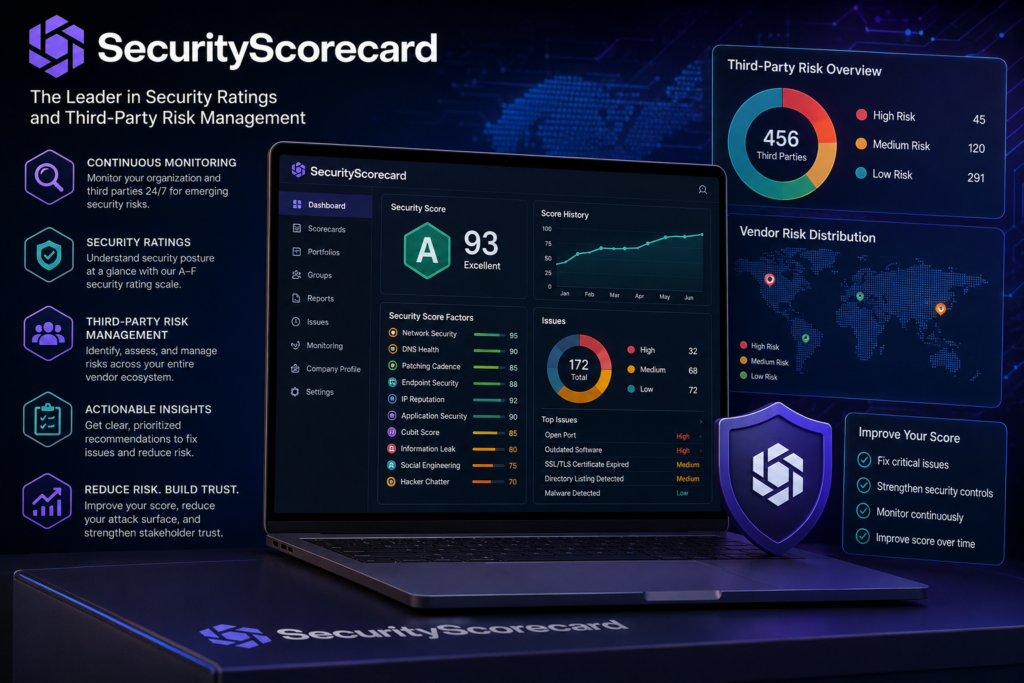
SecurityScorecard historically represented ratings through letter grades ranging from A through F, with higher grades indicating a stronger observed security posture and lower grades indicating more significant concerns. Its published methodology explains that scores are based on security issues identified across different factors, with severity and other characteristics influencing the calculation.
However, a rating should never be treated as a perfect representation of an organization’s complete cybersecurity condition. External ratings are one source of intelligence. They can highlight warning signs that deserve investigation, but they cannot replace internal security testing, audits, penetration testing, vulnerability management, governance reviews, or direct conversations with vendors. The smartest approach is to use a rating as a starting point for deeper risk analysis rather than treating one number as the final answer.
How SecurityScorecard Ratings Work
SecurityScorecard uses an outside-in methodology to evaluate organizations based on externally observable information. Its published materials describe the process as non-intrusive, using publicly available and commercial data sources to understand an organization’s security profile. The platform then analyzes collected signals and organizes cybersecurity issues into different risk factors.
The purpose of this approach is to see an organization from the perspective of the internet rather than from inside its corporate network. That perspective can reveal things such as exposed systems, security weaknesses, configuration concerns, suspicious activity indicators, or other signals that could contribute to cyber risk. Because the process does not depend entirely on a company’s self-reported information, it can provide an independent perspective.
SecurityScorecard’s methodology has evolved over time. Its published material explains that scoring involves signal collection, attribution, analytics, and a scoring engine, with issue types organized into security factors. The company also says its methodology uses statistical analysis and machine learning techniques to improve the relationship between observed security issues and security outcomes.
Understanding the SecurityScorecard Grade
The familiar SecurityScorecard grading system is designed to make cybersecurity information easier to interpret. Historically, an A represents the strongest rating range, while lower grades indicate progressively greater observed security concerns. The published methodology identifies A as above 90, B as 80–89, C as 70–79, D as 60–69, and F as below 60.
An important point is that the grade should be viewed in context. For example, an organization with a B rating is not automatically “secure,” while an organization with a C rating is not automatically unsafe. Cybersecurity is too complex to be summarized perfectly by a single letter. The grade is most useful when it leads analysts toward the underlying findings.
The trend can also matter as much as the current number. If a company’s score has been consistently improving, that may indicate successful remediation and stronger security hygiene. On the other hand, a sudden decline may deserve investigation even if the organization still has a relatively strong overall grade. Security teams should therefore look at both the current posture and how that posture is changing over time.
The Main Security Factors Behind a Rating
SecurityScorecard organizes security findings into different factors so that users can understand where weaknesses may exist. Its methodology materials describe ten major factors, including areas such as application security, endpoint security, network security, DNS health, IP reputation, patching cadence, information leak, and social engineering-related risks.
This factor-based structure is useful because an overall rating does not explain the entire story. Two companies could have similar overall grades while having completely different weaknesses. One might struggle with patching, while another could have problems involving application security or exposed infrastructure. Looking at individual factors provides a much more practical picture.
For security teams, this is where a rating becomes actionable. Instead of simply telling a vendor that its score is too low, an organization can investigate the underlying issues and determine which findings are legitimate, which require remediation, and which may need further verification. That creates a more productive conversation between customers and suppliers.
SecurityScorecard and Third-Party Risk Management
Third-party risk management, commonly abbreviated as TPRM, is one of the most important use cases for SecurityScorecard. Businesses depend heavily on external organizations, and a weakness in one supplier can sometimes become a problem for its customer. That means vendor security cannot be treated as a once-a-year paperwork exercise.
Traditional vendor assessments often rely on questionnaires, spreadsheets, security documents, and periodic reviews. These methods can be valuable, but they provide only a snapshot. A vendor that looked healthy six months ago could experience a new vulnerability, configuration problem, breach, or other security event before the next scheduled review.
SecurityScorecard’s current TITAN AI platform is designed around continuous and threat-informed TPRM. The company describes capabilities including continuous risk visibility, automatic vendor discovery, questionnaire automation, predictive analytics, threat intelligence, and remediation workflows.
Why Continuous Vendor Monitoring Is Important
Annual vendor assessments can create a dangerous gap between what an organization believes about a supplier and what is actually happening. Cyber threats do not follow annual review schedules. New vulnerabilities can appear overnight, credentials can be exposed, infrastructure can be misconfigured, and attackers can exploit weaknesses long before a traditional review cycle catches up.
Continuous monitoring changes the timing of risk management. Instead of asking, “How secure was this vendor when we reviewed it?” security teams can ask, “What does the available security evidence indicate about this vendor right now?” That is a much more useful question in a rapidly changing threat environment.
SecurityScorecard’s current platform emphasizes continuous monitoring and real-time security signals rather than relying exclusively on periodic snapshots. The company says TITAN AI is intended to help organizations discover risks earlier and prioritize them using threat intelligence and predictive insights.
SecurityScorecard for Vendor Onboarding
Vendor onboarding is one of the best places to introduce security risk management. Before a company gives a new supplier access to sensitive information, systems, applications, or infrastructure, it should understand what kind of security risk that relationship could introduce.
SecurityScorecard can provide an additional external perspective during this process. Procurement and security teams can use security intelligence to help identify vendors that may require more detailed assessment. A vendor with strong security signals may follow a streamlined path, while a higher-risk supplier may require questionnaires, documentation, contractual controls, technical validation, or additional approval.
The important thing is not to turn onboarding into a rigid score-based gate. Business relationships are more complicated than that. A company may need a particular supplier because of its unique capabilities, while the supplier may have legitimate reasons for some findings. A mature program uses security ratings to guide decisions and then combines them with business criticality, data sensitivity, regulatory requirements, and contractual considerations.
SecurityScorecard and Security Questionnaires
Security questionnaires are a familiar part of vendor risk management. They help organizations collect information about policies, controls, certifications, incident response procedures, encryption practices, access management, and other areas that may not be visible from the outside.
The problem is that questionnaires can become extremely time-consuming. A security team may send hundreds of questions to a vendor, receive lengthy documents in return, and then spend hours manually reviewing the answers. Vendors also become frustrated when different customers repeatedly request similar information.
SecurityScorecard’s current platform includes questionnaire-related automation designed to reduce this administrative workload. TITAN Assess, for example, is positioned around AI-assisted assessment workflows, questionnaire analysis, and centralized compliance information.
Using SecurityScorecard for Internal Security Monitoring
Although third-party risk is a major use case, organizations can also benefit from monitoring their own external security posture. Looking at your own company from an outside perspective can reveal weaknesses that internal teams may overlook.
This is especially useful for large enterprises with complicated infrastructure. Companies may have forgotten subdomains, legacy systems, cloud resources, old applications, exposed services, or infrastructure associated with acquisitions. As organizations grow, their internet-facing footprint can become difficult to track manually.
An external security rating can therefore serve as another layer of visibility. Security teams can compare observed findings against their internal asset inventory and vulnerability-management systems. When the two perspectives disagree, the difference itself can be valuable because it may reveal an asset-discovery or attribution problem that needs attention.
How SecurityScorecard Can Help Security Teams Prioritize Risk
One of the biggest challenges in cybersecurity is not finding problems. It is deciding which problems deserve immediate attention. A typical enterprise can have thousands of security findings, and treating every finding as equally urgent is impossible.
SecurityScorecard’s scoring and factor model can help teams identify areas that appear to have greater risk. Instead of spreading resources evenly across every issue, analysts can focus first on findings that could have the greatest potential impact, particularly when those findings involve critical vendors or business services.
That prioritization becomes even more valuable when security intelligence is combined with business context. A vulnerability affecting an insignificant test system is different from a similar issue affecting a vendor that processes sensitive customer information. The best risk-management programs therefore connect technical signals with business importance.
SecurityScorecard and Supply Chain Cybersecurity
Supply chain cybersecurity has become a central concern because organizations are interconnected. A business may have excellent internal security controls but still depend on external organizations that introduce risk. The attack surface is no longer limited to systems owned directly by one company.
SecurityScorecard has increasingly positioned its platform around supply chain security. Its current TITAN AI offering combines third-party risk management with threat intelligence and detection and response capabilities. The company describes the approach as threat-informed TPRM, with the goal of moving organizations from periodic assessments toward continuous risk reduction.
This broader approach recognizes that vendor risk management should not stop once a contract is signed. A supplier should be monitored throughout the relationship, particularly when it has access to sensitive data or critical systems. Continuous visibility allows organizations to react when the risk environment changes.
SecurityScorecard and Fourth-Party Risk
Third-party risk can become even more complicated when vendors depend on their own suppliers. These organizations are sometimes described as fourth parties or nth parties. A company may therefore be exposed to a security problem several layers away from its direct supplier relationship.
This creates a visibility challenge. An organization might know its primary cloud provider, payment processor, or software vendor but have little information about the external companies supporting that vendor. Yet those relationships can still influence the security of the overall ecosystem.
SecurityScorecard’s current platform emphasizes ecosystem visibility and automatic discovery of third- and fourth-party relationships. This can help security teams build a more complete picture of where dependencies exist and where hidden exposure might be concentrated.
SecurityScorecard for Compliance and Governance
Cybersecurity is increasingly connected to regulatory expectations. Organizations operating in regulated industries may need to demonstrate that they are identifying, monitoring, and managing technology and third-party risks.
SecurityScorecard offers capabilities intended to support compliance and reporting processes. Its current compliance offering focuses on continuous oversight, third-party risk, automated workflows, and regulatory requirements. The company specifically references frameworks and regulations such as DORA, NIS2, SEC requirements, and NYDFS in its platform materials.
Still, a security rating should not be mistaken for compliance itself. Regulatory compliance generally involves policies, governance, evidence, controls, documentation, accountability, and other requirements. SecurityScorecard can contribute useful evidence and monitoring data, but organizations still need a broader compliance program.
Benefits of Using SecurityScorecard
One obvious benefit is visibility. Security teams can gain an external perspective on organizations and their internet-facing security posture without relying entirely on self-reported information. This can be particularly useful when managing large vendor portfolios.
Another advantage is prioritization. SecurityScorecard organizes findings into ratings and factors, giving teams a framework for deciding where to investigate first. This can make conversations with executives and nontechnical stakeholders easier because the information can be communicated through understandable risk indicators.
Automation is another important benefit. Modern TPRM programs can generate huge amounts of administrative work, especially when teams rely heavily on questionnaires and manual reviews. SecurityScorecard’s current platform is designed to automate parts of assessment, monitoring, analysis, and remediation workflows.
Limitations to Keep in Mind
No cybersecurity rating platform can provide a complete picture of every internal control inside an organization. An outside-in rating is based on observable signals and analytical models. It cannot automatically tell you whether every employee follows security policies correctly or whether an internal access-control process works exactly as documented.
There is also the possibility of false positives or attribution issues. Internet infrastructure can be complicated, and determining which organization owns or controls a particular asset is not always straightforward. A security team should therefore investigate important findings instead of assuming that every automated observation is unquestionably correct.
Another limitation is overreliance on the score itself. A company might become focused on improving its letter grade rather than reducing meaningful business risk. That can lead to a “score chasing” mentality, which is not the same as building stronger cybersecurity. The rating should be treated as one component of a broader risk-management strategy.
How Companies Can Get the Most Value From SecurityScorecard
The first step is to define the business objective. Are you trying to improve your own external security posture? Are you managing hundreds of vendors? Are you preparing for regulatory requirements? Are you trying to identify hidden supply chain relationships? A clear objective makes the platform much more useful.
Next, connect security intelligence with business context. Vendors should not all be treated equally. A supplier that handles sensitive customer information or supports a mission-critical service deserves more attention than a low-impact vendor. Risk tiering helps security teams spend their limited resources where they matter most.
Finally, create a remediation process. Identifying a security issue is only the beginning. Teams need owners, deadlines, communication channels, verification procedures, and escalation paths. SecurityScorecard becomes more valuable when its findings are connected to real operational processes rather than simply viewed on a dashboard.
SecurityScorecard Compared With Traditional Vendor Assessments
Traditional vendor assessments are often based on annual questionnaires and document reviews. These methods still have value because they provide information about internal controls that cannot necessarily be observed externally. However, they can become outdated quickly.
SecurityScorecard provides a complementary outside-in view. Instead of asking only what a vendor says about its security program, organizations can also examine observable security signals. This creates a useful comparison between reported controls and external evidence.
The strongest TPRM programs do not necessarily choose one approach over the other. They combine them. A questionnaire can explain policies and procedures, while continuous monitoring can provide ongoing external visibility. When those sources disagree, the discrepancy can become a valuable signal for further investigation.
What Makes SecurityScorecard Different?
SecurityScorecard has a long-standing focus on security ratings, but its current positioning goes beyond simply assigning grades. The company now presents TITAN AI as a platform for continuous, threat-informed third-party risk management that combines visibility, assessment, threat intelligence, predictive scoring, and response capabilities.
Another distinguishing feature is the emphasis on external measurement. SecurityScorecard’s methodology is designed around an outside-in perspective, allowing organizations to evaluate security signals without requiring intrusive access to the systems being assessed.
The platform has also expanded its ecosystem approach. Rather than focusing only on direct vendors, current capabilities emphasize discovering extended relationships and using intelligence to prioritize risks across the broader supply chain. That reflects a wider shift in cybersecurity from isolated enterprise defense toward ecosystem resilience.
Is SecurityScorecard Useful for Small and Large Businesses?
Large enterprises can obviously benefit from automated vendor monitoring because they often have extensive supply chains and complex technology environments. Manually monitoring hundreds or thousands of suppliers is difficult, so automation can significantly improve consistency.
Smaller businesses can also benefit from the underlying concept of continuous external security visibility. Even a company with a small security team may have internet-facing systems and dependencies that need monitoring. The appropriate level of tooling depends on the company’s risk profile, budget, regulatory obligations, and vendor ecosystem.
The key is not company size alone. A smaller organization handling sensitive financial, healthcare, government, or customer information may face more serious cybersecurity requirements than a larger company with a relatively simple environment. Risk should ultimately determine the depth of monitoring.
Practical Tips for Improving a SecurityScorecard Rating
If an organization wants to improve its security rating, it should start by reviewing the underlying findings rather than simply focusing on the overall letter grade. Look for recurring issues, high-severity findings, exposed systems, patching weaknesses, configuration problems, and other signals that may be contributing to the score.
Asset management is another important foundation. Organizations cannot properly secure systems they do not know they own. Maintaining an accurate inventory of domains, subdomains, IP addresses, cloud assets, applications, and other internet-facing resources can help security teams identify and resolve unexpected exposure.
Patching and configuration management should also receive consistent attention. Vulnerabilities that remain unresolved for long periods can increase risk, while unnecessary internet exposure can expand the attack surface. Improving basic security hygiene often has a more meaningful impact than trying to optimize a score through superficial changes.
The Future of Security Ratings
Security ratings are likely to become more integrated with broader risk-management systems. Organizations increasingly want security intelligence that can be connected to procurement, governance, compliance, incident response, cyber insurance, and executive decision-making.
Artificial intelligence is also becoming an important part of this evolution. SecurityScorecard’s TITAN AI platform reflects this direction by combining AI-assisted workflows with security intelligence and third-party risk management. The goal is not simply to collect more data, but to help security teams turn data into decisions and actions.
The bigger trend is toward continuous risk management. Instead of assessing a vendor once and filing the results away, organizations increasingly need ongoing visibility into how their ecosystem changes. This is particularly important as businesses adopt more cloud services, artificial intelligence, software integrations, and interconnected digital platforms.
Final Thoughts on SecurityScorecard
SecurityScorecard represents an important shift in the way organizations think about cybersecurity risk. Instead of relying exclusively on annual assessments, internal audits, or self-reported questionnaires, businesses can use continuous external security intelligence to understand what their digital ecosystem looks like from the outside.
Its security ratings provide an accessible way to communicate cybersecurity posture, while its broader platform now focuses on third-party risk management, threat intelligence, assessment automation, ecosystem visibility, and remediation. SecurityScorecard’s current TITAN AI platform reflects the company’s move toward continuous, threat-informed TPRM rather than ratings alone.
The most important lesson is that a security score should never become the entire cybersecurity strategy. A rating is a signal, not a guarantee. Organizations get the greatest value when they investigate the findings behind the score, combine external intelligence with internal evidence, prioritize vendors according to business impact, and create a clear process for remediation.
In a world where businesses are connected to dozens, hundreds, or even thousands of external organizations, supply chain security is becoming impossible to ignore. Tools such as SecurityScorecard can help turn that complicated environment into something more visible and manageable. Used thoughtfully, the platform can support better vendor decisions, faster identification of security weaknesses, stronger governance, and a more proactive approach to cyber risk.
YOU MAY HAVE MISSED