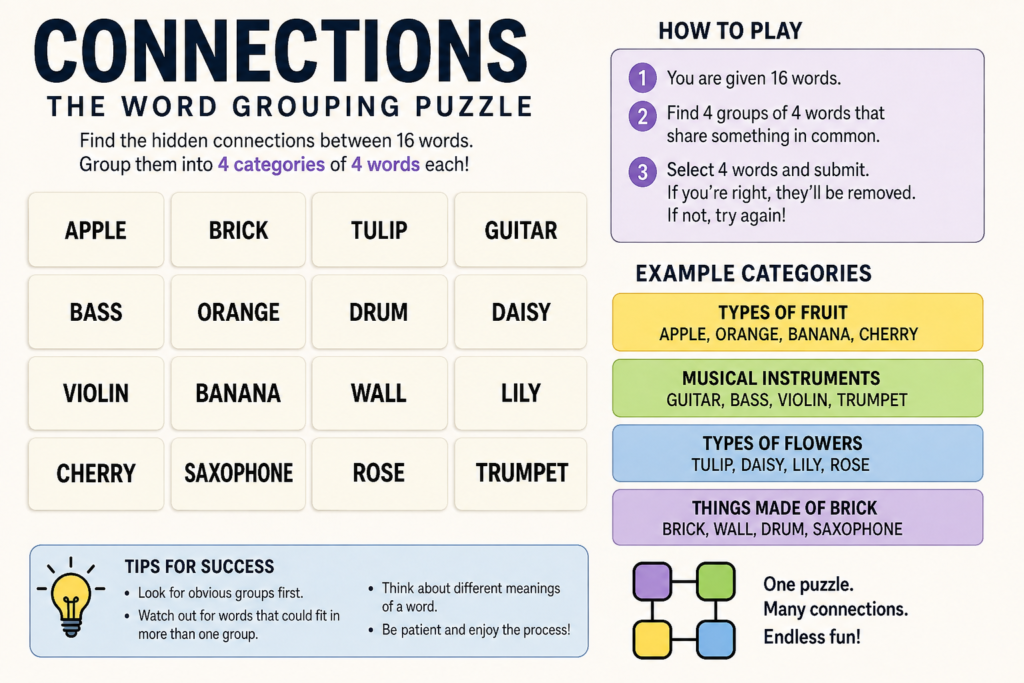
Connections has quickly become one of those daily word puzzles that people casually open in the morning, during a coffee break, or whenever they need a few minutes of mental exercise. The concept looks simple at first: players receive a grid of sixteen words and need to divide them into four groups of four. The real challenge, however, is figuring out what connects each group while avoiding the many tempting relationships hidden among the words.
What makes Connections especially enjoyable is that it is not simply a test of vocabulary. It requires observation, flexible thinking, pattern recognition, and a willingness to reconsider an idea when it does not quite fit. A word can appear to belong to several different categories, which is often exactly how the puzzle creates its difficulty.
This guide explores how Connections works, why it has become so popular, and how players can improve their solving skills without turning the experience into a stressful competition. Whether you are a newcomer or someone who plays every day, understanding the puzzle’s structure can make each grid more interesting.
What Is Connections?
Connections is a word association puzzle in which players are presented with sixteen words arranged in a four-by-four grid. The objective is to identify four groups, with each group containing four words that share a meaningful connection. Once a player believes four words belong together, those words can be submitted as a group.
The connections can take many forms. Four words might belong to the same category, describe similar things, follow the same word, contain abbreviations, refer to familiar phrases, or have another less obvious relationship. Because the categories are not displayed, the player has to discover both the words and the rule that unites them.
The simplicity of the format is part of its appeal. There are no complicated controls, lengthy instructions, or large amounts of information to process. Everything needed to solve the puzzle is right there on the screen. The challenge comes from interpreting the information correctly.
How the Connections Puzzle Works
A standard Connections puzzle begins with sixteen words. These words are deliberately selected so that four separate groups can eventually be formed. Each group contains exactly four answers, and every word should belong to one group only in the completed solution.
Players normally select four words and submit them as a possible group. If the selection is correct, the group is revealed and removed from the active grid. If the selection is incorrect, the player receives feedback that the chosen combination is not a complete category.
This structure creates an interesting balance between confidence and caution. A player may notice four words that seem related, but one of them could have been included specifically to create a misleading connection. That means recognizing a relationship is not always enough. The relationship also has to be the intended one.
Why Connections Can Be Surprisingly Difficult
The biggest challenge in Connections is that words rarely have only one possible meaning. A single word can fit into multiple categories depending on how it is interpreted. For example, a word could describe an object, appear in a common phrase, relate to entertainment, and also function as part of a technical term.
Puzzle creators use this ambiguity intentionally. If every word belonged obviously to one category, the game would be little more than sorting vocabulary into boxes. The fun comes from discovering the intended connection while ignoring plausible but incorrect alternatives.
Another difficulty is that players often become attached to their first theory. Once four words appear connected, it is tempting to submit them immediately. Experienced solvers learn to pause and ask whether the relationship is specific enough and whether each word fits equally well.
The Different Types of Connections
Connections puzzles can use many different category styles. Some are straightforward, while others require lateral thinking. Understanding the common types can help players recognize patterns more quickly.
One common type is a simple category. Four words might be different kinds of food, occupations, animals, colors, places, or objects. These categories are usually easier because the shared relationship is based on meaning.
Another type involves words that can follow or precede the same word. The connection may become obvious only after players mentally combine the words into familiar phrases. This is where vocabulary and familiarity with everyday language become useful.
There can also be connections involving names, titles, abbreviations, symbols, brands, or cultural references. These categories may depend on general knowledge rather than pure vocabulary.
The Importance of Looking for the Strongest Connection
When solving Connections, not every relationship deserves equal attention. A strong connection is one where all four words fit naturally and specifically. A weak connection may technically work but feels broad, forced, or dependent on an unusual interpretation.
This distinction is extremely important. Suppose five words appear related in some way, but only four form a precise and recognizable category. The extra word may have been placed there to distract you. The goal is not simply to find relationships; it is to find the intended relationships.
A useful habit is to ask yourself whether you could explain the category in a short phrase. If the explanation sounds awkward or requires several exceptions, the group may not be correct. Strong categories usually become clearer once identified.
Why Yellow, Green, Blue, and Purple Categories Matter
Connections commonly organizes categories by difficulty, represented by different colors. The easiest category is traditionally yellow, followed by green, blue, and purple as the difficulty increases.
The yellow category is generally the most direct. These words often share an obvious relationship that becomes visible after a little observation. Finding this group can provide a useful starting point.
Green and blue categories typically require more thought. They may involve wordplay, phrases, or knowledge that is not immediately obvious. Purple is often the trickiest category and may rely on a clever linguistic relationship or a connection that becomes apparent only after the other groups have been removed.
A Smart Strategy for Starting a Puzzle
A common mistake is trying to solve the entire grid at once. With sixteen words competing for attention, this can quickly become overwhelming. A better approach is to scan the grid and look for obvious clusters.
Start with words that clearly appear to belong to a recognizable category. If you see several obvious examples of a type of object, profession, food, or phrase, investigate them first.
At the same time, avoid committing too quickly. Before submitting a group, scan the remaining words and ask whether another word might fit the same category better. This simple check can prevent many mistakes.
The Four-Word Rule
One of the most important principles in Connections is that a category must contain exactly four words. This sounds obvious, but it has major strategic importance.
Sometimes you may discover five or six words that share a broad relationship. That does not mean you have found the intended category. Instead, the puzzle may be testing whether you can identify the four words that form the more precise connection.
The four-word rule encourages players to think about specificity. If your category has too many possible members, look for a narrower definition. The intended group usually has a distinct boundary.
Watch Out for Red Herrings
Red herrings are words that appear to belong to an attractive category but actually belong somewhere else. They are one of the main reasons Connections can feel harder than ordinary word puzzles.
A red herring works because the connection is not completely wrong. Instead, it is usually a relationship that is real but not the one the puzzle intends. This creates a moment of uncertainty and forces the player to examine the grid more carefully.
The best defense is comparison. If two possible groups overlap, look at which interpretation produces the cleaner four-word category. Usually, the intended solution will make the entire grid easier to divide.
How to Use the Process of Elimination
Elimination becomes increasingly powerful as you solve the puzzle. Once one category is confirmed, its four words disappear from consideration, leaving twelve words. That smaller pool makes the remaining relationships easier to see.
After solving a second group, the grid becomes even more manageable. Sometimes the final eight words make the remaining categories almost obvious.
This is why a puzzle does not necessarily need to be solved in the order of difficulty. You might discover a difficult category early, while another group only becomes clear after the easier words are removed.
The Value of Synonyms and Multiple Meanings
Connections frequently rewards players who think beyond the most obvious definition of a word. If a word has several meanings, consider each one.
For example, a word might function as a noun in one category and as part of a phrase in another. A familiar word may also represent a name, abbreviation, action, or cultural reference.
This flexibility is one of the puzzle’s defining characteristics. Strong solvers do not simply ask, “What does this word mean?” They also ask, “What else can this word represent?”
Common Mistakes New Players Make
One of the most common mistakes is submitting the first four related words that come to mind. The relationship may be genuine, but the puzzle may be using one of those words as a distraction.
Another mistake is treating every category as a literal subject. Connections can use spelling, sound, word placement, phrases, titles, abbreviations, and other forms of wordplay.
Players can also become frustrated by one stubborn word. Instead of forcing it into a category, it is often better to leave it alone and solve the surrounding groups. Once other words disappear, the difficult word may suddenly make sense.
How to Improve Your Connections Skills
Improvement comes mainly from developing better pattern-recognition habits. Playing regularly helps because you become familiar with the kinds of relationships puzzle creators like to use.
Reading widely can also help. Exposure to movies, music, sports, geography, science, literature, brands, and everyday expressions expands the pool of knowledge you can draw from.
Most importantly, learn from mistakes. If you choose an incorrect group, think about why it looked convincing. Was the connection too broad? Did one word have a different meaning? Was another word a better fit? Understanding the mistake is more useful than simply knowing that the guess was wrong.
A Practical Step-by-Step Solving Method
A reliable method begins with a quick scan of all sixteen words. Do not immediately attempt to solve every possible relationship. Instead, identify unusual words, obvious clusters, repeated themes, and words that seem especially flexible.
Next, look for the strongest group. Try to find four words with a very specific relationship. Before submitting them, check whether any of the other twelve words could fit the same definition more naturally.
After solving a group, repeat the process with the remaining words. If nothing looks obvious, consider phrases, alternate meanings, names, abbreviations, and wordplay.
For the final eight words, compare the two remaining possibilities carefully. At this point, the intended categories are often much easier to recognize because most distractions have already been removed.
Is Connections Good for Your Brain?
Word puzzles can be an enjoyable form of mental exercise because they encourage players to recognize patterns, retrieve vocabulary, compare meanings, and change strategies. Connections is particularly interesting because it combines several of these activities into one short challenge.
The game also encourages flexible thinking. A player may begin with one interpretation and then realize that another interpretation works better. Being willing to change direction is an important part of successful problem-solving.
Of course, Connections should primarily be viewed as entertainment rather than a guaranteed method for improving cognitive abilities. Its biggest benefit is that it provides an engaging reason to practice language and reasoning skills.
Connections as a Daily Habit
Part of Connections’ appeal comes from its daily format. A new puzzle gives players a small, predictable challenge without requiring a major time commitment.
For many people, that makes it easy to incorporate into a daily routine. Some players solve it first thing in the morning, while others prefer to use it as a short break during the day.
The limited format also creates a sense of anticipation. Because there is a new puzzle rather than an endless collection of random grids, each day’s challenge feels like a shared event.
How Connections Compares With Other Word Games
Connections belongs to a broader family of modern word games, but its gameplay is different from traditional crossword puzzles and guessing games.
A crossword usually depends on clues and intersecting answers. A guessing game may require identifying a hidden word through repeated attempts. Connections instead asks players to discover relationships among visible words.
That makes it particularly appealing to people who enjoy categorization and lateral thinking. You are not simply searching for a word; you are trying to understand how several words belong together.
Why People Enjoy Sharing Their Results
Another reason Connections has become popular is the social element surrounding daily puzzles. Players often discuss their results, strategies, mistakes, and surprising categories with friends or online communities.
The format is particularly suitable for conversation because two people can approach the same grid differently. One player may immediately recognize a phrase-based category, while another notices a cultural reference.
Sharing results also creates a friendly sense of competition. Players can compare how quickly they solved the puzzle or how many mistakes they made without needing a complicated scoring system.
The Psychology Behind the Puzzle
Connections works because the human brain naturally searches for patterns. When presented with a group of unrelated words, people automatically try to organize them into meaningful categories.
The puzzle takes advantage of this natural tendency while adding uncertainty. Several patterns may appear at the same time, but only some of them are intended.
That tension between recognition and doubt is what makes the game satisfying. Solving a group feels rewarding because you are not merely remembering information; you are discovering structure hidden inside a seemingly random collection of words.
Why Simple Words Can Be the Hardest
Players sometimes expect difficult vocabulary to be responsible for the hardest categories. Surprisingly, familiar words can be much more challenging.
A common word may have several meanings, occur in countless phrases, or represent different concepts. Because the possibilities are so broad, it can become difficult to determine which interpretation matters.
This is another reason Connections rewards restraint. When a word seems to fit everywhere, it may be better to leave it aside until the rest of the puzzle provides more information.
Tips for Solving Without Spoilers
If you enjoy solving Connections independently, avoid searching for the day’s answers before giving yourself enough time to think. Even a small hint can remove much of the satisfaction.
Instead, use a structured approach. Look for obvious categories, test the strongest connections, and then reconsider the difficult words from different perspectives.
If you become stuck, take a short break. Returning with fresh eyes can make an enormous difference. A category that seemed invisible five minutes earlier may suddenly become obvious.
Connections and Vocabulary Development
Although Connections is not designed as a formal vocabulary course, regular play can encourage players to think carefully about words and their relationships.
Players become more aware of synonyms, homonyms, phrases, abbreviations, categories, and cultural references. Over time, this can make language feel more interconnected.
The most useful lesson is that words rarely exist in isolation. Their meaning often depends on context, usage, and the words around them. Connections turns that idea into a game.
What Makes a Good Connections Puzzle?
A strong puzzle should feel challenging without feeling arbitrary. Players should be able to understand the intended categories once the solution is revealed.
Good puzzles also use misdirection carefully. A misleading relationship should feel plausible, but the final solution should be more precise and satisfying.
The best grids often create a moment of surprise. A player may struggle with one category for several minutes and then suddenly realize that four words share an unexpected connection. That “aha” moment is a major part of the game’s appeal.
The Role of Patience in Solving
Patience is an underrated Connections skill. When a puzzle does not immediately make sense, rushing usually creates more confusion.
Instead of repeatedly guessing, step back and inspect the grid. Look at the words individually and then compare them in pairs or small groups. Sometimes removing your attention from one suspected category allows another pattern to become visible.
A calm approach also helps prevent mistakes. The goal is not simply to submit groups quickly. It is to understand why the groups belong together.
Final Thoughts on Connections
Connections is a deceptively simple word puzzle that combines vocabulary, categorization, pattern recognition, cultural knowledge, and lateral thinking. Its sixteen-word grid may look manageable, but the overlapping meanings and carefully designed distractions can make each puzzle surprisingly challenging.
The most effective strategy is to look for strong, specific relationships rather than jumping at the first connection you notice. Think about alternative meanings, watch for red herrings, use elimination, and be willing to change your theory when the evidence does not support it.
Ultimately, Connections is enjoyable because it makes ordinary words feel more interesting. A familiar word can suddenly become part of an unexpected category, and a collection of seemingly unrelated terms can reveal a clever pattern. Whether you play competitively or simply enjoy a few minutes of daily brain exercise, the puzzle offers a satisfying combination of simplicity and depth.
With regular practice, you will likely become better at recognizing category structures and spotting misleading relationships. More importantly, you may find yourself looking at language differently—paying closer attention to how words connect, overlap, and change meaning depending on context. That is what gives Connections its lasting appeal: the puzzle is easy to understand, but there is always another clever connection waiting to be discovered.
YOU MAY HAVE MISSED