Introduction to Wordle
Wordle has become one of the most recognizable word games on the internet, thanks to a simple idea that is surprisingly difficult to master. The goal is straightforward: players have six attempts to discover a hidden five-letter word. With every guess, the game provides clues that help narrow down the possibilities. There are no complicated menus, lengthy instructions, or special gaming skills required. You simply choose a word, submit it, study the feedback, and try again.
What makes Wordle particularly interesting is the balance between vocabulary and logic. Knowing a large number of words can certainly help, but vocabulary alone does not guarantee success. Players also need to think about letter frequency, possible word patterns, repeated letters, and the information gained from previous guesses. A guess that is not the answer can still be extremely valuable if it reveals which letters belong in the solution and which ones should be eliminated.
Another major reason for Wordle’s popularity is its daily format. Everyone receives the same daily puzzle, which gives the game a shared sense of occasion. Players can solve the puzzle privately and then compare their results with friends, family members, or other players. The familiar colored-square result has also become closely associated with the game, allowing people to discuss their performance without immediately revealing the answer.
What Is Wordle?
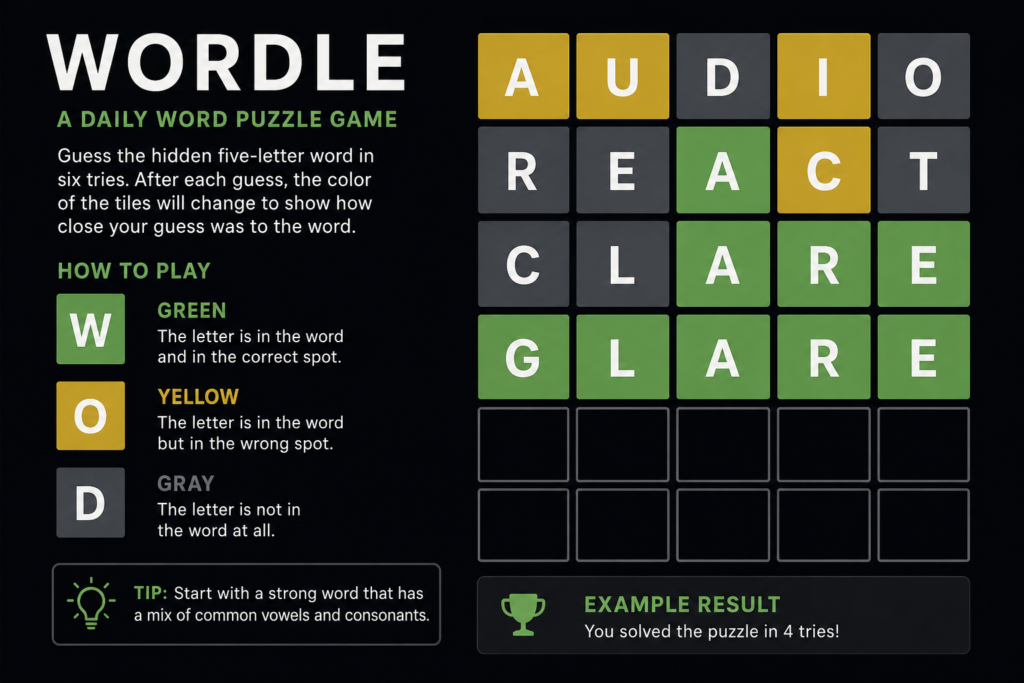
Wordle is a daily word puzzle built around a hidden five-letter word. Players have six opportunities to guess the answer, and each attempt produces visual clues. A correctly placed letter is highlighted differently from a letter that exists in the answer but appears in the wrong position. Letters that do not appear in the solution are also identified, allowing the player to remove them from future guesses.
The basic rules are easy to understand. A player enters a valid five-letter word, submits it, and examines the result. If a letter is in the correct position, that information becomes extremely useful because the player knows both the letter and its location. If a letter belongs to the answer but occupies the wrong position, the player knows it must be moved. If a letter is absent, it can generally be removed from consideration.
Despite its simple design, Wordle creates plenty of strategic depth. Every guess should ideally provide useful information. Players who treat every attempt as a random shot may quickly run out of opportunities, while players who carefully analyze the feedback can gradually reduce the number of possible answers. This combination of simplicity and strategy is one of the strongest reasons Wordle remains appealing to such a wide audience.
How Wordle Works
The Wordle board consists of six rows, with each row representing one guess. Players enter five letters and submit the word. The game then evaluates the letters and provides feedback. This process continues until the player identifies the hidden word or uses all six attempts.
The colored clues are the heart of the game. A green tile indicates that the letter is correct and appears in the correct position. A yellow tile means the letter is part of the answer but is positioned incorrectly. A gray tile indicates that the letter is not needed in that position and, depending on repeated-letter circumstances, may indicate that the letter is not present in the solution at all. Understanding these clues is essential for solving puzzles efficiently.
One subtle aspect of Wordle involves repeated letters. A letter can appear more than once in an answer, but the feedback system accounts for how many copies of that letter are actually present. This can occasionally confuse new players. For example, seeing one occurrence of a letter marked as correct does not automatically mean that another occurrence of the same letter must also be included. Players need to consider the complete feedback from the guess.
Why Wordle Became So Popular
Wordle’s popularity comes partly from its accessibility. There is nothing intimidating about opening the game for the first time. Players do not need to learn complicated controls, understand a fictional universe, or spend hours practicing before they can participate. Anyone who knows basic English vocabulary can immediately understand the objective.
The daily limit also plays an important role. Many games encourage players to continue playing for hours, but Wordle traditionally offers one main puzzle per day. Once the puzzle is solved or missed, the experience is essentially complete until the next challenge. This creates anticipation without demanding a large amount of time from the player.
Social sharing helped transform Wordle from a private puzzle into a shared online experience. Players can post their results using the familiar grid pattern without revealing the solution itself. This lets others know how difficult the puzzle was and how efficiently someone solved it. The format is concise, recognizable, and easy to share, which helped the game spread rapidly through social networks and group chats.
The Importance of the Starting Word
Choosing a strong opening word is one of the most discussed aspects of Wordle strategy. A good starting word should ideally contain several common letters, giving the player a useful amount of information immediately. Some players prefer words containing common vowels, while others prioritize frequently occurring consonants.
There is no single universally perfect starting word. The best choice depends on personal strategy and comfort. A word containing several vowels can quickly reveal which vowel sounds are relevant to the puzzle. On the other hand, a word with common consonants can help distinguish between many possible word patterns.
The important principle is to think about information rather than simply trying to guess the answer immediately. The first guess has little context, so it is often more useful to discover several important letters than to gamble on an obscure possibility. Once the first set of clues appears, later guesses can become much more targeted.
Understanding Letter Frequency
Letter frequency is one of the most useful concepts for improving at Wordle. Certain letters appear more frequently in English words than others. Common consonants and vowels can therefore be valuable when selecting early guesses.
However, letter frequency should not be treated as an absolute rule. A puzzle may contain an uncommon letter, and relying too heavily on statistical patterns can sometimes lead players away from the correct answer. Wordle rewards flexible thinking. Frequency is useful for generating possibilities, but the actual clues should always take priority.
Players can also use frequency differently depending on the stage of the puzzle. Early guesses benefit from common letters because the goal is to gather information. Later guesses are usually more constrained, so the player should focus less on general frequency and more on the specific pattern revealed by the board.
How to Use Green Letters
Green letters are among the most valuable clues Wordle provides. When a letter turns green, its position is confirmed. This means the player can preserve that letter and begin building possible words around it.
For example, if a player discovers that the third position contains the letter A, the number of possible five-letter words immediately becomes smaller. If another position becomes known, the pattern becomes even more restrictive. Eventually, players may see a structure that strongly resembles a familiar group of words.
The key is not to ignore green letters simply because another possible word looks attractive. Once a position has been confirmed, future guesses should respect that information. Good Wordle solving involves gradually turning uncertain letters into fixed pieces of the final answer.
How to Use Yellow Letters
Yellow letters provide a different kind of information. They confirm that a letter belongs somewhere in the answer, but they also tell the player that the current position is wrong. This creates an opportunity to experiment with different placements.
Suppose a player discovers that the letter R is yellow in the second position. The next guess should ideally place R somewhere else while also testing additional useful letters. This is more efficient than repeatedly placing R in the same position.
Yellow clues can become especially powerful when several letters have been identified. A player might know three or four letters but have them in uncertain positions. Rearranging those letters while testing the remaining possibilities can quickly lead to the answer. In this sense, yellow tiles are not just warnings; they are instructions about where to search next.
How to Handle Gray Letters
Gray letters are useful because they eliminate possibilities. When a letter is shown as absent, players should generally avoid using it in subsequent guesses. This prevents valuable attempts from being wasted on combinations that the game has already ruled out.
A growing list of eliminated letters can dramatically simplify a puzzle. Imagine that several common consonants and one or two vowels have been removed. The remaining possibilities may suddenly become much easier to identify.
Still, players should be careful with repeated letters. Wordle’s treatment of duplicate letters means that a gray occurrence can sometimes have a more nuanced meaning when another copy of the same letter appears in the same guess. Understanding this detail can prevent incorrect assumptions and improve accuracy.
The Role of Vocabulary in Wordle
Vocabulary obviously matters in Wordle, but having an enormous vocabulary is not the only path to success. In many cases, the challenge is recognizing a familiar word from an unusual arrangement of letters rather than knowing an obscure definition.
Strong Wordle players often develop pattern recognition. They become familiar with common five-letter structures, endings, prefixes, and letter combinations. For instance, certain pairs of consonants frequently appear together in English, while some letters are more likely to appear at the beginning or end of a word.
Reading regularly can naturally improve this skill. Exposure to different words makes unusual combinations feel less unfamiliar. Even when a player does not immediately remember a word’s definition, recognizing its structure can be enough to consider it as a possible answer.
Wordle and Logical Thinking
At its core, Wordle is a small deduction puzzle. Each guess provides evidence, and the player must use that evidence to update the list of possible answers. This makes the game surprisingly similar to other logic-based activities.
The strongest approach is to avoid treating each guess as an isolated event. Instead, every attempt should build on everything learned previously. If a letter has been confirmed, preserve it. If a letter has been eliminated, avoid it. If a letter is known to exist but is misplaced, move it to a new position.
This mindset turns Wordle into a process of elimination. Rather than asking, “What word should I guess?” players can ask, “Which possible answers are still consistent with all the clues?” That small change in thinking can make the puzzle feel considerably more manageable.
Common Wordle Mistakes
One common mistake is using guesses that provide very little new information. For example, after learning several important letters, a player may enter another word containing the same uncertain letters without testing anything new. While this can occasionally produce the answer, it often wastes an opportunity.
Another mistake is becoming too attached to an early theory. Players sometimes discover a pattern and immediately assume they know the answer. When that assumption turns out to be wrong, they may struggle to reconsider their options. Good solving requires flexibility and a willingness to abandon an idea when the evidence contradicts it.
A third mistake is forgetting previously revealed information. Wordle boards contain a lot of small details, especially when several guesses have been made. Taking a moment to review the confirmed, misplaced, and eliminated letters can prevent unnecessary errors. Careful observation is often more valuable than rushing.
Strategies for Solving Wordle Faster
Speed should not be the only objective, but players who want to improve their solving time can focus on making every guess purposeful. A strong first word, careful interpretation of the feedback, and efficient elimination of possibilities can reduce unnecessary attempts.
Another useful technique is to think in word families. Once a pattern becomes visible, consider several words that could fit it rather than immediately choosing the first one that comes to mind. This is especially useful when multiple words share similar endings or letter arrangements.
Players should also avoid overthinking extremely obscure possibilities too early. Wordle generally works best when players begin with common vocabulary and only consider less familiar words when the clues require them. The goal is to follow the evidence rather than invent increasingly complicated theories.
Wordle Without Spoilers
One of Wordle’s most enjoyable traditions is sharing results without revealing the answer. The familiar colored-square format allows players to communicate their performance while keeping the actual solution hidden.
This spoiler-free approach is important because many people solve the puzzle at different times. Someone might complete the daily challenge in the morning, while another person may not play until the evening. Sharing the answer directly can remove the fun for anyone who has not yet had a chance to try.
A good rule for discussing Wordle is to separate results from solutions. Saying that a puzzle took four attempts is generally harmless, while posting the actual five-letter word can spoil the experience. This simple etiquette helps preserve the game’s social appeal.
Wordle as a Daily Mental Exercise
Wordle is not a substitute for formal education or serious cognitive training, but it can be a pleasant way to engage with language and deduction. Players regularly think about spelling, word structure, letter placement, and vocabulary while solving the puzzle.
The short format makes it particularly easy to fit into a daily routine. A person can complete a puzzle during breakfast, while taking a short break, or at the end of the day. Unlike longer games, it does not require a significant time commitment.
The mental exercise also comes from making decisions under limited attempts. Players have to balance exploration with caution. Every guess can reveal useful information, but every incorrect guess also reduces the remaining opportunities. That tension is part of what makes the game satisfying.
Why People Keep Coming Back to Wordle
The biggest reason people return to Wordle is probably the combination of routine and variety. The basic rules remain the same every day, but the hidden word changes. Players know exactly how the game works, yet they never know what challenge awaits them.
There is also a satisfying sense of completion. Solving a Wordle puzzle provides a small daily achievement that can be completed in only a few minutes. The experience is simple enough to become a habit without feeling like a major commitment.
For many players, the social element is just as important. Friends can compare scores, families can discuss tricky puzzles, and online communities can debate strategies. Even though the game is fundamentally about one five-letter word, it has created a surprisingly broad community of people who enjoy solving the same daily challenge.
Wordle for Beginners
New players should not worry about solving every puzzle immediately. Wordle has a learning curve, and early mistakes are useful because they teach players how the feedback system works.
A beginner can start by choosing words with several common letters. After submitting the first guess, the next step is simply to pay attention to the colors. There is no need to memorize complicated mathematical formulas or develop an advanced strategy before playing.
Over time, beginners naturally become better at recognizing patterns. They learn which letters tend to appear together, how repeated letters work, and when a guess is likely to provide useful information. The most important thing is to remain curious rather than becoming frustrated by difficult puzzles.
Advanced Wordle Thinking
Experienced players often move beyond basic guessing and begin thinking about the remaining solution space. Once several letters have been identified, they can mentally generate a smaller collection of possible answers and compare those words against the clues.
Another advanced technique involves selecting a guess that distinguishes between multiple possibilities. Imagine that the board could represent several different words. Instead of immediately guessing one candidate, a player may choose another valid word that tests letters shared or differing among those possibilities. This can provide more information for the next turn.
This approach highlights an important principle: the best guess is not always the word that seems most likely to be the answer. Sometimes the best guess is the word that teaches you the most. That distinction separates casual guessing from deliberate puzzle solving.
Wordle and the Appeal of Simplicity
Modern digital entertainment can be complicated, but Wordle demonstrates how powerful a simple idea can be. There are no elaborate graphics required to make the game interesting. The challenge comes almost entirely from the relationship between the player and the letters.
The clean format also makes the game accessible across different devices. Players can understand the board almost immediately, and the rules require very little explanation. This simplicity lowers the barrier to entry while leaving enough strategic depth for experienced players.
Wordle’s success is therefore a useful example of minimalist game design. A small set of rules, a limited number of attempts, and meaningful feedback can create an experience that people willingly return to day after day.
Tips for Improving Your Wordle Results
The first tip is to stop thinking of the first guess as a race to the answer. Use it to collect information. Choose a word that gives you a strong mix of common letters and then let the feedback guide your next decision.
The second tip is to track information carefully. Keep confirmed green letters fixed, move yellow letters to new positions, and avoid eliminated letters. When the board becomes confusing, mentally summarize what you know before making another guess.
The third tip is to remain flexible. If your favorite strategy does not work on a particular puzzle, change your approach. Some puzzles reward vowel testing, while others become easier through consonant patterns or repeated-letter analysis. Strong players adapt to the evidence rather than forcing every puzzle into the same strategy.
The Future of Wordle
Wordle has already established itself as more than a temporary internet trend. Its format is memorable, easy to understand, and adaptable. The daily puzzle concept also gives it a natural rhythm that encourages continued participation.
Part of its long-term appeal comes from the fact that the fundamental experience does not need to change dramatically. Players enjoy the predictability of the rules while receiving a different challenge each day. That balance between familiarity and novelty is difficult to achieve in digital entertainment.
Whether someone plays Wordle casually once in a while or treats every puzzle as a serious daily challenge, the game’s basic attraction remains the same. It asks players to think, test possibilities, recognize patterns, and make decisions within a small set of limits.
Final Thoughts on Wordle
Wordle succeeds because it turns a very basic concept into a surprisingly engaging daily challenge. Six guesses, five letters, and a handful of clues are enough to create suspense, frustration, satisfaction, and plenty of conversation.
The best way to approach Wordle is to enjoy the process rather than obsess over perfection. A failed puzzle can still teach you something about letter placement, vocabulary, or strategy. A successful solve is rewarding because it represents a series of small deductions that eventually come together.
Ultimately, Wordle is a reminder that games do not need complicated mechanics to be memorable. Its straightforward rules, daily format, logical feedback, and social appeal have made it a favorite among word-game enthusiasts and casual players alike. Whether you are opening Wordle for the first time or trying to improve an already strong solving record, the basic principle remains simple: make a thoughtful guess, learn from the clues, and let the letters lead you toward the answer.
YOU MAY HAVE MISSED