When you come across the term allegory definition, you are essentially looking for a clear explanation of a literary technique in which a story, character, event, or image represents a deeper meaning beyond its literal surface. An allegory can make an ordinary story communicate ideas about morality, politics, society, religion, human behavior, or philosophy.
The interesting thing about allegory is that it allows writers to say something complicated through something much easier to understand. Instead of directly explaining an abstract idea, a writer can build a story around characters and events that symbolize that idea. Readers then look beneath the surface and discover another layer of meaning.
Allegory has been used for centuries and remains relevant today. You can find it in novels, poems, films, paintings, advertisements, political cartoons, speeches, and even everyday expressions. Understanding the allegory definition therefore helps readers interpret literature and recognize hidden messages in many forms of communication.
What Is the Allegory Definition?
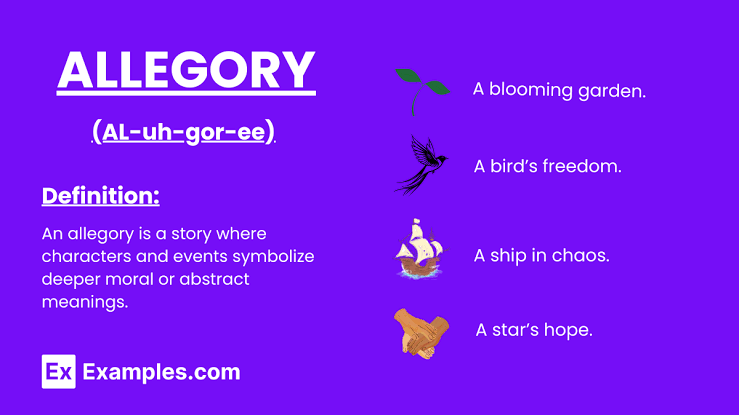
The simplest allegory definition is a story, narrative, artwork, or description in which characters, actions, settings, and events represent ideas or concepts beyond their literal meaning. In other words, an allegory tells one story on the surface while communicating another message underneath.
For example, imagine a story about a traveler walking through a dark forest. On the literal level, the traveler is simply trying to reach the other side. However, the forest might represent confusion, fear, or the difficulties of life. The journey could represent personal growth. In this case, the story works as an allegory because its events have a deeper symbolic purpose.
An allegory is usually more extensive than a single symbol. A symbol might be one object that represents an idea, such as a dove representing peace. An allegory, by comparison, can use an entire narrative structure to develop a broader meaning. Characters may represent particular qualities, while their actions and conflicts illustrate larger concepts.
How Does Allegory Work?
Allegory works by creating two connected levels of meaning. The first is the literal story that readers can follow directly. The second is the deeper meaning that the story communicates through symbolism, comparison, or representation.
A writer might create characters who seem like ordinary people but actually represent qualities such as greed, courage, freedom, jealousy, or wisdom. Their decisions then become part of a larger message. Readers do not necessarily need every character to represent only one idea, but the overall pattern usually points toward a deeper interpretation.
This layered approach makes allegory especially useful for discussing difficult subjects. A writer can explore political oppression through a fictional kingdom, discuss human temptation through a character’s journey, or examine social inequality through an imagined community. The story remains entertaining while also encouraging readers to think.
The effectiveness of an allegory often depends on how naturally the deeper meaning fits into the narrative. A strong allegory does not always feel like a lesson being forced onto the reader. Instead, the meaning develops through the characters, conflicts, choices, and consequences within the story.
Allegory vs. Symbolism
Allegory and symbolism are closely related, which is why they are sometimes confused. Both involve meanings that go beyond literal descriptions, but they operate differently.
A symbol is usually a specific object, character, color, action, or image that represents something else. For example, a broken chain can symbolize freedom. A storm might symbolize emotional turmoil. A road can symbolize a journey through life.
An allegory is broader. It may contain many symbols working together throughout an entire story. Instead of one object representing one idea, the narrative itself can represent a larger situation or argument.
Think of symbolism as one of the tools an author can use to build an allegory. A story may contain symbolic characters, settings, objects, and events, all contributing to a larger underlying meaning. This is why understanding symbolism can make allegorical writing much easier to recognize.
Allegory vs. Metaphor
Another common source of confusion is the difference between allegory and metaphor. A metaphor directly compares one thing to another to create meaning or imagery. For instance, saying that “life is a journey” is a metaphor because life is being compared to a journey.
An allegory can be much longer and more developed. Instead of simply stating that life is a journey, an author might write an entire story about a traveler crossing mountains, facing storms, meeting strangers, making difficult choices, and finally reaching a destination. The journey can then represent the experiences of life.
Metaphors can appear inside allegories, but an allegory usually operates across a larger portion of a work. A single metaphor may take one sentence, while an allegory can span an entire novel, poem, film, or artwork.
The key difference is scope. Metaphor generally creates a comparison, while allegory develops a sustained representation through narrative or artistic elements.
Allegory vs. Parable
A parable is another literary form that shares important similarities with allegory. Both can communicate moral or philosophical lessons through stories rather than direct explanations.
Parables are often relatively short and are traditionally associated with teaching a specific moral or spiritual lesson. Many well-known religious and philosophical teachings use parable-like storytelling because stories are easier to remember and discuss than abstract instructions.
Allegories can be much broader and more complicated. An allegorical work may explore several related themes at once, allowing readers to interpret its characters and events at different levels.
The distinction is not always absolute. Some works can reasonably be described as both allegorical and parabolic. The important point is that both techniques use storytelling to communicate ideas beyond the literal events.
Common Types of Allegory
Allegory appears in several forms, depending on the subject, purpose, and structure of the work. Understanding these categories can make it easier to identify allegorical writing.
Some allegories focus primarily on morality. Others examine politics, religion, philosophy, or society. There are also allegorical works designed primarily as satire, using fictional situations to criticize real-world behavior.
Although categories can overlap, several major types appear frequently in literature and popular culture.
Moral Allegory
A moral allegory uses characters and events to explore questions about right and wrong, virtue and vice, temptation, responsibility, and personal choices.
In a moral allegory, characters may represent qualities such as honesty, greed, pride, patience, courage, or selfishness. The conflicts between them can demonstrate the consequences of particular behaviors.
A classic moral allegory might feature a character choosing between two paths. One path appears attractive but eventually causes destruction, while the other is difficult but leads toward wisdom or fulfillment. The journey is not merely physical; it represents the character’s moral development.
Moral allegories remain popular because ethical questions are universal. Readers from different cultures and generations can recognize conflicts involving honesty, ambition, jealousy, fear, and compassion.
Political Allegory
Political allegory uses fictional characters, societies, governments, or events to comment on political systems and real-world power relationships.
A writer may create an imaginary kingdom ruled by an increasingly authoritarian leader. On the surface, the story is about that fictional kingdom. Beneath the surface, however, it may criticize dictatorship, corruption, propaganda, censorship, or the abuse of power.
Political allegory can be particularly effective when direct criticism is difficult or controversial. Fiction gives writers a way to explore political issues without simply presenting an argumentative essay.
Readers can also interpret political allegories differently depending on their historical context. A work written decades ago may continue to feel relevant because its themes of power, control, inequality, and resistance can appear in different societies.
Religious Allegory
Religious allegory uses stories, characters, and symbols to communicate spiritual beliefs, religious principles, or questions about faith and human existence.
Many older literary works use religious allegory extensively. Characters may represent virtues, sins, spiritual struggles, or stages of a person’s relationship with faith.
A journey toward a sacred destination, for example, might represent spiritual development. A dangerous wilderness might represent temptation or uncertainty. A guide may symbolize wisdom or divine assistance.
Religious allegories can be particularly rich because religious traditions often contain established symbols and concepts. Writers can draw on those traditions while creating new narratives that encourage readers to reflect on spiritual questions.
Philosophical Allegory
Philosophical allegory uses fictional situations to explore abstract questions about reality, knowledge, freedom, identity, morality, or human existence.
Philosophical concepts can be difficult to explain directly because they often involve ideas that cannot be physically observed. Allegory provides a way to turn those abstract questions into stories that readers can imagine.
For example, a story about people who have lived their entire lives inside a controlled environment may raise questions about knowledge and reality. Readers can consider what happens when someone discovers that their understanding of the world has been incomplete.
This approach makes philosophy more accessible. Instead of simply defining an idea, the writer gives readers a situation they can mentally experience.
Satirical Allegory
Satirical allegory combines allegorical storytelling with satire. It uses fictional situations to expose foolishness, hypocrisy, corruption, or social problems.
The surface story may appear humorous or absurd, but the underlying message can be serious. Animals, imaginary governments, exaggerated characters, or strange communities can all be used to represent real social behaviors.
Satirical allegory works particularly well because humor can make criticism easier to absorb. Readers may laugh at the fictional situation before realizing that the story is pointing toward something recognizable in real life.
This technique remains common in modern entertainment, especially animated films, comedy programs, political cartoons, and speculative fiction.
Famous Examples of Allegory
Several famous literary works are frequently discussed when people study allegory. These examples demonstrate how the technique can operate at different levels.
One of the best-known examples is Animal Farm, which uses a farm and its animals to explore political power, revolution, propaganda, and corruption. The animals and events function on both a literal storytelling level and a broader political level.
Another famous example is The Pilgrim’s Progress, which follows a protagonist named Christian on a journey filled with challenges and encounters. The journey represents a spiritual path, making the work a classic example of religious and moral allegory.
Plato’s Allegory of the Cave is another influential example. It presents people who have spent their lives seeing shadows and then considers what happens when one person encounters a broader understanding of reality. The story becomes a way to discuss knowledge, perception, education, and truth.
Animal Farm as an Allegory
George Orwell’s Animal Farm is one of the clearest examples used to explain political allegory.
The story takes place on a farm where animals rebel against human control. At first, the rebellion promises equality and freedom. However, as the story develops, a new power structure emerges, and the ideals of the revolution become increasingly distorted.
The animals and events can be read as representations of political figures, movements, and historical developments. The farm therefore works as more than a setting. It becomes a model through which readers can examine political power and manipulation.
What makes the work especially effective is its simple storytelling style. Readers can understand the events as a story about animals while simultaneously recognizing a much broader political message.
The Allegory of the Cave
Plato’s Allegory of the Cave is one of the most famous philosophical allegories in Western thought.
The story describes people confined in a cave who can see only shadows projected onto a wall. Because they have never experienced anything else, they assume those shadows represent reality. When one person leaves the cave and discovers the outside world, that person’s understanding changes.
The allegory explores the relationship between appearance and reality. It also raises questions about education and whether discovering the truth can initially feel uncomfortable or even painful.
The story remains influential because its central question is still relevant: how can people know whether what they believe is actually true? This is one reason allegory continues to be valuable in philosophical writing.
How to Identify an Allegory
Recognizing an allegory becomes easier when you look beyond the literal events of a story.
Start by asking whether the characters appear to represent qualities, groups, ideas, or historical figures. If several characters seem connected to abstract concepts, the story may contain allegorical elements.
Next, examine the plot. Ask whether the events seem to communicate a broader lesson or commentary. If a fictional conflict closely resembles a moral, political, religious, or philosophical issue, that can be a strong indication of allegory.
Finally, pay attention to repeated symbols and patterns. If certain objects, locations, or actions appear repeatedly and seem connected to the story’s larger message, they may contribute to an allegorical structure.
Questions to Ask When Reading Allegory
When reading a potentially allegorical work, it helps to ask several simple questions.
First, ask what the story literally describes. Understanding the surface narrative gives you a foundation for interpreting its deeper meaning.
Second, ask what the major characters might represent. Do their names, personalities, actions, or relationships suggest larger ideas?
Third, examine the conflict. What larger problem does the central struggle resemble? Is it about power, morality, identity, freedom, knowledge, or something else?
You should also consider the historical context. Knowing when and why a work was written can provide clues about the ideas it may be exploring.
Why Writers Use Allegory
Writers use allegory because it provides a powerful way to communicate complicated ideas without explaining everything directly.
An abstract argument can sometimes feel dry or difficult to remember. A story, however, gives the reader characters, emotions, conflicts, and consequences. These elements make an idea more concrete.
Allegory also gives writers flexibility. Instead of directly saying that greed can destroy a society, an author can create a fictional society where characters become increasingly obsessed with wealth until the community begins to collapse.
This approach allows readers to reach conclusions themselves. Rather than receiving a simple statement, readers participate in interpreting the story.
Why Allegory Is Important in Literature
Allegory adds depth to literature. A story can be enjoyable at the surface level while also offering ideas worth discussing for years.
It also encourages active reading. Readers cannot always understand an allegory by simply following the plot. They need to consider why characters behave in particular ways and why certain events happen.
This makes allegorical works especially useful in education. Students can examine the literal story, identify symbols, research historical context, and develop interpretations based on evidence.
Allegory also demonstrates how literature can address serious issues without becoming a straightforward lecture. A well-designed story can entertain while simultaneously encouraging reflection.
Allegory in Movies and Television
Allegory is not limited to books. Movies and television programs frequently use allegorical storytelling.
Science fiction is particularly well suited to allegory because imaginary worlds can represent real social concerns. A fictional future society might explore surveillance, inequality, technology, environmental destruction, or political control.
Fantasy can work similarly. Magical kingdoms and fictional creatures can represent human conflicts that exist in the real world.
Even comedy can use allegory. An exaggerated fictional situation may represent workplace culture, political behavior, family dynamics, or social expectations.
Allegory in Everyday Life
You do not have to read classic literature to encounter allegory. Allegorical thinking appears in everyday communication.
Political cartoons frequently use visual allegory. An artist might portray a nation as a person or represent an economic problem as a storm. These images allow viewers to understand complex issues quickly.
Advertising can also use allegorical ideas. A commercial might portray a product as a key that unlocks opportunity, freedom, confidence, or happiness. The product is not literally a key, but the image communicates an association.
Public speeches sometimes use stories in a similar way. A speaker may tell a personal or fictionalized story that represents a broader lesson about perseverance or leadership.
Allegory in Poetry
Poetry has a long relationship with allegory because poems often rely heavily on symbolism and figurative language.
A poem might describe a physical journey that represents emotional recovery. A changing season might represent aging. A battle might represent an internal struggle.
Because poetry is usually compact, allegorical meanings can sometimes be subtle. A single image may carry several possible interpretations.
Readers should therefore avoid assuming that every poetic image is automatically an allegory. Some poems use symbolism without creating a complete allegorical structure. Context and patterns are important.
How to Write an Allegory
Writing an allegory starts with choosing the larger idea you want to explore.
You might begin with a concept such as freedom, greed, fear, ambition, social inequality, environmental responsibility, or personal growth. Then create a fictional situation that naturally demonstrates that concept.
Next, develop characters who have clear motivations. Avoid making every character simply a walking definition of an abstract idea. Give them realistic desires, weaknesses, and conflicts.
Finally, allow the deeper meaning to emerge through the story. Strong allegory usually works best when readers can discover the message rather than having it repeatedly explained to them.
Common Mistakes When Understanding Allegory
One common mistake is assuming that every detail must have a secret meaning. Not every object in an allegorical story necessarily represents something specific.
Another mistake is treating allegory as identical to symbolism. While the two techniques overlap, allegory usually involves a larger and more sustained representation.
Readers can also make the mistake of ignoring historical context. A story may contain references that made immediate sense to its original audience but require additional research today.
Finally, interpretations should be supported by the text. It is possible to find almost any meaning in a story if there is no evidence. Good literary interpretation connects the proposed deeper meaning to characters, events, language, and structure.
Allegory Definition in Simple Words
If you need a very simple allegory definition, think of it this way: an allegory is a story that means more than what happens on the surface.
A character might represent courage. A journey might represent life. A fictional government might represent a real political system. A battle might represent an internal struggle.
The important idea is that the literal story and the deeper meaning work together.
Once you understand this concept, allegory becomes much easier to identify. You start asking not only, “What is happening?” but also, “What could this represent?”
YOU MAY HAVE MISSED