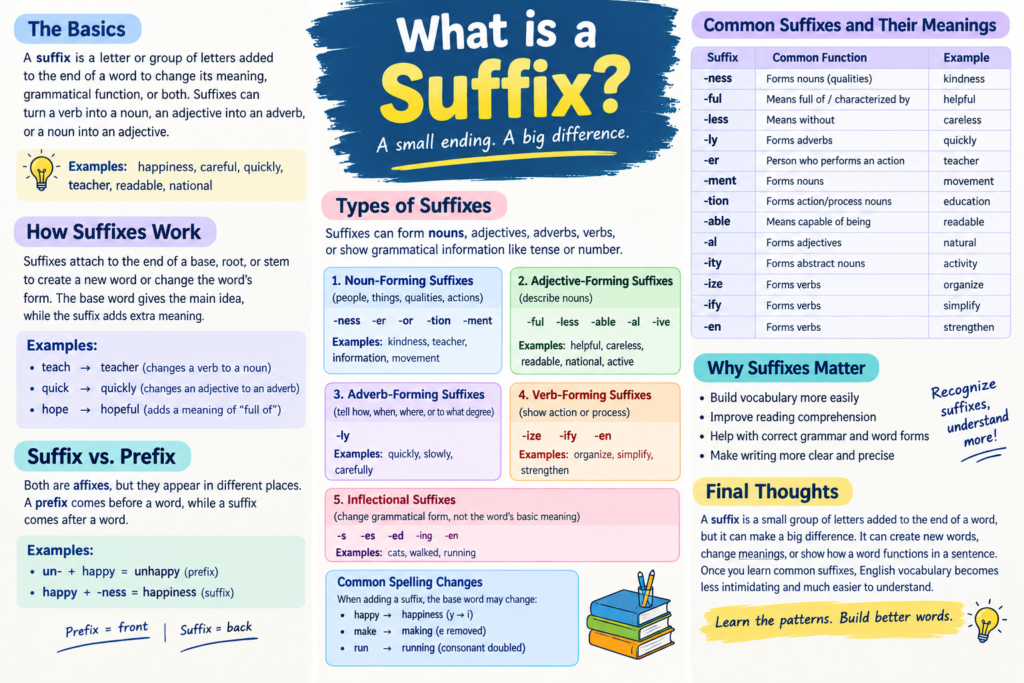
If you have ever seen words such as happiness, careful, quickly, teacher, readable, or national, you have already encountered suffixes. Suffixes are small groups of letters added to the end of a word to change its meaning, grammatical function, or both. They may look simple, but they play a major role in the way the English language works.
So, what is a suffix exactly? A suffix is a letter or group of letters placed at the end of a root word, base word, or stem. Depending on the suffix being used, it can turn a verb into a noun, an adjective into an adverb, or a noun into an adjective. Some suffixes also help show whether something happened in the past, whether there is more than one of something, or how a word functions in a sentence.
Understanding suffixes can make English vocabulary much easier to learn. Instead of memorizing every word as a completely separate item, you can recognize common patterns. Once you understand what certain suffixes usually do, unfamiliar words can become easier to understand, spell, and use correctly.
What Is a Suffix?
A suffix is an affix that comes at the end of a word. It is attached to a base, root, or stem to create a new word or to change the grammatical form of an existing word. For example, the word teach can become teacher when the suffix -er is added. In this case, the suffix changes the word from an action into a word describing a person who performs that action.
Another simple example is the word quick. By adding -ly, we get quickly. The original word is an adjective, while the new word is an adverb. The suffix does not simply add random letters; it changes how the word works within a sentence.
Suffixes can also change the meaning of words without completely changing their basic idea. Consider hope and hopeful. The suffix -ful adds the meaning “full of” or “having.” Similarly, hopeless uses -less to communicate the opposite idea: without hope. This is why understanding suffixes is such a useful vocabulary skill.
How Do Suffixes Work in English?
Suffixes work by attaching themselves to the end of another word or word part. The result may be a new word with a different meaning or a different grammatical role. In many cases, the base word gives you the central idea, while the suffix provides additional information.
For example, take the word kind. Adding -ness creates kindness. The base word describes a quality, while the suffix helps turn that quality into a noun. In the same way, dark can become darkness, and happy can become happiness.
Some suffixes have more than one use, and English spelling can sometimes change when a suffix is added. For instance, happy becomes happiness, changing the final y to i before adding -ness. These spelling patterns may seem confusing at first, but they become much easier with practice and exposure to common examples.
Suffix vs. Prefix: What Is the Difference?
One of the easiest ways to understand a suffix is to compare it with a prefix. Both are types of affixes, but they appear in different places. A prefix comes before a word, while a suffix comes after a word.
For example, the prefix un- can be added to happy to create unhappy. The suffix -ness can be added to happy to create happiness. The prefix changes the meaning of the adjective, while the suffix changes the word into a noun.
Think of the difference as a simple position rule. If the word part is added to the front, it is generally a prefix. If it is added to the back, it is a suffix. Remembering this basic distinction makes it much easier to identify affixes when reading or studying English.
Common Suffixes That Form Nouns
Many English suffixes are used to create nouns. These suffixes are especially useful because they can transform verbs or adjectives into words that represent people, things, qualities, actions, or conditions.
One common noun-forming suffix is -ness. It is often added to adjectives to create nouns describing qualities or states. Examples include kindness, darkness, softness, weakness, happiness, and sadness. When you see -ness, there is a good chance that the word refers to a quality or condition.
Another useful suffix is -er, which can identify a person or thing that performs an action. For example, teach becomes teacher, write becomes writer, and drive becomes driver. The suffix -or can serve a similar purpose in words such as actor and creator.
The suffix -tion is also extremely common. It often turns verbs into nouns referring to an action, process, or result. Examples include education, information, celebration, communication, and development. Learning these patterns can significantly expand your vocabulary.
Common Suffixes That Form Adjectives
Suffixes are also frequently used to form adjectives. Adjectives describe nouns, so these suffixes can help us recognize words that provide information about people, objects, places, or ideas.
The suffix -ful is a common example. It often means “full of” or “characterized by.” Words such as helpful, careful, useful, beautiful, and powerful all contain this suffix. The suffix -less, on the other hand, often means “without.” Examples include careless, hopeless, useless, fearless, and endless.
Another important adjective-forming suffix is -able. It often suggests that something can be done or is possible. For example, readable means something that can be read easily enough, while washable describes something that can be washed. Other examples include comfortable, understandable, acceptable, and predictable.
The suffix -al can also create adjectives. Words such as national, personal, natural, cultural, and educational use this pattern. Recognizing -al can help readers quickly identify words that describe relationships or characteristics.
Common Suffixes That Form Adverbs
Adverbs often tell us how, when, where, or to what degree something happens. One of the most recognizable adverb-forming suffixes in English is -ly.
For example, quick becomes quickly, slow becomes slowly, and careful becomes carefully. The suffix changes the way the word functions. Instead of describing a person or thing, the resulting adverb often describes an action.
However, not every word ending in -ly is necessarily an adverb. Words such as friendly, lovely, lonely, and lively are generally adjectives. This is a useful reminder that suffixes provide clues, but context still matters when determining how a word functions.
Common Suffixes That Form Verbs
Some suffixes can turn nouns or adjectives into verbs. These suffixes are particularly useful because they allow English speakers to create words describing actions or processes.
The suffix -ize is common in words such as modernize, organize, realize, and recognize. It can indicate the process of making something a certain way or putting something into a particular condition.
The suffix -ify is another verb-forming suffix. Examples include simplify, clarify, identify, and beautify. These words often express the idea of causing something to become a particular state or condition.
The suffix -en can also form verbs. Examples include shorten, strengthen, brighten, and widen. In many cases, these words describe making something have more of a particular quality.
Inflectional Suffixes Explained
Not every suffix creates a completely new dictionary word. Some suffixes are inflectional, meaning they change the grammatical form of a word while preserving its basic meaning and word class.
English has a relatively small group of commonly recognized inflectional endings. These include -s, -es, -ed, -ing, and -en, depending on the grammatical context. For example, cat can become cats to show plurality, while walk can become walked to indicate past tense.
Consider the difference between play, plays, played, and playing. The central idea remains connected to the action of playing, but the grammatical form changes. These endings provide important information about number, tense, or aspect.
Understanding inflectional suffixes is especially important for students learning English grammar. They may not create entirely new vocabulary items, but they help speakers and writers communicate when an action happened, who performs it, or whether there is one or more than one item.
Derivational Suffixes Explained
Derivational suffixes are different because they can create a new word or change the grammatical category of a word. They often have a stronger effect on meaning what is a suffix than inflectional endings.
For example, teach is a verb, while teacher is a noun. The suffix -er has created a new word with a different grammatical function. Similarly, happy becomes happiness, changing an adjective into a noun.
Other examples include careful, careless, national, musician, and movement. In each case, the suffix contributes additional meaning and can alter how the resulting word functions.
A useful way to think about derivational suffixes is that they help build vocabulary. They allow speakers to take familiar word parts and create related words. Once you understand the relationship between beauty, beautiful, beautifully, and beautify, for example, you can recognize how several words are connected.
What Is a Suffix in Grammar?
In grammar, a suffix can help show how a word should function in a sentence. Some suffixes create nouns, adjectives, adverbs, or verbs, while others indicate grammatical information such as tense or number.
Take the word walk. In “I walk every morning,” the word is a present-tense verb. In “She walked yesterday,” the -ed ending indicates past tense. In “They are walking now,” the -ing ending helps form the progressive construction.
Now consider a different example: happy, happiness, and happily. The base idea remains connected, but each form has a different grammatical role. Happy is an adjective, happiness is a noun, and happily is an adverb.
This is why suffixes are important in grammar as well as vocabulary. They help writers create the exact form of a word needed to express an idea clearly.
Why Are Suffixes Important for Vocabulary?
Learning suffixes can make vocabulary development much more efficient. Instead of treating every word as an isolated item, learners can recognize relationships between groups of words.
Suppose you know the word educate. Once you understand common suffixes, words such as education, educational, educator, and educationally become easier to recognize. You may not know every word perfectly, but the shared root gives you an important clue about meaning.
Suffix knowledge can also help with unfamiliar academic vocabulary. English contains many words derived from Latin, Greek, French, and other languages. Their structures can sometimes look complicated, but recognizing familiar suffixes gives readers a way to break them into manageable parts.
For students, this skill can be particularly valuable when reading textbooks, preparing for exams, or learning technical subjects. A single root combined with several common suffixes can produce an entire family of related words.
How Suffixes Can Change Word Meaning
Suffixes do more than change grammar. They can add specific shades of meaning to a word. This is one reason why choosing the right suffix matters.
Compare hopeful and hopeless. Both words are based on hope, but -ful suggests having hope, while -less suggests lacking hope. The base word stays recognizable, but the suffix changes the overall meaning.
Another example is careful and careless. A careful person pays attention and avoids unnecessary mistakes. A careless person does not pay sufficient attention. The suffix changes the meaning in a very noticeable way.
Similarly, child can appear in words such as childhood and childish. The suffixes add different concepts to the original word. Learning these patterns allows readers to understand new vocabulary more naturally.
Suffixes and Spelling Changes
Adding a suffix sometimes requires a spelling change. This can make suffixes slightly challenging for English learners because the base word may not remain exactly the same.
A common example occurs with words ending in y. When -ness is added to an adjective such as happy, the result is happiness, not “happyness.” The y changes to i before the suffix is added.
Another spelling pattern appears when a word ends in a silent e. For example, make becomes making, where the final e is removed before -ing is added. Similarly, hope becomes hoping.
There are also situations where consonants are doubled. For example, run becomes running. These spelling rules have exceptions, so it is important to learn common what is a suffix patterns while also paying attention to individual words.
Examples of Suffixes in Everyday English
Suffixes are everywhere in everyday communication. You do not need to study advanced grammar to encounter them because ordinary conversation is filled with words containing suffixes.
Consider a simple sentence such as, “The helpful teacher carefully explained the lesson.” The word helpful contains -ful, teacher contains -er, and carefully contains -ly. Three different suffixes are working together in one ordinary sentence.
Another example might be, “The children played what is a suffix happily outside.” The word children represents a plural form, played uses a past-tense ending, and happily uses an adverb-forming suffix. Each ending contributes useful grammatical information.
This shows that suffixes are not limited to academic English. They are part of normal speaking, reading, writing, texting, and everyday conversation.
How to Identify a Suffix in a Word
The first step in identifying a suffix is to look at the end of the word and ask whether the final letters form a recognizable word ending. Common examples include -ness, -ful, -less, -ly, -er, -ment, -tion, -able, and -ity.
Next, try removing the suspected suffix. Ask whether the remaining part is a recognizable root or base. For example, removing -ness from kindness leaves kind. Removing -ly from quickly leaves quick.
However, this method does not work perfectly for every English word. Some endings happen to look like suffixes even when they are not functioning as suffixes in that particular word. That is why understanding word history and word structure can sometimes be useful.
Context can also help. If a word ending in -ly describes how an action happens, it is likely functioning as an adverb. If an ending such as -ness creates the name of a quality or condition, it is likely forming a noun.
Common Suffixes and Their Meanings
Learning suffixes in groups can make memorization easier. Here are several common examples:
This table is not a complete list. English has many more suffixes, and individual suffixes can have different meanings depending on the word in which they appear.
Still, these examples cover many of the suffixes learners encounter regularly. Studying them gradually is usually more effective than trying to memorize every possible suffix at once.
Suffixes in Academic and Professional English
Suffixes become particularly noticeable inwhat is a suffix academic and professional vocabulary. Words used in science, education, business, technology, medicine, and law often contain complex combinations of roots and affixes.
For example, academic writing frequently uses words such as development, communication, organization, educational, theoretical, and professional. Recognizing their suffixes can help readers understand the grammatical role and general meaning of unfamiliar terms.
This is especially useful when reading long or technical sentences. If you recognize that a word ending in -tion is likely functioning as a noun, you can make a better prediction about how it fits into the sentence.
Professionals also benefit from understanding word formation because clear communication depends on choosing the correct form. A sentence may require a noun rather than an adjective or an adverb rather than a verb. Knowing how suffixes work helps make those choices more naturally.
How Children Learn Suffixes
Children often begin learning suffixes naturally through what is a suffix exposure to spoken and written language. They may first encounter simple grammatical endings such as plural -s or past-tense -ed.
As their vocabulary develops, children start noticing patterns. They may understand that words ending in -er can refer to people who perform actions, such as teacher, farmer, or runner. They can then use these patterns to understand unfamiliar words.
Teachers can support this development through word-building activities. Students can start with a root word and experiment with different suffixes to see how the meaning or grammatical function changes.
For example, a classroom activity could use the word care what is a suffix and develop careful, careless, carefully, and carelessness. Such exercises show students that vocabulary is connected rather than a collection of unrelated words.
Common Mistakes When Using Suffixes
One common mistake is assuming that every suffix can be attached to every word. English word formation has patterns, but it is not completely mechanical. A suffix that works naturally with one base may sound incorrect with another.
Another mistake involves spelling. Learners sometimes add a suffix without applying necessary spelling changes. Words such as happiness, running, and hoping demonstrate why spelling rules matter.
A third mistake is confusing suffixes with word endings that are simply part of the original word. Not every group of letters at the end of a word is necessarily a suffix. For example, identifying word structure requires looking at meaning and historical development, not just spelling.
The best approach is to learn common patterns through real examples. Reading widely, writing regularly, and checking unfamiliar words in reliable dictionaries can help reinforce correct usage.
How to Learn Suffixes More Easily
The easiest way to learn suffixes is to study them in word what is a suffix families rather than as isolated definitions. For example, instead of memorizing -ness alone, study groups such as kindness, happiness, darkness, weakness, and softness.
Another effective method is to compare related words. Take help, helpful, helpless, helpfully, and helper. Seeing the base word remain connected while different suffixes change the meaning or function makes the concept much easier to understand.
Reading is also extremely valuable. When you encounter an unfamiliar word, pause and examine its structure. Ask yourself what the root might be and whether the ending gives you a clue about meaning or grammar.
Finally, practice creating your own sentences. Using a new word actively is often more effective than simply reading its definition. The more naturally you use suffixes, the easier it becomes to recognize them automatically.
Why Understanding Suffixes Improves Reading Skills
Suffix awareness can improve reading comprehension because it gives readers additional information about unfamiliar words. Even when you do not know the complete definition, a suffix may help you make an educated guess.
For example, if you encounter a word ending in -ness, you can often predict that it refers to a quality or state. If you see -ly, you might expect the word to describe how an action occurs, although there are exceptions.
This becomes particularly useful when reading advanced material. Academic and professional texts frequently contain words that are unfamiliar to general readers. Breaking those words into recognizable parts can make them less intimidating.
Suffix knowledge also improves grammatical awareness. Readers become better at recognizing whether a word is functioning as a noun, verb, adjective, or adverb, which can make complicated sentences easier to understand.
Why Understanding Suffixes Improves Writing Skills
Good writing depends heavily on using the correct form of a word. Suffixes provide writers with many ways to express related ideas precisely.
For example, a writer might need the noun success, the adjective successful, or the adverb successfully, depending on the sentence. Choosing the wrong form can make a sentence grammatically incorrect or awkward.
Suffix knowledge also helps writers vary their vocabulary. Instead of repeating the same basic word, they can use related forms when appropriate. This can make explanations smoother and more precise.
However, variety should not be forced. Good writing is not about using the largest possible number of suffixes. The goal is to select the form that communicates the intended meaning clearly and naturally.
Frequently Asked Questions About Suffixes
What is a suffix in simple words?
A suffix is a letter or group of letters added to the end of a word. It can change the word’s meaning, grammatical function, or both. For example, adding -ness to kind creates kindness, while adding -ly to quick creates quickly.
What is an example of a suffix?
Common examples include -ness, -ful, -less, -ly, -er, -ment, -tion, and -able. In happiness, -ness is the suffix. In careful, -ful is the suffix. In teacher, -er is the suffix.
What is the difference between a prefix and a suffix?
A prefix is added to the beginning of a word, while a suffix is added to the end. For example, un- is a prefix in unhappy, while -ness is a suffix in happiness.
Final Thoughts on What Is a Suffix
So, what is a suffix? In simple terms, it is a letter or group of letters added to the end of a word or word stem. Suffixes can create new words, change meanings, identify grammatical categories, or communicate information such as tense and number.
The real value of suffixes becomes clear when you look at groups of related words. A single base can develop into several useful forms through different suffixes. Words such as help, helpful, helpless, helper, and helpfully demonstrate how flexible English word formation can be.
Once you become comfortable recognizing common suffixes, what is a suffix English vocabulary becomes less intimidating. Instead of seeing every unfamiliar word as something completely new, you can break it into smaller pieces and use those pieces as clues.
Whether you are a student improving your vocabulary, a teacher explaining grammar, or simply someone who wants to become a stronger English reader and writer, understanding suffixes is a practical skill. Start with common endings, study them in real words, and practice using those words in sentences. With regular exposure, identifying suffixes will become a natural part of the way you understand English.
YOU MAY HAVE MISSED