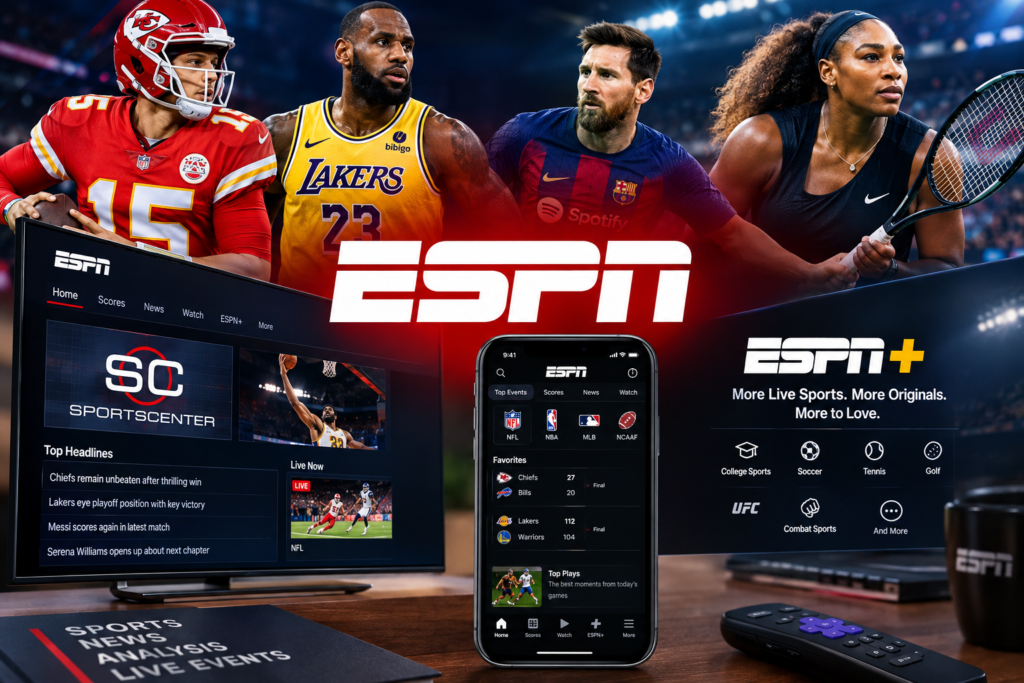
Introduction to ESPN
ESPN is one of the most recognizable names in sports media, and for many fans, the brand has become almost synonymous with following sports. Whether someone wants to check a live score, watch a major game, read breaking sports news, follow a favorite team, compare statistics, or catch up on analysis, ESPN has built an ecosystem designed around those everyday habits. What began as a television network has developed into a much broader digital and streaming destination.
The appeal of ESPN comes partly from its range. The platform covers major professional leagues, college sports, international competitions, studio programming, documentaries, analysis, and plenty of sports that might not receive the same attention elsewhere. Its website and app also make it possible for fans to move between scores, news, video, statistics, and live programming without constantly switching platforms.
Today, ESPN is more than a television channel. The ESPN ecosystem includes television networks, digital properties, streaming services, mobile applications, original programming, and specialized sports networks. The company’s current offerings include ESPN, ESPN2, ESPNU, ESPN Deportes, SEC Network, ACC Network, ESPN+, and additional services depending on the subscription or provider involved.
What Does ESPN Stand For?
ESPN originally stood for Entertainment and Sports Programming Network. The company launched in 1979, at a time when the idea of a dedicated television network focused almost entirely on sports was still unusual. The name reflected the network’s original mission, but it was eventually shortened simply to ESPN as the brand became more established.
According to ESPN’s own support information, the company adopted ESPN, LLC as its corporate name in 1985. The shorter name proved to be easier to recognize and eventually became one of the strongest brands in sports media. Over the decades, the letters ESPN became far more recognizable than the original expanded name.
The history behind the name is interesting because it shows how dramatically the business evolved. ESPN was initially centered on television broadcasting, while today’s ESPN experience combines television, streaming, mobile technology, websites, personalized content, social media, statistics, and interactive viewing.
The History and Growth of ESPN
ESPN’s early success came from identifying a simple but powerful opportunity: sports fans wanted more sports. Instead of treating sports as occasional programming, ESPN made athletics the central product. That strategy helped the network develop a dedicated audience that wanted sports coverage throughout the day.
Over time, ESPN expanded its programming to include major professional leagues, college athletics, international competitions, sports news, talk shows, documentaries, and analysis. Programs such as SportsCenter became important parts of the sports-viewing routine, while live events gave viewers a reason to return repeatedly.
The internet eventually changed the company just as dramatically as television had changed sports broadcasting. ESPN.com allowed fans to follow scores and news without waiting for television coverage. Later, smartphones and streaming created another shift, allowing ESPN to become something fans could carry with them rather than something they only watched in the living room.
ESPN as a Sports News Destination
One of ESPN’s biggest strengths is its sports news operation. Fans do not necessarily visit ESPN only when a game is being played. They may visit to find out about an injury, trade, coaching decision, lineup change, contract development, or major story surrounding a team or athlete.
The website organizes information across sports, leagues, teams, and personalities. That structure makes it easier for someone who follows several sports to move between topics. A football fan can check NFL coverage, while a basketball supporter can immediately move toward NBA stories or college basketball information.
The speed of sports news is another important factor. A major story can change the conversation around a team within minutes. ESPN’s digital presence is designed around that reality, giving users access to updates, articles, video segments, scores, and notifications rather than forcing them to wait for a scheduled television program.
ESPN and Live Sports
Live sports remain at the heart of ESPN’s identity. Fans often use ESPN to find out where a game is being broadcast, follow live scores, or watch an event through an available television or streaming subscription.
The modern ESPN ecosystem covers a broad range of sports. Depending on the subscription and current rights agreements, viewers can encounter NFL programming, college football, basketball, NHL coverage, soccer, tennis, golf, baseball, WWE, and many other competitions.
ESPN’s current streaming offerings are particularly broad. The company says its ESPN Unlimited plan includes ESPN’s major networks and services along with ESPN+, while ESPN Select focuses on ESPN+ content. This means viewers need to understand their subscription before assuming that every ESPN event is included in every plan.
Understanding the ESPN App
The ESPN app is one of the easiest ways for modern fans to interact with the brand. Instead of treating ESPN as only a television destination, the app combines scores, news, personalized information, alerts, video, and live viewing in one place.
Users can select favorite leagues, teams, and players so that the experience becomes more relevant to their interests. The app can also provide breaking-news notifications, personalized SportsCenter content, and information about where particular events can be watched.
Another useful feature is the ability to connect the app with compatible television devices. ESPN promotes interactive viewing features that can provide statistics, insights, key plays, and other information while a game is playing. Some supported plans and devices also provide multiview functionality for watching several games simultaneously.
ESPN Streaming Explained
Streaming has transformed how people consume sports, and ESPN has adapted heavily to this change. Instead of requiring every fan to watch through a traditional cable box, ESPN now offers multiple ways to access programming through digital subscriptions and participating television providers.
The important thing to understand is that ESPN streaming is not necessarily one single package. Access depends on the specific subscription, event, network, and provider. Someone with access to ESPN through a participating television provider may be able to authenticate inside the ESPN app, while another viewer may need an ESPN subscription.
The company currently describes ESPN Unlimited as its broader option, providing access to ESPN networks and services, while ESPN Select is focused on ESPN+ content. ESPN’s official information also notes that existing ESPN+ subscribers continue to receive ESPN+ content through the newer subscription structure.
What Is ESPN+?
ESPN+ was introduced as a streaming-focused extension of the ESPN brand. Rather than simply duplicating traditional television programming, it developed into a destination for additional live sports, international competitions, college events, combat sports, golf, tennis, soccer, original programming, and other content.
The service became particularly valuable for fans who wanted access to sports that did not always receive the same amount of television exposure. For dedicated sports followers, this could mean discovering competitions and events beyond the most prominent games shown on traditional networks.
The current ESPN structure places ESPN+ content within ESPN Select and ESPN Unlimited. ESPN states that ESPN Select consists entirely of ESPN+ content, while ESPN Unlimited includes ESPN’s broader collection of networks and services in addition to ESPN+.
ESPN Select vs. ESPN Unlimited
Understanding the difference between ESPN Select and ESPN Unlimited is important for anyone considering an ESPN subscription. ESPN Select is designed for people who primarily want ESPN+ content. It can be a more focused option for fans whose interests center on the sports and events available through ESPN+.
ESPN Unlimited is the broader package. ESPN says it includes ESPN, ESPN2, ESPNU, ESPNEWS, ESPN Deportes, SEC Network, ACC Network, ESPN+, ESPN on ABC, SEC Network+, ACC Network Extra, NFL Network, and CW Sports, although availability can depend on the provider through which the service is activated.
That distinction makes the choice fairly straightforward. A person who only needs ESPN+ programming may not need the broadest option, while a fan who wants access to the traditional ESPN networks plus ESPN+ has a stronger reason to consider Unlimited. The exact value depends on which sports the viewer follows and what other television subscriptions they already have.
ESPN and College Sports
College sports are a major part of ESPN’s identity. College football and basketball in particular generate enormous interest, and ESPN operates dedicated conference-focused networks that give fans much deeper coverage than a general sports channel could provide.
SEC Network and ACC Network are examples of ESPN’s approach to conference sports. These networks provide extensive coverage of their respective conferences, including live games, studio programming, analysis, and original content. ESPN currently says the two networks provide thousands of live events combined.
For college sports fans, this depth can be particularly valuable. Instead of only watching the biggest nationally televised games, supporters can follow conference schedules, regular-season competitions, tournaments, studio discussions, and other programming surrounding their favorite schools.
ESPN and Professional Sports
Professional sports are another central component of ESPN’s programming strategy. Football, basketball, hockey, baseball, soccer, and other major sports attract viewers who want both live events and the surrounding analysis.
Professional sports coverage also creates a natural cycle for ESPN’s digital products. A fan might begin by checking a score, read a game recap, watch highlights, follow an analyst’s reaction, and then return later for another live game. Each part of that process supports the larger ecosystem.
The value of this model is convenience. Sports fans do not always consume information in a predictable way. Sometimes they have thirty minutes to watch a game, sometimes they only want the score, and sometimes they want a detailed analysis of what happened. ESPN attempts to accommodate all of those habits.
ESPN SportsCenter
SportsCenter is one of the most recognizable programs associated with ESPN. Its basic concept is simple: gather the most important sports stories and present them through highlights, analysis, interviews, scores, and discussion.
The program has remained relevant because sports are constantly changing. A game can finish late at night, an athlete can make a major announcement, or a trade can reshape a team before the next scheduled broadcast. SportsCenter provides a way to organize those developments into a digestible presentation.
The broader SportsCenter brand has also moved beyond traditional television. ESPN’s digital ecosystem allows fans to receive personalized SportsCenter-style information, highlights, and breaking-news alerts through the app. ESPN specifically promotes a personalized SportsCenter experience as one of its current app features.
ESPN’s Original Programming
ESPN is not only about live games. Original programming has become a major part of the company’s identity, especially through documentaries and long-form storytelling.
The 30 for 30 documentary series is one of the best-known examples. These productions often explore the people, controversies, cultural moments, and behind-the-scenes stories that surround sports. That approach gives ESPN a way to appeal to viewers even when no live game is taking place.
Original programming also demonstrates why sports media can be about much more than scores. A championship can be remembered for decades, but the human story behind it may be just as compelling. ESPN’s documentary approach gives athletes, coaches, teams, and events room to be explored from different perspectives.
ESPN Fantasy and Interactive Features
Fantasy sports have changed how many fans watch professional sports. Instead of following only one team, fantasy players may monitor dozens of athletes across multiple games.
ESPN’s digital ecosystem supports this behavior by connecting sports information with fantasy-related features. Real-time statistics, player information, game updates, and news can all influence fantasy decisions.
This creates a more interactive relationship between the fan and the game. A viewer may care about a particular matchup because a fantasy player is involved, even when that game does not include their favorite real-world team. It is another example of how digital sports platforms can increase engagement.
ESPN Scores and Statistics
For many users, the most important part of ESPN is simply the score page. Sports fans frequently want quick information rather than a long article. They want to know who won, what the score is, how much time remains, and which players are performing well.
ESPN’s digital products are built to support that behavior. Scores can be followed across multiple leagues, while detailed statistics provide additional context for fans who want more than the final result.
Statistics have become particularly important in modern sports because fans increasingly use data to understand performance. A box score may tell one story, while advanced statistics and trends can reveal another. ESPN’s combination of news, scores, and statistical information helps bring these different pieces together.
ESPN and Mobile Sports Viewing
Mobile devices have changed sports consumption dramatically. Fans no longer need to be sitting in front of a television to follow a game or breaking story.
The ESPN app is designed for this mobile-first environment. Users can receive alerts, check scores, follow teams, read articles, and, where their subscription permits, watch live events. ESPN also supports connected devices and smart televisions, allowing the same ecosystem to extend beyond a phone.
This flexibility is especially useful for fans with busy schedules. Someone might check a score while commuting, read a story during a break, and then watch the rest of a game on a television later. Sports information can now follow the fan throughout the day.
Watching ESPN on Smart TVs and Streaming Devices
ESPN has expanded beyond conventional television by supporting a wide variety of connected devices. Its streaming information lists platforms such as Apple TV, Roku, Fire TV, Chromecast, LG smart TVs, Samsung smart TVs, Xbox, PlayStation, and other supported devices.
This matters because households increasingly use a mixture of streaming devices rather than one traditional cable setup. A sports service needs to work wherever the viewer watches television.
ESPN also supports interactive features on compatible devices. Depending on the subscription and platform, viewers can access live games, replays, statistics, multiview, and other features designed to make sports viewing more interactive.
How ESPN Has Adapted to Streaming
The transition from cable television to streaming has been one of the biggest changes in sports media. ESPN has responded by developing a more flexible subscription model rather than treating streaming as a secondary product.
This transition is important because sports fans have different needs. Some still have traditional television providers, while others rely almost entirely on streaming services. ESPN’s current model attempts to serve both groups.
The result is a broader digital ecosystem in which television access, streaming subscriptions, mobile applications, and connected devices work together. For viewers, that can provide greater flexibility, although it also means understanding exactly which package provides access to a particular event.
ESPN’s Role in Sports Culture
ESPN’s influence extends beyond broadcasting. Over several decades, the brand has helped shape the way sports fans talk about games, athletes, teams, controversies, and major moments.
Sports discussion has become part of everyday culture. A major performance can quickly become a topic across television, websites, social media, podcasts, and fan communities. ESPN participates in that conversation through reporting, analysis, debate programming, highlights, and commentary.
That influence comes with responsibility. Sports media has to balance entertainment with accuracy, especially when reporting breaking news. A fast story may attract attention, but reliable reporting is ultimately what builds long-term trust with an audience.
Why ESPN Remains Popular
One reason ESPN remains popular is its sheer breadth. A sports fan does not have to visit one place for football, another for basketball, and another for scores. ESPN attempts to provide a centralized sports experience.
Convenience is another major advantage. The ESPN app combines scores, news, alerts, live viewing, and personalized content. This makes it useful even when someone is not actively watching television.
Finally, ESPN benefits from familiarity. Generations of sports fans have grown up recognizing the brand, watching its programs, reading its website, and using its digital products. That accumulated recognition gives ESPN an advantage that newer sports platforms have to work hard to replicate.
The Future of ESPN
The future of ESPN will likely be increasingly digital, personalized, and interactive. Streaming is already a central part of the company’s strategy, while mobile applications continue to add features designed around individual preferences.
Personalization could become even more important. Rather than presenting the same homepage to everyone, sports platforms can increasingly prioritize a user’s favorite teams, leagues, players, and competitions.
Artificial intelligence, real-time statistics, interactive viewing, multiview experiences, and personalized alerts could also change the way fans consume sports. The goal will be to make the experience feel less like passive television viewing and more like an interactive sports environment.
Is ESPN Worth Using?
For sports fans, ESPN can be valuable even without purchasing the broadest subscription. The free digital experience provides useful access to scores, news, statistics, schedules, and other information, while paid options expand access to live programming and additional content.
The key is matching the service to personal viewing habits. Someone who mostly wants scores and news may not need a premium subscription. A viewer who watches multiple ESPN networks and wants ESPN+ content may find a broader plan more useful.
It is also worth checking the exact subscription details before signing up. ESPN’s current plans differ significantly in what they include, and television-provider packages can affect access. ESPN itself recommends checking provider availability when applicable.
Final Thoughts on ESPN
ESPN has evolved from a pioneering sports television network into a large sports-media ecosystem that combines broadcasting, streaming, digital journalism, mobile technology, statistics, entertainment, and original programming. That evolution explains why the ESPN name remains relevant even as the way people watch sports continues to change.
For fans, the biggest advantage is the range of options. Someone can use ESPN simply to check a score, while another viewer can spend an entire day moving between live games, analysis, documentaries, fantasy information, and breaking news.
The most important thing to remember is that ESPN is no longer just a television channel. It is a connected sports platform designed around the modern fan. With traditional networks, digital content, the ESPN app, and subscription-based streaming options working together, ESPN continues to occupy an important place in the sports media landscape.
YOU MAY HAVE MISSED