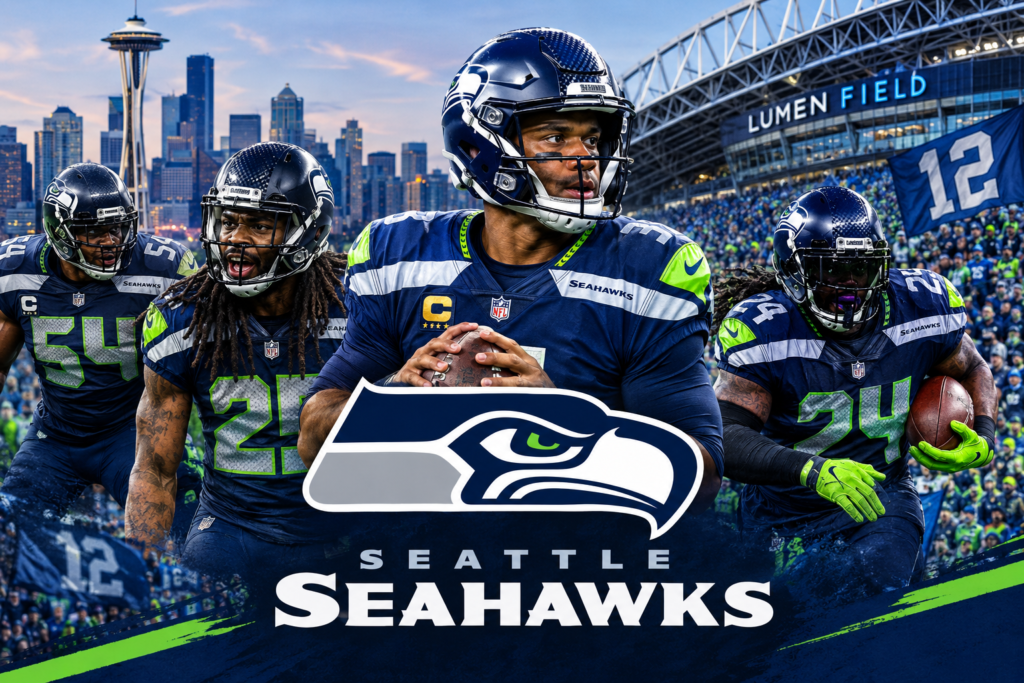
The Seahawks are much more than a professional football team based in Seattle. Over the years, they have developed one of the strongest identities in the NFL, combining an intense home-field advantage, passionate supporters, memorable players, aggressive defensive football, and a culture that feels deeply connected to the Pacific Northwest. Since entering the NFL in 1976, Seattle has experienced rebuilding years, dramatic playoff runs, heartbreaking defeats, legendary performances, and championship celebrations.
For fans, following the Seahawks is rarely just about checking the final score. The team has become part of Seattle’s sporting personality. The famous “12s” have helped create an atmosphere that opposing teams know they are going to experience before they even walk into the stadium. From the old Kingdome days to the modern Lumen Field era, the relationship between the team and its supporters has remained one of the defining characteristics of the franchise.
The Seahawks have also entered a particularly interesting chapter of their history. After decades of notable coaching eras and superstar players, Seattle has built another competitive team under head coach Mike Macdonald. The franchise won Super Bowl LX following the 2025 season, giving the organization its second Super Bowl championship. The victory added another major chapter to a history that already included the dominant 2013 championship team.
The Beginning of the Seahawks
The story of the Seahawks began before the team ever played an NFL game. Seattle had been pursuing major professional sports opportunities for years, and the NFL eventually awarded the city its 28th franchise in June 1974. The new team was scheduled to begin play in 1976, creating a professional football presence in the Pacific Northwest that would eventually become one of the region’s most recognizable sporting institutions.
Choosing the team’s name was itself a community event. More than 20,000 suggestions were submitted during the naming campaign, representing more than 1,700 different proposed names. “Seahawks” was ultimately selected, giving the franchise a name connected to the region’s coastal environment while also providing a distinctive identity that could work visually and culturally.
The first Seahawks season was understandably challenging. Expansion teams rarely arrive fully prepared to compete with established NFL organizations, and Seattle finished its inaugural 1976 campaign with a 2-12 record. The franchise improved quickly, however, posting winning records in both 1978 and 1979. That early progress gave fans reasons to believe that Seattle could eventually become more than just another expansion club.
From Expansion Team to NFL Contender
The Seahawks did not need decades to establish themselves as a competitive team. During the 1980s, Seattle began appearing in the postseason and developed a reputation for physical football. The franchise reached the AFC Championship Game for the first time following the 1983 season, an important milestone that demonstrated how quickly the organization had moved beyond its expansion beginnings.
One of the most important figures from that era was Steve Largent. The wide receiver became the face of the franchise and eventually one of the greatest players in NFL history. Largent spent his entire NFL career with Seattle and retired following the 1989 season as the league’s all-time leading receiver at the time. His career helped establish a tradition of elite pass catchers in Seattle.
The 1988 season brought another major milestone when Seattle captured its first division championship. The team was no longer simply an exciting young franchise trying to establish itself. It had become a legitimate postseason organization, and that competitive identity would remain important throughout later decades. The foundation created by players such as Largent helped establish the idea that Seattle could consistently compete with established NFL powers.
The Paul Allen Era Changed Everything
A major turning point arrived in 1997 when Paul Allen purchased the Seahawks. His ownership eventually helped stabilize the franchise and provided the resources and long-term vision necessary for Seattle to become a perennial contender. Allen’s influence extended well beyond simply owning the team; his tenure became closely associated with organizational stability and sustained competitive ambition.
Allen later hired Mike Holmgren as head coach, and that decision helped push the Seahawks toward another level. Holmgren brought extensive NFL experience and a strong offensive background, giving Seattle a clear football philosophy. Under his leadership, the franchise developed into a regular playoff participant and eventually captured multiple division titles.
The Allen era also helped create the environment for the franchise’s most successful period. According to the Seahawks’ historical timeline, Seattle reached the postseason 13 times during Allen’s ownership, won nine division titles, recorded nine seasons with at least 10 victories, and appeared in three Super Bowls. Most importantly, the organization finally won its first Lombardi Trophy.
The Rise of Pete Carroll and John Schneider
When Pete Carroll became Seattle’s head coach in 2010, the franchise entered another defining era. Carroll brought an energetic coaching style, while general manager John Schneider became responsible for constructing a roster capable of competing at the highest level. Their partnership became one of the most important leadership combinations in modern Seahawks history.
The roster they built was especially impressive on defense. Seattle developed a group that became known as the “Legion of Boom,” featuring stars such as Richard Sherman, Earl Thomas, Kam Chancellor, and other physical defenders. The defense played with confidence and aggression, and its identity became closely connected with the team’s success.
Seattle’s defense was so dominant that it led the NFL in scoring defense for four consecutive seasons from 2012 through 2015, according to the Seahawks’ historical record. During Carroll’s 14 seasons as head coach, Seattle reached the postseason 10 times, posted a winning record in 11 seasons, and won five NFC West titles.
The 2013 Seahawks and Super Bowl XLVIII
The 2013 Seahawks remain one of the most memorable teams in NFL history. Seattle’s defense was aggressive, fast, physical, and extremely confident. The team also possessed a strong running game and a quarterback capable of making plays outside the structure of the offense.
The season culminated in Super Bowl XLVIII against the Denver Broncos. Denver entered the game with one of the NFL’s most productive offenses, but Seattle’s defense completely controlled the matchup. The Seahawks won 43-8, producing one of the most decisive Super Bowl victories ever recorded.
That championship was especially meaningful because it represented the first Super Bowl victory in franchise history. Seattle had reached the Super Bowl before, including the 2005 season, but the 2013 team finally delivered the Lombardi Trophy. The victory transformed the Seahawks from a respected franchise into a championship organization.
Russell Wilson’s Importance to the Franchise
Russell Wilson became one of the most recognizable Seahawks players of the modern era. Drafted in 2012, Wilson quickly established himself as a quarterback capable of extending plays, avoiding pressure, and creating opportunities when the original play broke down.
His mobility and decision-making complemented Seattle’s defense and running game perfectly during the team’s championship period. Wilson was not asked to carry every game with massive passing numbers, but his ability to make crucial throws in important situations gave Seattle another weapon.
Wilson eventually became the franchise’s career leader in passing yardage. The Pro Football Hall of Fame lists his Seattle career total at 37,059 passing yards, illustrating how significant his contribution was over the course of his Seahawks tenure.
The 2014 Super Bowl and a Painful Ending
Seattle returned to the Super Bowl after the 2014 season, creating a rare opportunity to win championships in consecutive years. The Seahawks faced the New England Patriots in Super Bowl XLIX in a game that remains one of the most discussed endings in NFL history.
Seattle was in position to score late in the game, but an interception near the goal line ended the team’s championship hopes. The decision to throw rather than hand the ball to Marshawn Lynch became the subject of years of debate among fans, analysts, and football historians.
Although the defeat was painful, reaching consecutive Super Bowls demonstrated just how strong the Seahawks had become. The franchise was firmly established among the NFL’s elite, and the 2013 and 2014 seasons remain central to the team’s modern identity.
Marshawn Lynch and Beast Mode
Marshawn Lynch became one of the most iconic players associated with the Seahawks. His running style was powerful, physical, and unpredictable, and he developed the famous nickname “Beast Mode” because of the way he could break tackles and create yards after contact.
Lynch was especially effective in Seattle’s run-oriented offensive philosophy. Rather than relying entirely on passing, the Seahawks could use Lynch to control the clock, wear down defenses, and create explosive plays. His running style also fit perfectly with the team’s physical personality.
Even beyond statistics, Lynch became part of Seahawks culture. His personality, memorable interviews, and powerful running style made him one of the most recognizable figures of the team’s championship era. His legacy remains closely tied to Seattle football.
The Legion of Boom
The Legion of Boom represented the defensive personality of the Pete Carroll era. Richard Sherman became one of the league’s most famous cornerbacks, Earl Thomas established himself as an elite safety, and Kam Chancellor became known for his physical style of play.
What made the group special was not simply individual talent. The secondary played with a collective understanding of how Carroll wanted defensive football to be played. Communication, physical coverage, aggressive tackling, and confidence allowed the unit to control games.
The defense became so influential that the Seahawks’ championship identity was often discussed through the lens of the secondary. The Legion of Boom eventually broke apart as players moved on, but its impact on the franchise remained long after the original group stopped playing together.
The Meaning of the 12s
One of the most distinctive features of the Seahawks is the team’s fan culture. Seattle supporters are commonly known as the “12s,” a reference to the idea that the fans function as an additional member of the team.
The connection between the franchise and its supporters has produced some of the loudest environments in professional football. During the 2013 season, Seahawks fans twice set Guinness World Records for crowd noise at a sporting event. The relationship between the team and the fan base has therefore become part of the Seahawks’ competitive identity.
The number 12 has become so closely associated with Seattle that the franchise retired No. 12 in honor of its supporters. It is a simple concept, but it captures something important: Seahawks football is presented as a shared experience between players and the community.
Lumen Field and Home-Field Advantage
Lumen Field has become one of the most recognizable home venues in the NFL. Its location, design, and passionate crowds combine to create an atmosphere that can make communication difficult for visiting teams.
Home-field advantage is often discussed in terms of statistics, but the Seahawks’ environment is also psychological. Visiting players know that Seattle fans are going to be loud, particularly during crucial defensive situations. That expectation can influence communication and pre-snap organization.
The stadium is therefore more than a physical venue. It is part of the Seahawks identity. The noise, colors, traditions, and energy all contribute to the experience of attending a Seattle game.
Seattle’s Modern Football Identity
After the championship era began to fade, Seattle went through the natural transition that every successful NFL team eventually faces. Veteran stars departed, younger players took larger roles, and the organization had to determine what its next version of competitive football would look like.
Pete Carroll remained an important figure for many years, but eventually the franchise moved toward a new coaching direction. The transition required patience because rebuilding a championship-caliber organization involves much more than changing one position or replacing one coach.
The modern Seahawks have increasingly emphasized speed, versatility, defensive discipline, and roster development. The organization has continued looking for players who can fit a broader system rather than simply relying on individual stars.
Mike Macdonald’s New Era
Mike Macdonald represents one of the newest major chapters in Seahawks history. His defensive background and analytical approach provide Seattle with a different coaching identity from the Carroll era.
Macdonald’s arrival did not mean abandoning everything that had worked in Seattle. Instead, the organization could take elements of its traditional physical style and combine them with modern defensive concepts, adaptable personnel usage, and a more contemporary approach to game planning.
The results became significant during the 2025 season. Seattle won a franchise-record 14 regular-season games, captured the NFC West, and eventually won Super Bowl LX. Macdonald became one of the youngest head coaches to win a Super Bowl, while the organization demonstrated that it could successfully transition into another competitive era.
Sam Darnold and the Quarterback Position
Sam Darnold became an important part of Seattle’s latest championship story. After several seasons in different NFL environments, Darnold arrived in Seattle and delivered a highly productive campaign during the 2025 season.
He passed for 4,048 yards and 25 touchdowns during that championship season, according to the Pro Football Hall of Fame’s Seahawks history. Those numbers gave Seattle a productive passing attack while allowing the team to maintain its broader balance.
The 2026 season has also demonstrated why quarterback depth matters. Darnold suffered a glute injury early in the season, allowing Drew Lock to step in. Darnold was subsequently cleared to return for Week 3, illustrating how quickly an NFL season can change because of injuries.
Jaxon Smith-Njigba’s Emergence
Jaxon Smith-Njigba has become another major name in the current Seahawks era. The wide receiver developed into a central component of Seattle’s offense and produced an exceptional 2025 season.
Smith-Njigba accumulated 1,793 receiving yards during the championship campaign and was named the 2025 NFL Offensive Player of the Year. The award represented a major individual accomplishment and highlighted Seattle’s ability to develop young offensive talent.
His emergence is particularly important because modern NFL offenses often depend on having multiple reliable receiving options. A receiver who can consistently create separation, gain yards after the catch, and handle a significant target share can change how defenses approach an entire offense.
The Seahawks in 2026
The Seahawks entered the 2026 season as defending Super Bowl champions, which naturally brought increased expectations. Winning one championship is difficult, but remaining competitive after a title can be even more challenging because opponents prepare differently and expectations become much higher.
Seattle opened the regular season with a 13-10 victory over the New England Patriots before defeating the Arizona Cardinals 31-7 in Week 2. Those results gave the team a 2-0 start heading into its Week 3 matchup with Washington.
The 2026 season therefore represents a fascinating test. Seattle has already demonstrated that its new coaching structure can produce a championship, but maintaining that standard requires continued roster development, health, strong quarterback play, and the ability to adapt as opponents adjust.
Why the Seahawks Remain Popular
The Seahawks have an unusually strong combination of history, personality, and regional identity. Some teams are primarily known for a superstar quarterback or a specific championship season. Seattle has multiple generations of recognizable players and coaches who have contributed to the franchise’s identity.
The team also has a distinctive visual brand. The navy, green, and silver color combination is instantly recognizable, while the Seahawks logo has remained one of the NFL’s more memorable designs. Uniform changes and throwback releases continue to generate interest among longtime fans and newer supporters.
Most importantly, the Seahawks have created an emotional connection with their supporters. The 12s are not treated as passive spectators. They are presented as part of the team, and that idea has become one of the strongest branding elements in Seattle sports.
Famous Seahawks Players
Seattle’s history includes an impressive collection of football talent. Steve Largent is one of the foundational names, while players such as Walter Jones, Cortez Kennedy, Kenny Easley, Shaun Alexander, Russell Wilson, Richard Sherman, Earl Thomas, Kam Chancellor, and Marshawn Lynch helped define later eras.
The franchise has also been represented by players whose careers extended beyond Seattle. Several Seahawks-associated stars have earned recognition from the Pro Football Hall of Fame, reflecting the quality of talent that has passed through the organization.
The Seahawks’ official historical record includes retired numbers for Steve Largent, Walter Jones, Cortez Kennedy, Kenny Easley, and No. 12 for the fans. Those retirements demonstrate how the organization recognizes players and supporters who made lasting contributions to its identity.
The Importance of the NFC West
The Seahawks compete in the NFC West, one of the NFL’s most interesting divisions. The division has included long-standing rivalries with the San Francisco 49ers, Los Angeles Rams, and Arizona Cardinals.
Divisional games matter because teams face familiar opponents twice every regular season. Coaches and players learn each other’s tendencies, strengths, and weaknesses, which can make those games especially tactical.
For Seattle, the rivalry with San Francisco has been particularly intense. Both teams have experienced successful periods, and their matchups have often carried playoff implications. Winning the NFC West is therefore more than a regular-season accomplishment; it often serves as a gateway to a deeper postseason run.
The Future of Seattle Football
The Seahawks appear to have entered another promising phase. Winning Super Bowl LX gives the current organization credibility, while young players such as Jaxon Smith-Njigba provide a foundation for the offense.
The challenge now is sustainability. Championship teams cannot remain unchanged. Opponents study successful systems, veteran contracts create difficult roster decisions, and injuries can dramatically alter a season.
Seattle’s ability to continue developing younger players may ultimately determine whether this current era becomes a short championship window or the beginning of another long period of contention. The organization’s history suggests that Seattle is capable of reinventing itself when necessary.
What Makes the Seahawks Different?
The Seahawks have always had something distinctive about them. The franchise began as an expansion team, moved between conferences, experienced ownership changes, developed legendary players, endured rebuilding periods, and eventually became a Super Bowl champion.
Their greatest strength may be the connection between football and community. The 12s, the stadium atmosphere, the Pacific Northwest setting, and the team’s distinctive identity make Seattle feel different from many other NFL markets.
That identity has survived coaching changes and roster turnover. From Steve Largent to Russell Wilson, from the Legion of Boom to the current generation, the names have changed while the underlying passion has remained.
Final Thoughts on the Seahawks
The Seahawks are a franchise with a history that continues to evolve. Their story includes humble expansion beginnings, early struggles, legendary receivers, powerful running backs, dominant defenses, dramatic Super Bowl appearances, painful defeats, and championship celebrations.
Seattle’s first Super Bowl victory in 2013 established the franchise as a true NFL powerhouse, while the Super Bowl LX championship following the 2025 season proved that the organization could build another championship team in a new era. The combination of Mike Macdonald’s coaching, Sam Darnold’s quarterback play, Jaxon Smith-Njigba’s emergence, and a strong roster has given the franchise another exciting foundation.
For longtime supporters, the Seahawks represent decades of memories. For newer fans, the current team offers a fresh reason to become invested. Either way, Seattle football remains closely tied to its fans, its home stadium, and the distinctive competitive personality that has developed since 1976.
The most interesting part of the Seahawks story is that it is clearly not finished. The franchise has already reinvented itself multiple times, and another generation of players is now carrying the identity forward. If Seattle can maintain its current trajectory, the Seahawks could remain one of the NFL’s most fascinating teams for years to come.
YOU MAY HAVE MISSED