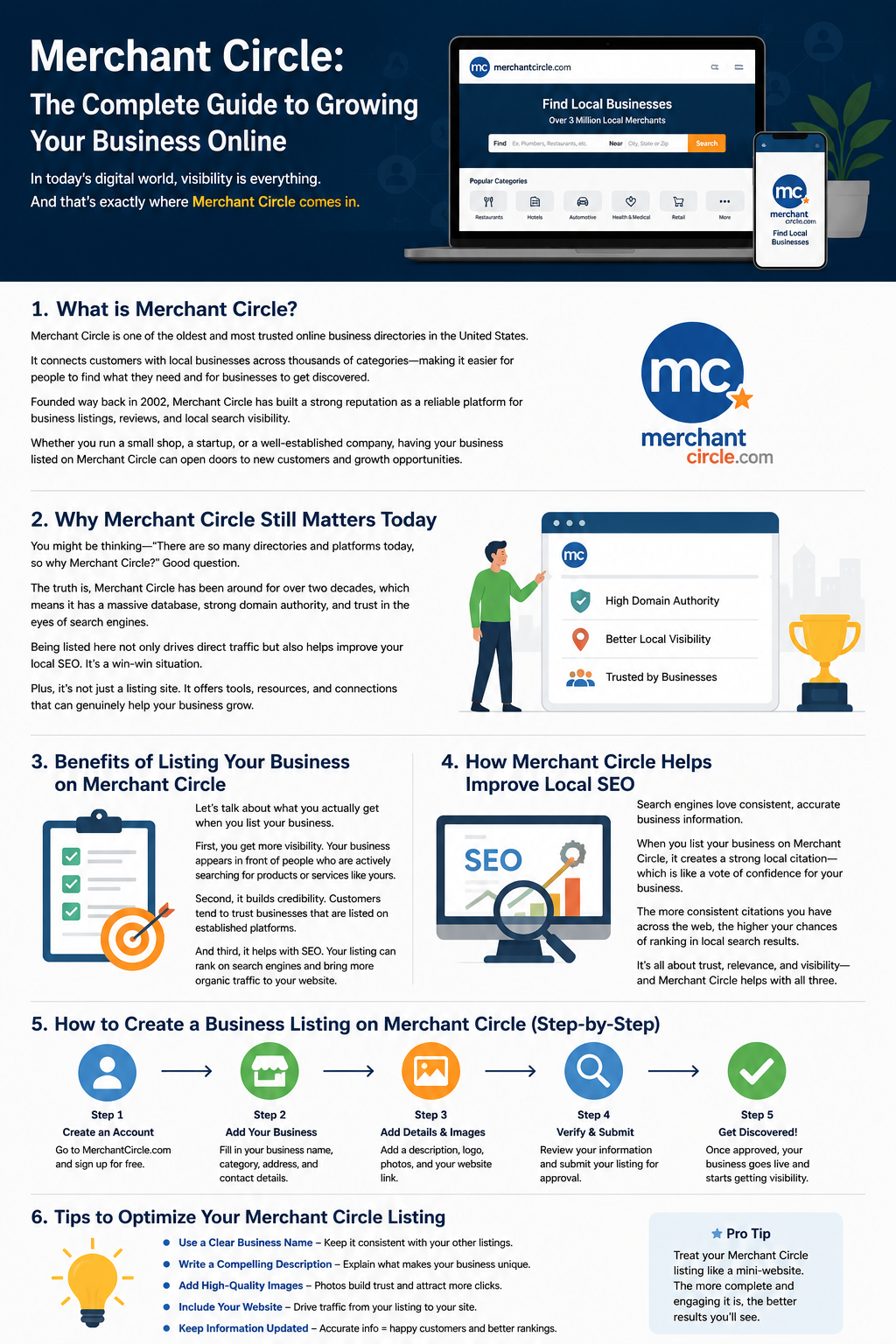
MerchantCircle is a name that has been around in the local-business internet space for years, but many people still wonder what it actually does, how it works, and whether it is useful for a modern small business. At its core, MerchantCircle is an online platform built around local businesses. It helps consumers discover merchants while giving business owners tools to create an online presence, communicate with potential customers, manage reputation, publish content, promote offers, and improve visibility.
The idea behind MerchantCircle is fairly straightforward: local businesses need to be found, and consumers need an easier way to find trustworthy businesses in their communities. Instead of treating local business discovery as nothing more than a list of phone numbers and addresses, the platform combines business listings with reviews, recommendations, content, promotions, and networking features. MerchantCircle describes itself as an online business directory and social network for local businesses.
For small businesses, that basic concept can still be valuable. A plumber, contractor, salon, mechanic, accountant, real estate professional, restaurant, educator, or other local service provider can benefit from having accurate business information available online. The real opportunity, however, comes from treating a directory profile as part of a broader marketing strategy rather than simply creating a listing and forgetting about it.
This guide takes a detailed look at MerchantCircle, including what it is, how it works, why local visibility matters, how businesses can build stronger profiles, how reviews influence customer confidence, how content can support discovery, and how to think about free versus premium options. It also explains common mistakes and offers practical ideas for getting more value from a local business listing.
What Is MerchantCircle?
MerchantCircle is an online platform designed to connect local businesses with consumers searching for products and services. The company says it was founded in 2005 and announced in June 2006. Its original concept centered on bringing local business owners together online while helping consumers discover merchants in their communities.
The platform operates differently from a simple static directory. A business profile can contain information such as the company’s name, location, contact details, services, photos, customer ratings, reviews, and other business information. Depending on the available features and account level, merchants can also use promotional and content tools to communicate with potential customers.
For consumers, this creates a more useful discovery experience than simply seeing a business name and telephone number. Someone searching for a contractor, automotive service, professional service, home improvement company, educational provider, or another local business can potentially learn more about the company before making contact.
MerchantCircle also positions itself as a network rather than only a directory. Its historical features have included connections between merchants, local recommendations, questions and answers, coupons, blogs, newsletters, and other ways of engaging with a local community. The goal is to make the relationship between a business and its surrounding market more interactive.
The Main Purpose Behind MerchantCircle
The easiest way to understand MerchantCircle is to look at the problem it attempts to solve. Local businesses often have excellent products or services but struggle to get noticed online. A company may have satisfied customers and years of experience, yet a potential customer searching online may never discover it if the business has a weak digital presence.
That is where local directories can become useful. They provide another location where a company’s basic information can be presented to people who are actively searching for something. MerchantCircle specifically focuses on local merchants and says its purpose is to help consumers find qualified businesses while helping merchants connect with customers.
The second problem is trust. Finding a business is only the first step. Consumers usually want to know whether the company is legitimate, experienced, responsive, and capable of delivering what it promises. Business descriptions, reviews, photographs, ratings, and answers to customer questions can help provide that additional context.
The third problem is marketing consistency. Small businesses often do not have a large marketing department. A local owner may be responsible for sales, operations, customer service, accounting, hiring, and marketing at the same time. Platforms that bring several promotional and reputation-management tools together can therefore be useful because they reduce some of the complexity involved in maintaining an online presence.
How MerchantCircle Works for Consumers
From a consumer’s perspective, MerchantCircle is primarily a local discovery resource. A visitor can search for a type of business and a location, then explore businesses that match the search. The platform currently organizes businesses across categories such as automotive services, home and garden, legal and financial services, education, professional services, and real estate.
The consumer experience is not limited to finding contact information. Business profiles can provide additional details that help someone decide whether a company deserves further consideration. Reviews and ratings can offer insight into customer experiences, while descriptions and photographs can give visitors a better understanding of what a business provides.
Another interesting aspect of MerchantCircle is its emphasis on local knowledge. The platform has offered features through which consumers can ask questions and receive answers from local merchants. That approach makes sense because business owners often have practical knowledge that cannot easily be found in a generic search result.
For example, someone might not know what type of roofing material is appropriate for a particular climate or how often a vehicle needs a specific service. A local professional can potentially provide a useful answer. MerchantCircle’s Answers guidelines specifically describe the service as a way for consumers to ask local merchants questions and benefit from their knowledge and experience.
How MerchantCircle Works for Businesses
For businesses, MerchantCircle is essentially a combination of local directory exposure, profile management, reputation tools, promotional features, and networking opportunities. A merchant can claim or create a listing and then improve the information associated with the business.
The current MerchantCircle business page promotes a free basic listing. According to the platform, businesses can use the basic listing to make information accurate and visible, edit business details, monitor and respond to reviews, and access preferred rates on certain MerchantCircle products.
The platform also offers a premium listing option. Its current business page lists a premium plan at $30 per month, with the page noting a $40 comparison price, although pricing and promotional terms can change. Features presented for the premium listing include greater visibility, up to five locations, review and rating presentation, preferred ranking in local searches, a verified badge, and removal of competitor advertising from the listing.
The important point is that businesses do not necessarily need to pay before they can benefit from having a presence. A free, complete, accurate listing can be a reasonable starting point, particularly for a small business that is still evaluating the platform.
Why Local Business Listings Still Matter
It is easy to assume that local directories are outdated because search engines and social media dominate online discovery. In reality, local business information remains important because customers often search with strong local intent.
Someone searching for a nearby electrician, dentist, mechanic, roofer, accountant, cleaning service, or real estate professional is not simply looking for information. They may be looking for someone they can call, visit, or hire. That means accurate business information has practical value.
A local listing also gives a business another place where its identity can be established. Name, address, phone number, category, service description, website, operating hours, photographs, and reviews all contribute to how customers understand the business.
MerchantCircle itself emphasizes online visibility and says that businesses can use its platform to create an online presence and connect with consumers searching for services.
The key is not to assume that one directory will automatically produce a flood of customers. A listing works best as one piece of a broader local marketing strategy that can include a website, search visibility, social media, customer reviews, referrals, advertising, and community involvement.
Creating or Claiming a MerchantCircle Listing
One of the most important steps for a business is making sure its listing actually represents the business accurately. MerchantCircle says it has created listings for millions of small businesses and notes that a business may already be present in the directory.
If a listing already exists, claiming it can be more useful than creating a duplicate profile. A claimed profile gives the business greater control over the information customers see and provides an opportunity to correct outdated details.
The first things to check should be the business name, address, telephone number, website, category, hours, and service description. Even a small mistake can create unnecessary friction. If customers call an outdated number or arrive at an old location, the listing has failed at one of its most basic jobs.
After the essential details are correct, the business can move toward richer information. Adding useful descriptions, photographs, service details, offers, and customer-focused content can make a listing more informative and persuasive.
Why Accurate Business Information Is Essential
Accuracy may sound boring, but it is one of the most important parts of local digital marketing. Customers expect a business listing to tell them how to contact the company and where to find it.
Imagine someone searches for an emergency repair service late in the evening. They find a listing with an incorrect telephone number. Even if the company is excellent, the customer may simply choose another provider. The business has lost an opportunity before the customer ever reaches a salesperson.
MerchantCircle’s reputation resources have historically placed significant importance on accurate contact information, along with reviews and content. Its help materials describe reputation measurement as incorporating information such as contact details, online reviews, ratings, and business-created content.
This is why businesses should review their listings regularly. Changes to phone numbers, locations, operating hours, websites, service areas, and staff should be reflected online as quickly as practical.
Building a Strong Business Profile
A good MerchantCircle profile should answer the basic questions a potential customer has before making contact. What does the company do? Where does it operate? Who does it serve? Why should someone consider it? How can the customer reach it?
The description should be clear rather than stuffed with keywords. A local customer does not want to read a paragraph that repeats the same city and service phrase twenty times. They want useful information.
A stronger description might explain the company’s specialty, experience, service area, and approach to customers. For example, a remodeling company could describe the types of renovation projects it handles, the areas it serves, and what customers can expect during the process.
Photographs can also improve the profile. A professional-looking photo of the storefront, team, completed projects, equipment, or products can make the business feel more real. For service businesses that customers may never visit before hiring, visual evidence can be especially useful.
The Importance of Categories
Categories help connect a business with relevant searches. Choosing the most appropriate category is therefore more than a minor administrative task.
A business should select the category that most accurately describes its primary service. If a company specializes in residential roofing, for example, it should not try to position itself primarily as a general home business simply because the broader category contains more potential customers.
Relevance is generally more valuable than being associated with every possible category. Customers who discover a company through a relevant category are more likely to understand what the company actually does.
Businesses should also make sure their descriptions naturally explain secondary services. If a company offers roofing, gutter installation, and roof inspections, those services can be described clearly without turning the profile into a pile of repetitive search terms.
MerchantCircle and Local SEO
Local SEO is the process of improving a business’s visibility when people search for products or services in a particular geographic area. MerchantCircle can fit into that broader strategy because it provides a structured location-based business profile.
MerchantCircle has historically promoted the idea that information and content added to a listing can contribute to visibility in search results.
However, businesses should avoid treating a directory profile as a magic SEO button. Search visibility depends on many factors, and no single directory can guarantee a particular ranking.
A smarter approach is consistency. The business should use accurate information across its important online profiles, maintain a strong website, publish genuinely useful content, collect authentic reviews, and make sure customers can easily contact it.
Using MerchantCircle for Reputation Management
Reputation management is another major reason businesses may pay attention to MerchantCircle. Online reviews can influence whether a potential customer decides to call, visit, request a quote, or continue searching.
MerchantCircle provides businesses with tools for monitoring and responding to reviews. Its help documentation explains that ratings and written reviews appear on business listings and can be managed from the merchant dashboard.
The right response to reviews is not to chase a perfect score at all costs. A healthier strategy is to create an environment where genuine customers feel comfortable sharing honest experiences.
Positive reviews can reinforce strengths, while negative reviews can reveal areas that need improvement. A professional response to criticism can sometimes be more persuasive than pretending every customer has been delighted.
How to Respond to Positive Reviews
Positive reviews deserve more than a generic “Thank you.” A thoughtful response can show that the business actually reads what customers write.
For example, if a customer praises the staff for explaining a repair clearly, the business can thank them and mention that clear communication is important to its service philosophy. That feels more personal than copying the same sentence beneath every review.
Responses can also reinforce useful brand characteristics. A restaurant might thank a customer for mentioning hospitality, while a contractor might appreciate a comment about finishing a project on schedule.
The goal is not to turn every review response into an advertisement. It is to demonstrate attentiveness and professionalism.
How to Handle Negative Reviews
Negative reviews are unavoidable for many businesses. Even excellent companies eventually encounter an unhappy customer, a misunderstanding, a delayed project, or a situation where expectations were different.
The worst response is usually an emotional argument. A business owner may know details the reviewer has left out, but publicly attacking the customer can make the company look defensive.
A better response is calm and concise. Acknowledge the concern, explain that the business takes customer feedback seriously, and invite the customer to continue the conversation privately when appropriate. If the company genuinely made a mistake, accepting responsibility can be powerful.
The response should also be written for future readers. A negative review may be written by one person, but dozens of potential customers may read the exchange later. The real audience is often much larger than the reviewer.
MerchantCircle Reviews and Customer Trust
Reviews work partly because customers want evidence from people who have already interacted with a business. A business can say that it provides excellent service, but an independent customer describing an actual experience may carry more weight.
This is why review quantity, quality, recency, and authenticity all matter. Ten detailed reviews can sometimes tell a prospective customer more than a single five-star rating.
Businesses should never build their strategy around manipulating reviews. The better long-term approach is to deliver good service and make it easy for satisfied customers to leave honest feedback.
MerchantCircle’s platform includes both star ratings and written reviews, giving consumers different ways to express their experiences.
Using Photos to Make a Listing More Persuasive
Photos are one of the easiest ways to make a business profile feel less generic. A listing containing only text may technically provide information, but photographs can create immediate context.
A restaurant might show its dining area, signature dishes, staff, and exterior. A landscaping company might display completed gardens and outdoor projects. An automotive business could show its workshop, technicians, and finished repairs.
The photographs do not need to look like a national advertising campaign. They need to be clear, relevant, current, and authentic.
Businesses should also avoid using random stock photos when real images are available. Customers generally benefit more from seeing the actual business, actual team, actual products, and actual work.
Using Content to Stay Visible
MerchantCircle has historically provided tools for blogs, newsletters, coupons, and other forms of business content.
Content can be useful because customers often have questions before they are ready to buy. A company that answers those questions can demonstrate expertise without making every interaction feel like a sales pitch.
A plumber could publish an article about signs of a leaking water heater. A roofing company could explain how homeowners can recognize storm damage. An accountant could discuss common tax preparation mistakes. A fitness professional could explain how beginners can establish a sustainable routine.
The strongest content usually begins with a real customer question. Instead of asking, “What keyword should I write about?” a business can ask, “What are customers repeatedly asking me?”
That shift tends to produce more useful content.
MerchantCircle Coupons and Promotions
Promotional tools can be useful when a business has a genuine offer that gives customers a reason to act. MerchantCircle has historically included coupons and deals among its local marketing features.
A good coupon should be specific. “Special savings available now” is vague, while “10% off your first service appointment this month” gives the customer a clear reason to pay attention.
Promotions can also be used strategically rather than permanently. A business might use an offer during a slow season, promote a new service, or encourage first-time customers to try the company.
The important thing is to make sure the offer is financially sensible. Generating customers at a loss is not successful marketing.
MerchantCircle as a Networking Platform
One of the distinctive aspects of MerchantCircle is its emphasis on connections between businesses. Local businesses often depend on referrals, partnerships, suppliers, contractors, and complementary service providers.
A wedding photographer may work with venues, florists, caterers, DJs, and event planners. A real estate professional may interact with mortgage specialists, inspectors, contractors, movers, and insurance professionals.
These relationships can generate opportunities that advertising alone cannot create. A trusted business partner may recommend another company because they have personally seen its work.
MerchantCircle has promoted networking and merchant connections as part of its local-business model, including tools for building relationships with other merchants.
Why Referral Networks Matter
Referrals are powerful because they transfer trust. If a customer already trusts a business owner and that owner recommends another company, the second company starts the conversation with a credibility advantage.
Of course, referrals should be based on real quality. Sending customers to an unreliable partner can damage the reputation of the business making the recommendation.
Local businesses can therefore use MerchantCircle networking as an opportunity to identify complementary companies and build professional relationships. The objective should not be collecting hundreds of meaningless connections.
Ten strong local relationships can be more valuable than hundreds of passive contacts.
MerchantCircle for Service-Based Businesses
Service businesses are particularly suited to local directory marketing because customers frequently search by service and location.
Think about electricians, plumbers, HVAC technicians, roofers, cleaners, landscapers, mechanics, contractors, tutors, photographers, legal professionals, accountants, and similar businesses. Their customers usually care about proximity, reputation, availability, pricing, expertise, and responsiveness.
A well-built MerchantCircle listing can provide some of the information needed during that evaluation process.
However, service businesses should make sure their profiles explain exactly what they do. “Home services” is much less informative than a clear description of plumbing repair, drain cleaning, water heater installation, or emergency plumbing services.
MerchantCircle for Professional Services
Professional service providers can also benefit from local visibility. Attorneys, accountants, consultants, real estate professionals, financial service providers, educators, and other professionals often depend heavily on trust.
For these businesses, credibility is especially important. A profile should explain experience and specialties without making exaggerated claims.
Professional photographs, clear service descriptions, accurate contact information, useful educational content, and authentic customer feedback can all help a potential client understand what the business offers.
Professionals should also remember that customers may be comparing several providers. A profile that answers common questions before the first phone call can make the initial conversation much easier.
MerchantCircle for Home Improvement Businesses
Home improvement is one of the clearest examples of a category where online reputation matters. Customers may be preparing to spend thousands of dollars on roofing, remodeling, flooring, windows, landscaping, kitchens, bathrooms, or other projects.
Before choosing a contractor, many people want to see evidence of previous work. This makes photographs, descriptions, reviews, and clear service information especially valuable.
A contractor’s MerchantCircle profile should therefore focus on proof rather than empty marketing language. Completed project photographs, explanations of specialties, service areas, and customer experiences can make the profile more useful.
The same principle applies to nearly every high-consideration local service: show potential customers what working with the company actually looks like.
MerchantCircle for Automotive Businesses
Automotive businesses operate in another category where local search and trust are closely connected. Customers may need repairs, maintenance, inspections, tires, body work, detailing, or other services.
A strong profile can help customers understand the shop’s specialties and location before they make contact.
Automotive businesses can also use educational content effectively. Articles about warning lights, routine maintenance, brake symptoms, tire care, or seasonal vehicle preparation can demonstrate expertise.
The goal is not necessarily to turn every article into a sales pitch. Useful information can build familiarity, and familiarity can make a customer more comfortable choosing the business when a service is actually needed.
MerchantCircle and the Customer Journey
It helps to think of local marketing as a journey rather than a single click.
First, a customer realizes there is a problem or need. Next, they search for possible solutions. Then they compare businesses. After that, they may check reviews, visit websites, look at photos, compare prices, ask questions, and finally contact one or more companies.
MerchantCircle can potentially participate in several stages of that process. A business listing can support discovery, reviews can support evaluation, content can answer questions, and contact information can help convert interest into an inquiry.
This is why businesses should not measure a listing only by direct clicks. The broader value may be helping a customer recognize and evaluate the company before contacting it through another channel.
Free Versus Premium MerchantCircle Options
MerchantCircle currently promotes both free and premium business listing options. The free listing is positioned as a way to establish an online presence and manage core business information.
The premium listing adds features intended to increase visibility and control, including preferred placement, additional locations, a verified badge, review presentation, and removal of competitor advertising from the business listing.
Whether premium is worthwhile depends entirely on the individual business. A company operating in a highly competitive market may find additional visibility useful, while a business in a small market may be perfectly satisfied with a complete free listing.
The right decision should come from measurable results. If a paid feature generates enough qualified inquiries to justify its cost, it can make sense. If it does not, the business should reconsider the investment.
How to Decide Whether Premium Is Worth It
The first question should be simple: what is one new customer worth to the business?
Suppose a company makes a healthy profit from every new customer and the premium listing generates several qualified leads each month. The subscription may be reasonable.
On the other hand, if the business cannot identify meaningful inquiries from the platform after a reasonable testing period, paying for higher placement may not be the best use of the marketing budget.
Businesses should also consider customer lifetime value. A single customer may purchase repeatedly or refer other people. In that case, the value of a successful acquisition can be much higher than the revenue from the first transaction.
The important thing is to measure rather than guess.
Common MerchantCircle Mistakes
One common mistake is creating a profile and never updating it. A stale listing can become a liability if hours, services, addresses, or telephone numbers change.
Another mistake is writing a description that is packed with keywords but provides little useful information. Customers can recognize when content has been written for algorithms rather than humans.
A third mistake is ignoring reviews. Whether the review is positive or negative, silence can make the business appear disconnected.
Another problem is inconsistent information. If the business has different names, phone numbers, addresses, or hours across multiple online platforms, customers may become confused.
Finally, some businesses expect immediate results from a single directory. Local marketing generally works better when multiple channels reinforce one another.
Avoiding Keyword Stuffing
Keyword stuffing is an outdated approach to online marketing. Repeating a phrase again and again does not automatically make a profile more useful.
MerchantCircle’s own community guidelines specifically warn against spam and keyword stuffing in its Answers community.
Instead, businesses should use natural language. If a company is a residential roofing contractor in a particular area, it can say that clearly once or twice and then focus on explaining its services.
Good SEO content should still sound like something a real person would say.
How Often Should a Business Update Its Profile?
There is no universal number of updates that guarantees success. What matters more is keeping information accurate and adding useful material when there is something worthwhile to share.
Essential information should be updated immediately when it changes. A new address, telephone number, operating schedule, website, or service should not wait for a monthly marketing routine.
Content can be added when the business has something genuinely useful to say. Seasonal maintenance advice, new services, customer questions, project highlights, promotions, and community activities can all provide natural opportunities.
Consistency matters, but quality matters more than producing content simply to fill a calendar.
Using MerchantCircle Alongside a Website
A MerchantCircle listing should not replace a company’s own website. Instead, the two can complement each other.
The listing can provide local discovery and a concise overview, while the website can provide deeper information about services, pricing, portfolios, team members, FAQs, booking systems, and company policies.
A customer might discover a business through a directory and then visit the company’s website before making contact. If the website is outdated or difficult to use, the business may lose the customer despite having a good listing.
The best strategy is therefore to make every digital touchpoint reinforce the same brand identity and business information.
MerchantCircle and Social Media
Social media serves a different purpose from a business directory, but the channels can support each other.
Social platforms are often useful for ongoing community engagement, behind-the-scenes content, announcements, short videos, and direct interaction. A directory profile is more focused on structured business discovery and information.
A local business can therefore use social media to build familiarity while using directory profiles to make its essential information easier to discover.
The exact mix depends on the industry. A visual business may gain substantial value from social platforms, while a professional service company may place more emphasis on educational content, search visibility, reviews, and referrals.
Measuring Results From MerchantCircle
Marketing becomes much easier to manage when results are measured. Businesses should decide what success means before spending money.
Possible measurements include profile visits, website visits, phone inquiries, quote requests, appointment requests, new customers, and revenue associated with leads.
It is also useful to ask new customers how they found the business. A simple question such as “How did you hear about us?” can reveal whether a directory listing is contributing to customer acquisition.
Businesses should avoid focusing only on vanity numbers. A thousand profile views may sound impressive, but ten qualified inquiries could be much more valuable.
MerchantCircle and Lead Generation
MerchantCircle has historically promoted lead-generation tools, including its LeadStore, which it describes as a way of delivering customers who are actively searching for services to businesses.
Lead generation can be particularly useful for businesses that depend on inquiries and quotes. Contractors, home service providers, consultants, and other service businesses often need a steady stream of prospects rather than simple website traffic.
But leads should always be evaluated for quality. A large number of irrelevant or low-intent inquiries can create more work without producing revenue.
The best lead is one that matches the business’s service, location, budget range, and ability to serve the customer.
Building Trust Through Expertise
One of the most underrated marketing strategies for local businesses is simply demonstrating expertise.
Customers often do not know which provider is genuinely knowledgeable. A company can claim to be experienced, but educational content gives customers a chance to see how the business thinks.
A contractor who explains project planning clearly can appear more trustworthy. An auto professional who explains a vehicle problem in plain English can demonstrate knowledge. An accountant who provides useful financial education can make complex topics less intimidating.
MerchantCircle’s educational and content-oriented features provide opportunities for businesses to communicate this kind of expertise.
MerchantCircle and Local Community Engagement
Local businesses are part of communities, not just search results. Customers often prefer companies that feel connected to the places where they live and work.
Businesses can highlight community involvement, local events, partnerships, charitable activities, sponsorships, and neighborhood projects when appropriate.
This kind of content should be genuine. Customers can usually tell the difference between meaningful community involvement and marketing that simply tries to borrow a local image.
A strong local reputation develops from repeated positive interactions, not from a single promotional campaign.
How Consumers Can Use MerchantCircle Effectively
Consumers should treat MerchantCircle as one source of information rather than the only source. A listing can help identify businesses, but customers should still evaluate important details independently.
Look at the business description, contact information, location, reviews, photos, website, and available service information. If the purchase is expensive or important, consider contacting several providers.
Pay attention to patterns rather than one isolated review. A single complaint does not necessarily tell the entire story, just as one enthusiastic review does not guarantee perfection.
For major services, customers should also verify licenses, certifications, insurance, warranties, pricing, and other requirements that may apply to the particular industry.
How Businesses Can Stand Out Without Overdoing It
Standing out does not require excessive advertising language. Often, specificity is enough.
Instead of saying “We are the best company in town,” explain what the company actually does well. Describe the types of customers served, common problems solved, areas covered, and what the service process looks like.
Real photographs can help. Detailed reviews can help. Helpful articles can help. Prompt responses can help.
In other words, businesses stand out by reducing uncertainty. The easier it is for a potential customer to understand the company, the easier it becomes to decide whether contacting that company makes sense.
MerchantCircle and Small Business Marketing Budgets
Small businesses usually cannot spend unlimited amounts on marketing. Every subscription and advertising campaign needs to earn its place in the budget.
This makes free tools especially attractive during the early stages of growth. A business can establish its profile, improve its information, collect authentic reviews, and see whether the platform produces meaningful engagement before committing to additional spending.
Paid visibility should be evaluated like any other advertising expense. The question is not whether the feature sounds useful. The question is whether it produces enough business to justify the cost.
That mindset helps prevent small businesses from spending money simply because a marketing platform promises exposure.
Why Consistency Across Directories Matters
MerchantCircle is only one part of the online ecosystem. Businesses may also appear on search engines, map services, social networks, industry directories, review platforms, and other local websites.
Consistency across these sources matters because customers should not have to figure out which version is correct.
The business name should be consistent. Contact details should be consistent. Locations and hours should be kept current.
A business should periodically audit its online presence and fix important errors. This process can be tedious, but it protects customers from confusion and strengthens the overall digital presence.
MerchantCircle for Multi-Location Businesses
Businesses with multiple locations have an additional challenge: each branch needs accurate information.
A customer searching for a location-specific service wants to know which branch is closest, when it is open, and how to contact it.
MerchantCircle’s current premium listing information says businesses can add up to five locations.
For multi-location companies, each location should be treated as a real customer-facing entity rather than simply copying the same content everywhere. Local details, photographs, hours, services, and contact information should reflect the individual location.
The Role of Customer Service
Marketing can attract someone to a business, but customer service determines what happens next.
A beautiful profile cannot compensate for unanswered calls, confusing pricing, missed appointments, poor communication, or unreliable service.
This is especially important because online reviews can expose gaps between marketing promises and real experiences.
Businesses should therefore view MerchantCircle as part of the customer experience rather than a separate marketing activity. The promises made online should match what customers experience offline.
MerchantCircle as a Long-Term Marketing Asset
The most useful way to think about a business directory profile is as a long-term digital asset.
A profile can continue working after it has been created, especially when it contains accurate information, useful content, strong reviews, and current photographs.
That does not mean businesses can ignore it. Like a website, a profile becomes more useful when it is maintained.
Over time, a collection of customer feedback, educational content, photographs, and business information can create a stronger representation of the company than a basic listing ever could.
Is MerchantCircle Still Useful Today?
MerchantCircle remains active as a local business platform and currently promotes free listings, premium visibility options, reviews, business content, promotions, and local discovery. Its homepage also continues to publish business and home-improvement-related content and invites local merchants to establish free listings.
Whether it is useful for a particular business depends on the business itself. A local company that wants additional online exposure may find value in maintaining a complete profile.
The most sensible approach is to test it rather than assume it will either transform the business or provide no value at all.
Businesses should establish a strong profile, keep it updated, monitor engagement, track leads, and compare the results with other marketing channels.
Advantages of MerchantCircle
One advantage is accessibility. The platform offers a free listing option, which gives small businesses a low-cost way to establish another online presence.
Another advantage is the combination of features. Businesses can potentially use listing information, reviews, content, promotions, and networking tools within the same ecosystem.
The local focus is another positive. Businesses that depend primarily on customers in a specific geographic area can benefit from platforms designed around local discovery.
Finally, MerchantCircle’s educational resources provide guidance for businesses that are still learning how online marketing works. Its MerchantCircle University includes FAQs, how-to guides, forums, and educational material about marketing tools.
Potential Limitations to Consider
No directory should be treated as a guaranteed customer-generation machine. Competition, location, category, profile quality, consumer behavior, and many other factors influence results.
Another limitation is that businesses have limited control over how customers behave. A profile can provide excellent information, but customers may still choose a competitor.
There is also the ongoing work of keeping information accurate. A directory profile that is abandoned can become outdated.
Finally, businesses considering premium services should evaluate the actual return rather than assuming higher placement automatically means higher profits.
A Practical MerchantCircle Strategy for Beginners
A beginner can start with a simple process.
First, search for the business and determine whether a listing already exists. If it does, claim or manage it when possible.
Second, verify every essential detail. Check the name, address, phone number, website, hours, category, and services.
Third, improve the profile with a clear description and high-quality photographs.
Fourth, encourage genuinely satisfied customers to share honest feedback without attempting to manipulate the review process.
Fifth, respond professionally to reviews and questions.
Sixth, add useful content when appropriate. Answer real customer questions rather than producing generic articles.
Seventh, measure inquiries and customers that appear to come from the platform.
Finally, consider premium features only after understanding whether the free presence is generating meaningful value.
A More Advanced MerchantCircle Strategy
Businesses that already have a basic presence can take a more strategic approach.
Start by identifying the company’s most profitable services. Make sure those services are clearly represented in the profile.
Then identify the most common customer questions. Turn those questions into helpful content.
Next, review customer feedback for recurring themes. If customers repeatedly praise communication, highlight the company’s communication process. If they complain about scheduling, fix the underlying operational issue rather than merely changing the marketing language.
Build relationships with complementary local businesses. Referrals can create opportunities that traditional advertising may miss.
Finally, measure results every month. Marketing decisions should become increasingly data-driven as the business gathers more information.
The Future of Local Business Discovery
Local search continues to evolve. Consumers now use search engines, maps, social media, AI tools, review sites, directories, and community recommendations to find businesses.
That does not make directories irrelevant. It makes accurate digital information more important.
A business needs to be represented consistently wherever customers may discover it. MerchantCircle can be one of those locations.
The businesses most likely to benefit from local digital marketing are not necessarily those that appear everywhere. They are the ones that provide useful, accurate, trustworthy information wherever customers encounter them.
Final Thoughts on MerchantCircle
MerchantCircle is best understood as a local-business discovery and marketing platform rather than simply another online directory. Its model combines business listings with reviews, content, promotions, networking, reputation management, and tools designed to help local merchants reach consumers.
For consumers, it can provide another way to discover local companies, compare businesses, read feedback, and connect with merchants. For business owners, it can provide an additional digital presence and a collection of tools for improving visibility and customer engagement.
The most important lesson is that creating a listing is only the beginning. A business should claim its profile, verify its information, write a useful description, add real photographs, monitor reviews, answer customer questions, publish helpful content, and track whether the platform contributes to actual business results.
MerchantCircle’s current offering includes a free basic listing and paid premium features, so businesses can start at a relatively low barrier and evaluate whether additional investment makes sense.
Ultimately, local marketing works best when it is built around trust. Customers want accurate information, real experiences, useful answers, and businesses that communicate clearly. A MerchantCircle profile can support those goals, but the profile itself is not the product customers ultimately buy. The real product is the experience delivered by the business.
When a company combines a complete local profile with excellent service, authentic reviews, useful content, consistent information, professional communication, and a broader marketing strategy, MerchantCircle can become one more useful piece of the local customer-acquisition puzzle.
That is the real value of MerchantCircle: not simply being listed, but being discoverable, understandable, credible, and easy to contact when a local customer is ready to take the next step.AY A
YOU MAY HAVE MISSED