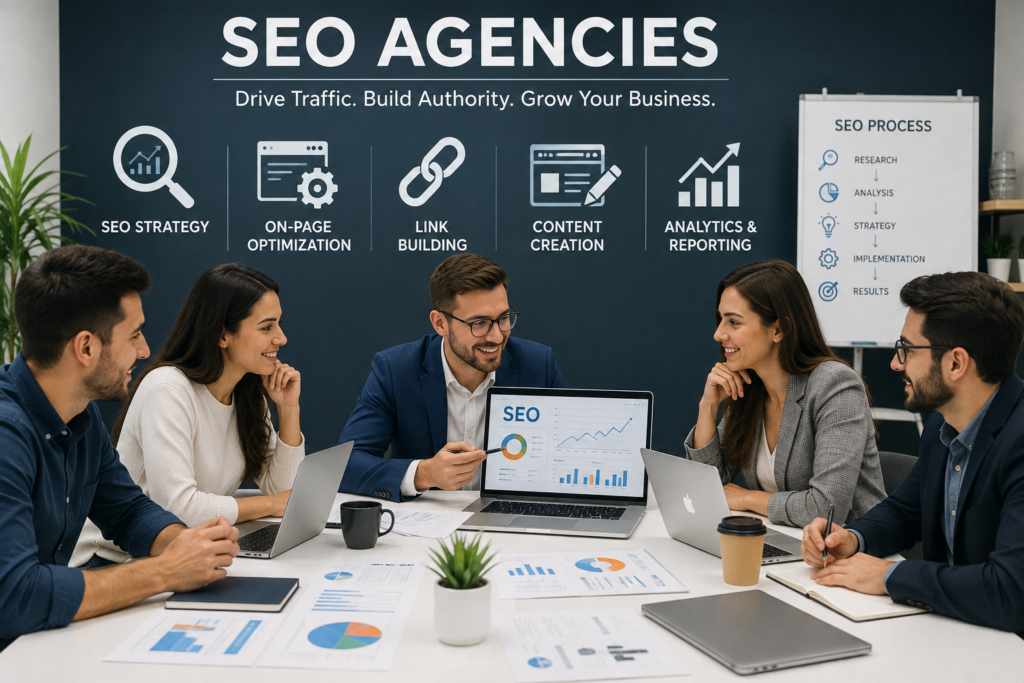
In today’s digital-first business environment, having a website is only the beginning. The bigger challenge is making sure the right people can actually find that website when they search for products, services, information, or solutions online. This is where SEO agencies can make a significant difference. Search engine optimization has become one of the most important parts of digital marketing because strong search visibility can bring consistent traffic without requiring a business to pay for every individual click.
SEO agencies help businesses improve their visibility on search engines by combining technical optimization, content strategy, keyword research, link building, competitor analysis, and performance tracking. While some companies attempt to manage SEO internally, others prefer working with experienced professionals who understand how search engines work and how search behavior changes over time.
The SEO industry has also become much more sophisticated. Modern search optimization is not simply about adding keywords to a webpage. Search engines evaluate content quality, relevance, technical performance, user experience, authority, intent, and many other signals. Because of this, choosing the right SEO agency requires more thought than simply searching for the cheapest provider.
Whether you run a small local business, an online store, a software company, a professional service, or a large enterprise, the right SEO partner can help turn your website into a valuable long-term marketing asset. This guide explains what SEO agencies do, why businesses hire them, what services they provide, how pricing works, and how to select an agency that fits your goals.
What Are SEO Agencies?
SEO agencies are specialized digital marketing companies that help businesses improve their organic visibility on search engines. Their primary goal is to help a website appear more prominently for relevant searches, ultimately increasing qualified visitors, leads, sales, or other desired actions.
A professional SEO agency usually combines several areas of expertise. These can include technical SEO, on-page optimization, keyword research, content development, digital PR, link acquisition, local SEO, analytics, and conversion optimization. Instead of treating search optimization as a single task, agencies typically approach it as an ongoing marketing process.
The best SEO agencies also understand that rankings are not the final objective. A website can receive thousands of visitors and still generate disappointing results if the traffic is irrelevant or the website does not convert visitors effectively. Good SEO strategies therefore connect search visibility with meaningful business outcomes.
Why Do Businesses Hire SEO Agencies?
One of the biggest reasons businesses work with SEO agencies is the complexity of modern search optimization. Search engines have become incredibly sophisticated, and successful SEO requires knowledge that goes beyond basic keyword placement.
A business owner may understand their industry extremely well but may not have the time to monitor algorithm changes, analyze search competitors, audit technical problems, produce optimized content, and evaluate organic performance every month. Hiring an agency allows the business owner and internal team to focus on their core responsibilities while specialists handle the search strategy.
Another important advantage is experience. Established SEO professionals have often worked across different industries and website types. That experience can help them identify opportunities and problems more quickly. They may recognize technical issues, content gaps, keyword opportunities, or competitive weaknesses that an inexperienced marketer could easily overlook.
SEO agencies can also provide accountability. Instead of randomly publishing blog posts or changing website pages without measuring results, a good agency develops a strategy, establishes benchmarks, monitors performance, and adjusts its approach based on data.
What Services Do SEO Agencies Offer?
SEO agencies can offer a wide range of services depending on their specialization, team size, and client requirements. Some agencies focus heavily on technical SEO, while others are known for content marketing, local search, ecommerce SEO, or enterprise optimization.
Most comprehensive SEO agencies provide a combination of services. These services are designed to address different aspects of search visibility and work together rather than functioning as isolated activities.
SEO Audits
An SEO audit is often one of the first steps in an optimization campaign. During an audit, an agency examines a website to identify technical, content, usability, and search visibility problems.
The audit may look at indexing, crawlability, page speed, internal linking, metadata, duplicate content, broken links, redirects, mobile usability, structured data, and other technical elements. The goal is to understand the current condition of the website before recommending major changes.
A useful SEO audit should not simply produce a giant list of technical problems. A good agency should explain which issues actually matter, why they matter, and how fixing them could support the broader business objective.
Keyword Research
Keyword research is another fundamental service provided by SEO agencies. It involves identifying the words and phrases potential customers use when searching for information, products, or services.
Modern keyword research goes beyond looking at search volume. Agencies also consider search intent, competition, relevance, commercial value, variations, related topics, and the stage of the customer journey.
For example, someone searching for “best running shoes” may be researching options, while someone searching for “buy Nike running shoes online” has a much stronger purchasing intent. A smart SEO strategy recognizes these differences and creates appropriate content for each stage.
On-Page SEO
On-page SEO focuses on optimizing individual webpages so that search engines and users can better understand them. This can involve titles, headings, content structure, internal links, image optimization, metadata, URLs, and topical relevance.
However, effective on-page SEO should never make content feel unnatural. Repeating a keyword excessively can make an article uncomfortable to read and may damage the overall quality of the page.
Professional SEO agencies focus on creating pages that satisfy user intent first. Keywords are incorporated naturally while the content remains useful, readable, comprehensive, and relevant.
Technical SEO
Technical SEO deals with the underlying structure and performance of a website. It can be particularly important for large websites, ecommerce platforms, publishing sites, and websites with complicated architectures.
Technical SEO specialists may examine crawling, indexing, site architecture, canonicalization, redirects, JavaScript rendering, mobile performance, page speed, structured data, XML sitemaps, and other technical factors.
A technically strong website gives search engines a clearer understanding of its content while also creating a better experience for visitors. Technical improvements can therefore benefit both search performance and usability.
Content Strategy
Content has become one of the central components of modern SEO. Search engines want to provide users with useful answers, which means businesses need content that genuinely addresses search intent.
SEO agencies can develop content strategies based on keyword opportunities, customer questions, competitor weaknesses, industry trends, and existing website performance.
Rather than publishing dozens of low-quality articles simply to target keywords, a strong agency may recommend fewer but more useful resources. These can include detailed guides, comparison pages, service pages, product content, tutorials, case studies, FAQs, and other formats.
Link Building
Links from reputable websites can contribute to a website’s authority and visibility. Because of this, link acquisition is another service offered by many SEO agencies.
High-quality link building focuses on earning relevant mentions from legitimate websites. This may involve digital PR, original research, expert commentary, partnerships, useful resources, guest contributions, or other editorial opportunities.
Businesses should be cautious about agencies that promise hundreds or thousands of backlinks instantly. Quantity alone does not guarantee quality. In SEO, a smaller number of relevant and trustworthy links can be far more valuable than a huge collection of low-quality links.
Local SEO
Local SEO is particularly valuable for businesses that serve customers in specific geographic areas. Restaurants, clinics, contractors, retailers, law firms, agencies, repair companies, and other local businesses can benefit from appearing prominently in local search results.
Local SEO agencies may optimize business listings, location pages, citations, reviews, local content, and other signals that help search engines understand where a business operates.
The objective is not simply to generate website traffic. Local SEO should help potential customers discover the business when they are actively looking for relevant products or services nearby.
Ecommerce SEO
Online stores have unique SEO requirements. Ecommerce websites may contain hundreds, thousands, or even millions of product and category pages.
SEO agencies specializing in ecommerce can help businesses improve category structures, product pages, internal linking, faceted navigation, metadata, product content, technical indexing, and other areas.
The ultimate goal is to help shoppers discover products through relevant searches while creating a smooth path from search result to purchase.
How SEO Agencies Build a Strategy
A strong SEO campaign usually begins with research rather than immediate implementation. Before changing anything, an agency needs to understand the business, its customers, competitors, website, industry, and objectives.
The first stage often involves discovery and auditing. The agency examines the current website, analyzes organic performance, studies competitors, and identifies opportunities. This creates a foundation for the strategy.
The next stage involves prioritization. Not every SEO issue has the same impact. An experienced agency determines which changes should happen first based on potential value, difficulty, resources, and business priorities.
Implementation then begins. This may involve technical fixes, content improvements, new landing pages, internal linking, authority development, or other activities. Performance is monitored continuously, allowing the agency to refine the strategy over time.
SEO Agencies and Content Marketing
SEO and content marketing are closely connected. Search engines need content to understand what a website is about, while users need useful information to make decisions.
A good SEO agency does not create content simply because a keyword has a high search volume. Instead, it considers what the searcher actually wants. The content should answer the underlying question clearly and provide enough value to satisfy the visitor.
For example, an article targeting a competitive commercial keyword may need to explain product differences, pricing considerations, common mistakes, alternatives, benefits, and purchasing factors. The exact structure depends on search intent.
Strong content can also create opportunities beyond rankings. Useful resources may attract backlinks, generate social shares, support sales conversations, answer customer questions, and strengthen brand credibility.
How Much Do SEO Agencies Cost?
SEO agency pricing varies significantly. There is no universal price because the cost depends on the size of the website, competitiveness of the industry, target market, number of locations, scope of work, technical complexity, and desired results.
Some agencies work on monthly retainers. Others offer fixed-price projects, hourly consulting, or customized packages. Larger businesses may have dedicated enterprise SEO contracts that involve multiple specialists.
Businesses should avoid selecting an SEO agency based solely on price. A very cheap service may provide limited strategic value, while a more expensive agency may deliver substantially better research, content, technical expertise, and reporting.
The most important question is not simply, “How much does SEO cost?” It is, “What value can this investment reasonably create for the business?” SEO should be evaluated as a long-term marketing investment rather than an isolated monthly expense.
How Long Does SEO Take to Produce Results?
One of the most common misconceptions about SEO is that it produces immediate results. In reality, organic search growth usually takes time.
A new website competing against established businesses may need considerable time to build authority, publish useful content, earn links, and demonstrate consistent quality. Even established websites may need several months to see meaningful results from major strategic changes.
The timeline can also vary depending on the starting point. A website with serious technical problems may see improvements relatively quickly after important fixes. Another website in a highly competitive industry may require a much longer campaign.
A trustworthy SEO agency should avoid guaranteeing instant rankings. Instead, it should explain the expected process, identify measurable milestones, and communicate what is being done to improve the website.
How to Choose the Right SEO Agencies
Choosing an SEO agency is an important decision because the wrong partner can waste money, time, and opportunities. Before signing a contract, businesses should investigate the agency carefully.
Start by examining its experience. Look at the types of businesses it has worked with and whether it understands your industry or business model. Experience in a completely different field does not automatically make an agency unsuitable, but relevant experience can reduce the learning curve.
Next, evaluate communication. SEO involves ongoing collaboration, so you need an agency that explains its work clearly. If an agency uses complicated terminology to avoid answering simple questions, that can be a warning sign.
Finally, ask about reporting. You should know what the agency measures, how frequently it reports results, and how it connects SEO metrics with business outcomes.
Questions to Ask Before Hiring an SEO Agency
Before choosing an agency, prepare a list of practical questions. These questions can reveal how the agency approaches SEO and whether its expectations align with yours.
Ask what their initial audit process looks like and what information they need from your team. Ask how they conduct keyword research and how they determine which opportunities are worth pursuing.
You should also ask how they approach content creation and link acquisition. Find out whether content is produced internally, outsourced, or created with a combination of resources.
It is also reasonable to ask how they measure success. Rankings are useful, but they should not be the only metric. Organic traffic, qualified leads, conversions, revenue, visibility, and engagement may all be relevant depending on your business.
Red Flags to Watch for When Hiring SEO Agencies
Not every company offering SEO services follows ethical or sustainable practices. Businesses should know how to recognize warning signs before entering an agreement.
One major red flag is a guaranteed number-one ranking. Search engines control rankings, and no legitimate agency can guarantee a specific position for every keyword.
Another warning sign is a promise of thousands of backlinks within a very short period. Large quantities of low-quality links can create more problems than benefits.
Be careful with agencies that refuse to explain their methods. You do not need to understand every technical detail, but you should receive a reasonable explanation of what work will be performed and why.
Extremely vague reporting is another concern. If monthly reports only contain generic statements such as “SEO is improving,” it becomes difficult to understand whether your investment is producing value.
White-Hat SEO vs. Risky SEO Practices
Ethical SEO focuses on creating sustainable improvements that follow search engine guidelines. This approach is often called white-hat SEO.
White-hat strategies can include useful content, technical optimization, genuine outreach, relevant link acquisition, strong website architecture, and improved user experience.
Risky practices may include manipulative link schemes, keyword stuffing, hidden content, automated spam, misleading redirects, or other attempts to manipulate search rankings.
The problem with risky SEO is that short-term gains can sometimes lead to long-term problems. Search engines continually improve their ability to identify manipulative behavior, so businesses should prioritize sustainable strategies.
SEO Agencies for Small Businesses
Small businesses often have limited budgets, making SEO efficiency particularly important. A well-planned SEO campaign can help smaller companies compete for searches that are highly relevant to their services.
Local businesses can benefit significantly from focused optimization. Instead of attempting to rank nationally for extremely competitive keywords, a small company may focus on service-specific and location-specific searches.
For example, a local plumbing company might benefit more from appearing for searches related to emergency plumbing in its service area than from trying to rank for the broad keyword “plumbing.”
A good agency understands these differences and creates a realistic strategy based on the business’s resources and market.
SEO Agencies for Large Companies
Enterprise SEO is considerably more complicated than optimizing a small website. Large organizations may have thousands of pages, multiple teams, complicated technology stacks, and websites serving different countries or languages.
Enterprise SEO agencies need to work effectively with developers, content teams, product managers, marketing departments, and executives.
Technical scalability is particularly important. A small mistake on one page might be insignificant, but the same mistake across hundreds of thousands of pages can create a major search visibility problem.
Enterprise SEO therefore requires strong processes, automation, reporting, governance, and cross-team communication.
The Role of Analytics in SEO
Data is essential for understanding whether an SEO strategy is working. SEO agencies use analytics and search performance data to identify trends, measure progress, and discover opportunities.
Organic traffic is one useful metric, but it should be interpreted carefully. An increase in traffic is not necessarily positive if the visitors are irrelevant.
Conversion data can provide much more meaningful insight. If organic traffic increases while qualified leads or sales also improve, the campaign is likely contributing to business growth.
Agencies may also monitor keyword visibility, click-through rates, landing-page performance, engagement, backlinks, technical health, and other indicators.
SEO Agencies and User Experience
SEO and user experience are increasingly connected. Search engines want to provide useful results, and users expect websites to be fast, readable, mobile-friendly, and easy to navigate.
A page that ranks well but frustrates visitors is unlikely to create strong business results. Visitors may leave quickly, fail to find the information they need, or abandon the conversion process.
SEO agencies can work with businesses to improve navigation, page structure, readability, performance, and other aspects of the visitor experience.
This creates a useful cycle: better optimization attracts qualified visitors, while a better experience gives those visitors more reasons to stay and take action.
Why SEO Should Be Treated as a Long-Term Investment
SEO is different from many forms of advertising because its benefits can continue after the initial work has been completed. A useful article, strong service page, or authoritative resource can continue attracting organic traffic for years when properly maintained.
That does not mean SEO is completely passive. Search results change, competitors publish new content, businesses update their offerings, and search engines continue evolving.
Successful SEO therefore requires ongoing maintenance. Agencies may refresh older content, identify new opportunities, improve underperforming pages, monitor competitors, and respond to technical changes.
The long-term nature of SEO is one of its biggest advantages. Instead of paying for every visitor individually, businesses can build an organic search presence that continues generating opportunities over time.
How SEO Agencies Adapt to Search Engine Changes
Search engines continually improve their systems to provide better results. This means SEO strategies that worked several years ago may not be effective today.
Professional SEO agencies monitor changes in search behavior, search features, technical standards, and content expectations. They also analyze performance data to determine whether existing strategies remain effective.
The best agencies do not chase every rumor about algorithm updates. Instead, they focus on fundamentals such as useful content, technical quality, relevance, authority, and user experience.
This balanced approach is important because businesses should not completely rebuild their SEO strategy every time the industry discusses a new search update.
SEO Agencies and Artificial Intelligence
Artificial intelligence has changed the digital marketing landscape, including SEO. AI tools can help with research, data analysis, brainstorming, content assistance, and workflow automation.
However, AI does not eliminate the need for experienced SEO professionals. Tools can produce information quickly, but they do not automatically understand every business’s customers, competitive position, brand voice, or strategic priorities.
The strongest approach is to use technology as an assistant rather than treating it as a replacement for expertise. Human review, original insights, fact-checking, editing, and strategic decision-making remain important.
SEO agencies that use AI responsibly can potentially improve productivity while maintaining quality. The focus should always remain on creating useful resources for real users.
Measuring the Success of an SEO Agency
The success of an SEO agency should be measured against agreed business objectives. Rankings are useful indicators, but they should not be treated as the complete definition of success.
For some businesses, the most important outcome may be qualified leads. For an ecommerce company, revenue and transactions may matter most. For a publisher, organic traffic and audience growth may be more relevant.
Set clear benchmarks before the campaign begins. This allows both the client and agency to understand what improvement looks like.
Regular communication is equally important. A good agency should explain what changed, what worked, what did not work, and what will happen next.
Common SEO Mistakes Businesses Make
One common mistake is expecting SEO to work without investing in the website itself. If the website is slow, confusing, outdated, or difficult to navigate, improving rankings alone may not solve the business problem.
Another mistake is focusing exclusively on high-volume keywords. High-volume searches can be extremely competitive, and they may not always produce the most valuable customers.
Ignoring existing content is another missed opportunity. Sometimes the fastest SEO Agencies improvement comes from updating and improving pages that already have visibility rather than creating entirely new content.
Businesses also sometimes change agencies too quickly. SEO requires patience, SEO Agencies and constantly switching strategies can prevent a campaign from reaching its potential.
DIY SEO vs. Hiring an SEO Agency
Some businesses can successfully handle basic SEO internally, especially when they have a knowledgeable marketing team. Learning fundamental SEO principles can also help business owners make better decisions.
However, advanced SEO can require significant time and specialized knowledge. SEO Agencies Technical problems, large-scale content strategies, competitive research, and link acquisition can become difficult to manage without dedicated expertise.
The decision ultimately depends on resources, goals, competition, and internal capabilities.
A business with a strong marketing department may only need specialized SEO consulting. Another business with no internal SEO knowledge may benefit from a full-service agency.
How to Get the Most From Your SEO Agency
Hiring an agency is only one part of the process. Clients also play an important role in campaign success.
Provide the agency with accurate information about your customers, services, SEO Agencies products, competitors, sales process, and business priorities. This information helps specialists create more relevant strategies.
Be available when approvals are needed. Content, technical changes, website updates, and other activities can be delayed when communication is slow.
Most importantly, treat the agency as a strategic partner rather than simply a vendor. When both sides share information and collaborate effectively, SEO campaigns generally have a stronge SEO Agencies r foundation.
The Future of SEO Agencies
The future of SEO will likely become even more focused on quality, relevance, user experience, and strategic differentiation.
As search technology becomes more advanced, businesses will need to provide genuinely useful information rather than relying on outdated optimization tricks.
SEO agencies will also continue expanding beyond traditional keyword optimization. Their work may increasingly involve content strategy, digital PR, technical consulting, brand visibility, SEO Agencies analytics, conversion optimization, and broader organic growth.
Agencies that continue learning and adapting will be better positioned to help SEO Agencies clients navigate these changes.
Conclusion
SEO agencies can play a valuable role in helping businesses build sustainable SEO Agencies online visibility. From technical audits and keyword research to content development, local optimization, link acquisition, analytics, and strategy, a professional agency can handle many of the complex tasks involved in modern search optimization.
However, not every agency is the same. Businesses should look beyond impressive promises and focus on experience, transparency, communication, strategy, and measurable results.
The right SEO partner will not simply promise better rankings. It will work to understand the business, identify realistic opportunities, improve the website, create useful content, monito r SEO Agencies performance, and adjust the strategy as conditions change.
SEO is not a magic button that produces overnight success. It is a long-term process that rewards consistency, quality, patience, and smart decision-making. When handled correctly, the investment can create a strong organic presence that continues generating traffic, leads, customers, and brand visibility over time.
Ultimately, the best SEO agencies are not the ones that make the loudest promises. They are the ones that understand the fundamentals, communicate honestly, use data intelligently, and consistently connect SEO activity to real business goals. For companies serious about long-term digital growth, finding that kind of partner can be one of the most valuable marketing decisions they make.
YOU MAY HAVE MISSED