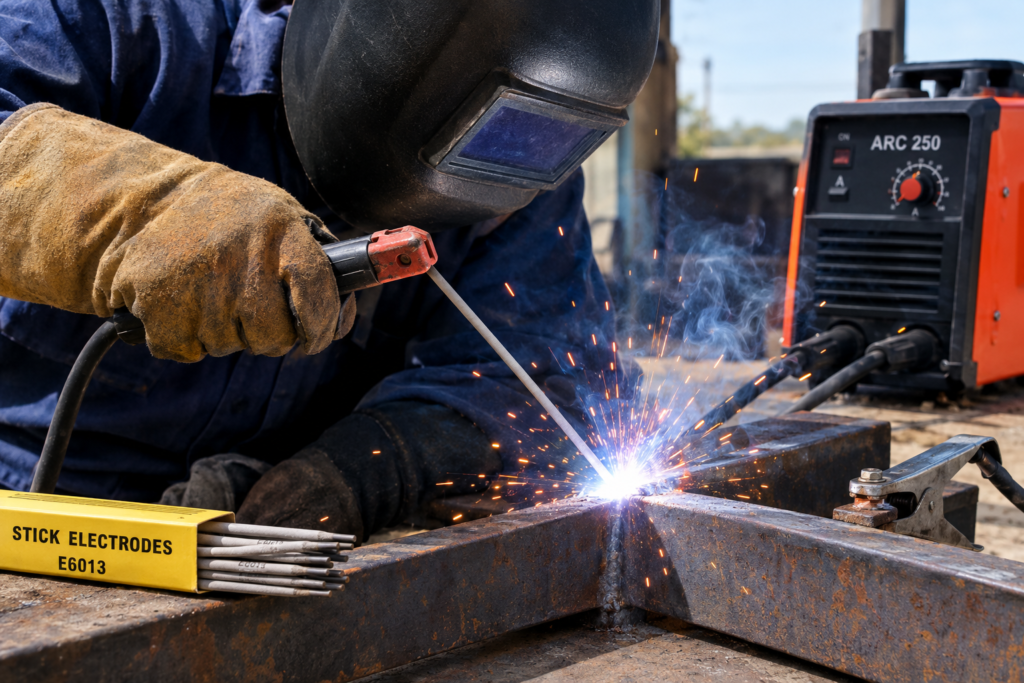
Stick welding is one of the most practical and widely used welding methods in metal fabrication, construction, maintenance, repair work, and DIY projects. Officially known as Shielded Metal Arc Welding (SMAW), the process uses an electric arc between a consumable electrode and the workpiece to create enough heat to melt the metal and form a strong joint.
What makes stick welding interesting is its simplicity. You do not need a complicated setup filled with gas cylinders, hoses, and sensitive equipment. A suitable welding machine, electrode holder, ground clamp, cables, and the correct electrode can be enough to get started. That straightforward setup is one reason the process remains popular even as newer welding technologies continue to develop.
At the same time, stick welding is not simply a matter of striking an arc and moving the electrode across the metal. Producing clean, strong, consistent welds requires an understanding of electrode selection, current settings, arc length, travel speed, work angle, preparation, and safety. Once these fundamentals become familiar, the process becomes much easier to control.
What Is Stick Welding?
Stick welding is an arc-welding process in which a coated metal electrode is used to join two or more pieces of metal. When the electrode gets close enough to the workpiece, electricity jumps the gap and creates an intense arc. The heat from this arc melts the electrode and part of the base metal, producing a molten weld pool.
The electrode is commonly called a stick, which explains the name of the process. As the electrode melts, its metal becomes filler material for the joint. At the same time, the coating around the electrode burns and produces shielding gases and slag. These help protect the molten weld pool from atmospheric contamination.
Unlike processes such as MIG welding, stick welding normally does not require an external shielding-gas cylinder. This gives it a major practical advantage when welding outdoors or in locations where transporting gas equipment would be inconvenient.
How Does Stick Welding Work?
The basic principle behind stick welding is relatively simple. The welding machine supplies electrical current to the electrode through an electrode holder. A separate cable connects the workpiece to the machine through a ground or work clamp.
When the welder touches the electrode to the metal and then slightly lifts it, an electrical arc forms. Temperatures at the arc can become extremely high, allowing both the electrode and a small portion of the base metal to melt. The welder controls the movement of the electrode to guide the molten metal along the joint.
As the electrode melts, its coating also decomposes. This produces shielding gases around the weld and leaves a layer of slag over the solidifying weld bead. After the weld cools sufficiently, the slag can be removed with a chipping hammer and wire brush.
The process therefore combines several functions into one consumable electrode. The stick supplies filler metal while its coating provides much of the shielding required during welding. This is a major reason SMAW equipment can remain relatively compact and portable.
Understanding SMAW
SMAW stands for Shielded Metal Arc Welding. The term describes exactly what happens during the process. An electric arc provides the heat, a metal electrode provides filler material, and the electrode coating creates shielding around the weld.
The coating is particularly important. Without suitable shielding, oxygen and nitrogen from the atmosphere can contaminate the hot molten metal. This can contribute to defects and reduce weld quality. The coating helps isolate the weld pool during the critical period when the metal is extremely hot and reactive.
Different electrodes have different coating compositions and characteristics. Some are designed for easier starting and smoother operation, while others are selected for high-strength applications, specific positions, or difficult-to-weld materials. Understanding electrode classifications is therefore an important part of becoming competent at stick welding.
Essential Stick Welding Equipment
A basic stick welding setup does not require a huge amount of equipment. The most important component is the welding power source. Machines can be designed for different output types and may provide direct current, alternating current, or both.
You will also need an electrode holder, welding leads, and a work clamp. The holder securely grips the electrode while allowing current to flow through it. The work clamp establishes the electrical connection between the workpiece and welding machine.
Personal protective equipment is equally important. A suitable welding helmet with the appropriate lens shade, welding gloves, flame-resistant clothing, safety footwear, and eye protection should be considered essential rather than optional. Welding produces intense light, heat, sparks, fumes, and potentially dangerous ultraviolet radiation.
Choosing the Right Welding Machine
The best welding machine depends on the type of work you expect to perform. For occasional repairs, a compact inverter machine can be a convenient choice because modern inverter welders can be relatively small and lightweight.
For heavier fabrication or demanding industrial work, a machine with sufficient output and appropriate duty cycle becomes more important. You should consider the thickness and type of metal you plan to weld, the electrodes you intend to use, and whether you will work with AC, DC, or both.
Portability can also matter. One of stick welding’s major strengths is its suitability for remote work. If you frequently weld on construction sites, farm equipment, gates, trailers, or outdoor structures, a portable machine can make the process considerably easier.
Selecting Stick Welding Electrodes
Choosing the correct electrode is one of the most important decisions in stick welding. Electrodes are identified using classification systems that communicate information about strength, position, and operating characteristics.
For example, an electrode such as E6010 or E6011 is commonly associated with deep penetration and certain demanding applications. E6013 is widely recognized as an easy-to-use general-purpose electrode that can be suitable for many light fabrication jobs. E7018 is known for producing strong, quality welds and is frequently used for structural applications when handled and stored appropriately.
The correct electrode depends on more than tensile strength. You must also consider the base metal, welding position, polarity, joint design, thickness, machine capabilities, and required appearance. Using the first electrode available may produce a weld, but it does not necessarily produce the right weld.
Understanding Electrode Numbers
Learning how electrode classifications work makes electrode selection much easier. In an AWS-style designation such as E7018, the first letter “E” indicates an electrode. The first two or three digits generally communicate the nominal tensile strength in thousands of pounds per square inch, while another digit indicates the welding positions for which the electrode is designed.
The final digits describe coating type and current characteristics. This means an electrode classification contains useful technical information rather than being an arbitrary product code.
However, classification numbers should always be interpreted using the manufacturer’s information and the applicable welding standard. Electrode formulations and recommended settings can differ, so checking the electrode package or technical data sheet is a good habit.
Setting the Correct Amperage
Amperage has a major effect on the behavior of a stick welding arc. Too little current can make the electrode difficult to maintain and may result in poor fusion. Too much current can produce excessive penetration, undercutting, spatter, and an overly fluid weld pool.
The electrode diameter provides a useful starting point when selecting current. Larger electrodes generally require higher amperage than smaller electrodes. However, the exact setting also depends on electrode type, welding position, joint design, material thickness, and machine characteristics.
Instead of treating a recommended amperage as an absolute number, consider it a starting point. Practice on scrap metal and observe the arc. A stable arc, controlled puddle, and appropriate bead profile are better indicators than simply trusting a number on the machine.
AC Versus DC Stick Welding
Stick welding machines may provide alternating current, direct current, or both. Each has characteristics that can affect arc behavior and electrode compatibility.
DC welding is often appreciated for its smooth arc and relatively easy control. Depending on the electrode, DC electrode-positive or electrode-negative operation can influence penetration and arc characteristics.
AC can be useful in situations where the power source or application calls for it. Certain electrodes are specifically designed to perform well on AC. One practical advantage of AC welding equipment is that it can be less affected by certain magnetic arc-blow conditions.
The correct polarity should always be determined from the electrode manufacturer’s recommendations. Incorrect polarity can significantly change arc behavior and weld quality.
Preparing the Metal Before Welding
Good welds usually begin before the arc is struck. Dirt, oil, paint, rust, moisture, and other contaminants can interfere with welding and contribute to defects.
For critical work, clean the joint thoroughly. Depending on the material and condition, preparation may involve grinding, wire brushing, degreasing, or removing coatings. Be particularly careful with painted, galvanized, or otherwise coated materials because heating certain coatings can produce hazardous fumes.
Joint preparation also matters. Thick material may require a suitable bevel, root opening, or other preparation so that the weld can achieve the required fusion and penetration. Simply placing two pieces of metal together and running a bead over the top is not always sufficient for a strong joint.
Striking the Arc
Starting the arc is one of the first skills beginners need to develop. Two common techniques are the scratch-start method and the tap-start method.
With the scratch technique, the electrode is moved across the surface briefly, similar to striking a match, and then lifted to establish the arc. With the tapping technique, the electrode is brought toward the workpiece and quickly lifted after contact.
The key is to establish the arc without sticking the electrode to the metal. If the electrode freezes to the workpiece, do not panic. Twist or pull it free when safe, or release it from the holder if necessary. Beginners often need practice before starting becomes smooth and automatic.
Maintaining the Correct Arc Length
Arc length is one of the most important variables in stick welding. Holding the electrode too far away can produce excessive spatter, unstable arc behavior, and a poor-quality bead.
A very short arc can cause the electrode to stick and may interfere with proper movement. The ideal distance depends on the electrode type, but a relatively short, controlled arc is generally preferred.
As the electrode burns away, the welder must continuously lower it toward the workpiece to maintain a consistent relationship between the electrode and weld pool. This becomes easier with practice because experienced welders learn to judge arc length by sound, feel, and visual appearance.
Controlling Travel Speed
Travel speed determines how long the arc remains over a particular section of metal. Moving too quickly can produce a narrow bead with insufficient fusion. Moving too slowly can result in excessive buildup, excessive heat, and an overly wide weld.
A useful approach is to watch the weld pool rather than simply watching the electrode tip. The molten pool provides valuable information about how much metal is being deposited and how the joint is filling.
Consistency is more important than speed. A controlled travel rate usually produces better results than trying to move quickly. Once the technique becomes comfortable, you can adjust speed according to electrode type, position, material thickness, and desired bead profile.
Electrode Angle and Manipulation
Electrode angle affects how the molten metal moves and how the arc interacts with the joint. A common starting point for many welding situations is to hold the electrode at a modest travel angle rather than completely perpendicular to the surface.
Some joints may require slight manipulation of the electrode to control bead width or help fill the joint. Small side-to-side movements can be useful, but excessive weaving can introduce unnecessary heat and create an inconsistent weld.
Beginners often make the mistake of focusing too much on complicated movement patterns. In many situations, a simple and consistent technique produces better results than a dramatic weaving motion.
Welding Different Positions
Stick welding can be performed in several positions, including flat, horizontal, vertical, and overhead. The flat position is generally the easiest place for a beginner to develop fundamental skills.
Horizontal welding requires better control of the molten pool because gravity can encourage the metal to sag. Vertical welding requires careful manipulation and often involves controlling a smaller weld pool to prevent excessive dripping.
Overhead welding is particularly demanding because molten metal is positioned above the welder. Proper technique, protective equipment, and suitable work practices are essential. Beginners should develop confidence in easier positions before progressing to overhead work.
Common Stick Welding Mistakes
One common mistake is using the wrong amperage. If the current is too low, the arc may be unstable and penetration may suffer. If it is too high, the weld can become excessively fluid and create undercut or other defects.
Another frequent problem is excessive arc length. Beginners sometimes pull the electrode away from the workpiece because they are worried about sticking. Unfortunately, this can make the arc unstable and produce more spatter.
Poor preparation is another major issue. Welding over heavy rust, grease, paint, or other contaminants can create defects even when the welder’s technique is otherwise good. Cleaning and preparation should therefore be considered part of the welding process rather than an optional extra.
Understanding Welding Slag
Slag is a normal part of many stick welding electrodes. It forms from the electrode coating and covers the solidifying weld bead.
After the weld cools sufficiently, the slag is normally removed with a suitable chipping hammer and wire brush. This reveals the surface of the weld and makes it easier to inspect.
Slag should not simply be ignored. Trapped slag between weld passes can create inclusions and weaken the completed weld. When making multiple passes, remove the previous pass’s slag thoroughly before depositing the next layer.
Stick Welding and Weld Penetration
Penetration refers to how deeply the weld fusion extends into the base material. Adequate penetration is essential for many joints because a weld that merely sits on top of the material may not provide the required structural connection.
Penetration is influenced by electrode selection, current, polarity, travel speed, joint preparation, and technique. Deep-penetrating electrodes can be valuable when the application requires them.
However, maximum penetration is not automatically better. Excessive heat can cause burn-through, distortion, undercut, or damage to thin material. The goal is appropriate fusion for the particular joint, not simply the deepest possible weld.
Stick Welding Thin Metal
Stick welding thin material requires additional care because the process produces substantial heat. Excessive current or slow travel can quickly cause burn-through.
Smaller electrodes and appropriately reduced current can help. Short welds, controlled movement, and allowing the material to cool between passes may also reduce heat buildup.
For very thin sheet metal, other welding processes may be more convenient. MIG or TIG can provide greater control in some thin-material applications. Nevertheless, experienced welders can perform surprisingly precise work with stick welding when the electrode and settings are appropriate.
Stick Welding Thick Metal
Thick metal can be well suited to stick welding because the process can provide substantial penetration and is available with electrodes designed for demanding applications.
Heavy sections may require joint preparation and multiple passes. A root pass establishes the initial connection, while additional filler and cap passes build the weld to the required size.
The exact procedure depends on the material, thickness, joint configuration, required strength, applicable code, and electrode. For structural or safety-critical work, follow an appropriate qualified welding procedure rather than relying solely on general advice.
Welding Outdoors With Stick Welding
Outdoor work is one of the areas where stick welding has a major advantage. Because the process generates its own shielding from the electrode coating, it can be more practical than gas-shielded processes in windy environments.
However, “wind resistant” does not mean “immune to environmental problems.” Strong wind, rain, moisture, contaminated surfaces, and poor electrode storage can still affect welding quality.
The work area should be protected whenever practical. Electrodes must also be kept in accordance with their storage requirements, especially low-hydrogen electrodes, which can require controlled handling and storage to maintain their intended characteristics.
Stick Welding Safety
Safety should always be treated as part of the welding technique. The welding arc produces intense ultraviolet and infrared radiation that can injure eyes and skin. A properly rated welding helmet and suitable protective clothing are essential.
Welding also creates sparks, hot metal, fumes, and potentially hazardous gases. Keep combustible materials away from the welding area and make sure adequate ventilation is available. Never assume that a space is safe simply because it looks open.
Extra caution is required around tanks, drums, pipes, vehicles, painted surfaces, and containers that may have held flammable substances. Welding can ignite hidden vapors and create extremely serious hazards.
Protecting Yourself From Welding Fumes
Different metals and coatings can generate different fumes when heated. The risk becomes especially important when welding materials with coatings, paints, galvanizing, or unknown compositions.
Good ventilation is essential, but ventilation should not simply mean blowing contaminated air toward another person. Local exhaust ventilation can be useful for controlling fumes at the source.
Appropriate respiratory protection may also be necessary depending on the material, environment, and risk assessment. If you are unsure about a coating or material, identify it before welding rather than assuming it is harmless.
How to Improve Your Stick Welding Skills
The fastest way to improve is usually controlled practice. Instead of randomly welding different materials, use clean scrap pieces and deliberately practice one variable at a time.
Start with straight beads. Focus on maintaining a consistent arc length, travel speed, and electrode angle. Once you can produce consistent beads, move to simple lap, butt, and fillet joints.
Inspect your results after each practice session. Look at bead width, profile, penetration, slag removal, spatter, and visible defects. This turns practice into a learning process rather than simply burning through electrodes.
Reading the Weld Bead
A weld bead can tell you a great deal about what happened during the welding process. An excessively narrow bead may indicate fast travel or insufficient heat, while an excessively wide bead may suggest slow movement or excessive current.
Undercutting along the edges can indicate excessive current, excessive travel speed, poor electrode angle, or inappropriate manipulation. Excessive spatter may be associated with incorrect settings, poor arc length, or electrode characteristics.
With experience, welders begin to diagnose problems almost automatically. Instead of seeing a poor bead simply as “bad welding,” they can identify likely causes and make targeted adjustments.
Stick Welding for Beginners
Beginners should resist the temptation to start with complicated projects. A simple practice plate is often more useful because it lets you concentrate on the fundamentals without worrying about the final product.
Learn how to prepare the metal, connect the machine, select the electrode, set the current, strike the arc, maintain arc length, control travel speed, and remove slag.
Once these basic movements become comfortable, move on to joints and different positions. Skill develops through repetition and observation. There is no substitute for practice, but good practice is much more valuable than simply spending more hours welding without evaluating the results.
Stick Welding vs. MIG Welding
Stick and MIG welding are both popular, but they suit different working conditions. MIG welding generally offers faster deposition and can be easier for beginners to learn when working indoors with clean material.
Stick welding, on the other hand, is highly portable and does not normally require an external shielding-gas cylinder. It is particularly useful for outdoor work, repairs, construction, and situations where equipment needs to be transported.
Neither process is universally better. The right choice depends on the material, environment, required productivity, joint design, available equipment, and desired weld characteristics.
Stick Welding vs. TIG Welding
TIG welding is known for excellent control and high-quality weld appearance. It is especially useful when precision and clean welds are important.
Stick welding is generally faster to set up and more forgiving in demanding field environments. TIG requires more coordination because the welder controls the torch, filler material, and arc separately in many applications.
For heavy outdoor repair work, stick welding may be the more practical option. For precision fabrication involving thinner materials, TIG can offer advantages. Again, the application should determine the process.
Advantages of Stick Welding
Stick welding remains popular because it offers several practical benefits. Equipment can be relatively simple, portable, and durable. The process can be used in locations where gas-shielded welding would be inconvenient.
It also supports a wide variety of electrodes designed for different materials and applications. With the right electrode and technique, welders can work on carbon steel, low-alloy steels, stainless steels, and certain other materials.
Another advantage is field versatility. Construction crews, maintenance workers, farmers, fabricators, and repair technicians can take a welding machine and electrode supply to locations where setting up a larger welding system would be difficult.
Limitations of Stick Welding
Stick welding is not perfect. The electrode has a limited length, meaning welding must stop periodically to replace it. This makes the process less continuous than some wire-feed systems.
Slag must also be removed, particularly between multiple passes. This adds time compared with processes that do not produce a slag layer in the same way.
The process can also be more challenging for thin materials. Beginners may find it easier to control thin sheet metal with another welding method. Stick welding produces considerable heat and can create distortion if heat input is not controlled.
Maintaining Your Welding Equipment
Taking care of your equipment can improve reliability and safety. Inspect cables regularly for cuts, damaged insulation, exposed conductors, or loose connections.
The electrode holder and work clamp should also remain in good condition. Poor electrical connections can produce unstable arcs and unnecessary heating.
Keep the welding machine clean and dry, and follow the manufacturer’s maintenance instructions. Do not ignore unusual sounds, overheating, damaged controls, or other signs that equipment may need inspection or repair.
Storing Electrodes Correctly
Electrode storage can have a major impact on welding performance. Moisture is particularly important for electrodes that require controlled storage.
Low-hydrogen electrodes such as certain E7018 products are especially sensitive to moisture exposure. Manufacturers commonly specify storage and, when necessary, reconditioning procedures to maintain electrode quality.
Do not assume every electrode can be treated identically. Read the packaging and technical documentation for the specific product. Proper storage helps prevent avoidable welding problems and supports consistent results.
How to Produce Cleaner Welds
Clean welds come from controlling several variables at the same time. Start with clean material and use the correct electrode. Set a suitable current and maintain a consistent arc length.
Keep your hand movement steady and watch the weld pool. Avoid unnecessary manipulation. When making multiple passes, remove slag completely before adding another layer.
Finally, inspect the completed weld instead of judging it only by appearance. A visually attractive bead is not automatically a structurally sound weld. Where strength or safety is important, appropriate inspection methods and qualified procedures should be used.
Final Thoughts on Stick Welding
Stick welding remains one of the most useful welding processes because it combines simplicity, portability, versatility, and strong field performance. Its basic equipment can be relatively straightforward, yet the process is capable of handling demanding fabrication and repair applications when used correctly.
Learning stick welding takes practice, but the fundamentals are manageable. Understand your machine, choose the correct electrode, prepare the metal properly, use suitable settings, control your arc length, maintain a consistent travel speed, and pay attention to the weld pool.
Most importantly, treat safety as part of the process rather than something added afterward. Welding involves electricity, extreme heat, intense radiation, fumes, sparks, and hot metal. Proper protective equipment, ventilation, fire prevention, and sensible working practices are essential.
With consistent practice and careful observation, stick welding can become a highly useful skill. Whether you are repairing equipment, fabricating metal structures, maintaining machinery, or simply learning a practical trade, understanding stick welding gives you a solid foundation in one of the industry’s most enduring welding processes.
YOU MAY HAVE MISSED