Introduction
The internet is full of websites offering information, advice, entertainment, and solutions to everyday problems. However, finding a website that provides useful information while helping readers understand online safety can sometimes be challenging. This is where thealitekeepsafe.com becomes an interesting name for internet users who want to learn more about websites, digital privacy, personal information, and safer browsing habits.
When people come across an unfamiliar domain, they naturally want to know what it offers, why it exists, and whether it is worth visiting. A website’s name can provide a general idea of its purpose, but understanding its actual content requires looking beyond the domain name. Visitors should consider its published information, available features, privacy practices, and transparency before deciding how much they should rely on it.
Thealitekeepsafe.com is particularly interesting because its name suggests a connection with keeping information safe. That makes it relevant to discussions about digital awareness, online privacy, and responsible internet use. Nevertheless, readers should distinguish between an informational website and an actual cybersecurity product. A website discussing security does not automatically provide antivirus protection, encrypted storage, or account security services.
This article explores thealitekeepsafe.com, its apparent purpose, the subjects associated with it, and the practical lessons readers can take from exploring websites that discuss online safety. Let’s go!
1. What Is Thealitekeepsafe.com?
Thealitekeepsafe.com is a website domain associated with online information and digital safety-related content. People searching for it may want to understand its purpose, explore its published material, or determine whether it provides a particular online service. These are reasonable questions, especially when a website has an unfamiliar name.
The name Thealite Keep Safe creates an association with protecting personal information and maintaining safer digital habits. In today’s online environment, those subjects are important because people regularly use websites and mobile applications to communicate, shop, work, store photographs, and manage personal accounts. Understanding how digital platforms work can help visitors make more informed decisions.
It is important, however, not to confuse the website’s name with proof of a particular security service. Readers should examine the actual pages, descriptions, and available functionality before assuming that the domain offers specialized protection. Based on the available website information, its identity and content should be assessed through its published pages rather than assumptions based on its branding.
2. The Main Purpose of Thealitekeepsafe.com
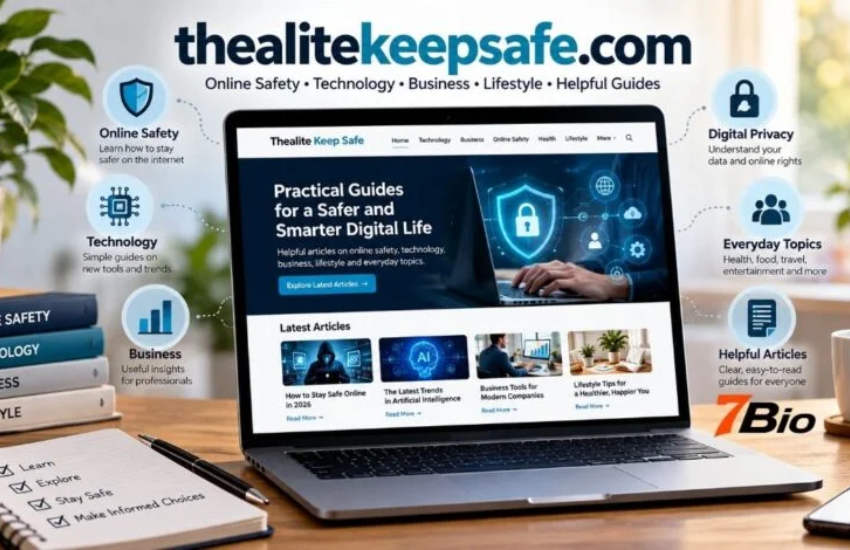
The main purpose of Thealitekeepsafe.com appears to be publishing accessible online content for people who want straightforward information. Its homepage features articles across several subjects, including technology, business, artificial intelligence, home security, food, education, and general lifestyle topics. This variety gives visitors opportunities to explore different subjects without necessarily visiting multiple specialized blogs.
One noticeable aspect of the website is its emphasis on readable content. Many internet users prefer explanations that get straight to the point instead of lengthy technical discussions filled with unfamiliar terminology. A reader-friendly publishing platform can make complicated subjects easier to understand, particularly when the articles explain common problems and provide practical suggestions.
The website also includes general navigation sections that help visitors explore its material. Its homepage displays recent posts, categories, archives, and links to additional pages. These elements are useful because they give readers different ways to discover content, whether they are interested in the latest publication or looking for information about a particular subject. Thealite Keep Safe
3. Understanding the Content Available on the Website
A website becomes useful when its content answers questions that visitors actually have. Thealitekeepsafe.com features a broad selection of informational articles, meaning its content is not restricted to one narrow topic. This approach can appeal to readers with different interests, although visitors should always check whether an individual article provides the depth and accuracy they need.
Technology is one of the subjects represented on the platform. Articles about artificial intelligence, software, digital tools, and technology-related developments can help readers understand changes in the online world. Since technology evolves quickly, these topics require regular updates. A useful technology article should explain what a tool does, how people might use it, and what limitations they should understand before making a decision.
The website also features content related to business, home security, food, and other everyday subjects. For example, its homepage has displayed articles about remote system administration, restaurant safety requirements, home security upgrades, and artificial intelligence tools. This broad publishing approach makes it important to evaluate each article individually rather than assuming every subject receives the same level of specialist attention. Thealite Keep Safe
4. Why Digital Safety Is an Important Topic
Digital safety has become a major concern because people now depend on internet-connected devices for many daily activities. Smartphones contain personal photographs, private conversations, contact details, financial applications, and work-related documents. Computers and tablets may also store sensitive information that should not be accessible to unauthorized individuals.
One of the biggest problems is that many people underestimate the amount of information they share online. A simple registration form might request an email address, telephone number, or other personal details. Social media platforms can reveal information about someone’s interests, relationships, location, and daily activities. When users share information without considering the consequences, they may create unnecessary privacy risks.
Learning basic cybersecurity practices can reduce these risks. Strong passwords, two-factor authentication, regular software updates, and careful browsing habits are practical starting points. Websites that discuss online safety can introduce readers to these subjects, but users should also consult established cybersecurity organizations and official software documentation when making important security decisions.
5. Website Navigation and User Experience
Website navigation plays an important role in determining whether visitors can find information comfortably. Even a website with useful articles can become frustrating if its menus are confusing, its pages load slowly, or its categories are difficult to understand. A clear layout helps readers spend more time exploring relevant information instead of trying to figure out how the website works.
Thealitekeepsafe.com provides several familiar navigation elements, including a homepage, search area, category listings, archives, and links to informational pages. These features create a recognizable blogging structure. Visitors can browse recent publications, explore older content, or use the category system to find subjects that interest them.
Another important part of user experience is readability across different devices. Many people browse websites using smartphones rather than desktop computers. A good mobile experience should include readable text, properly arranged menus, accessible links, and pages that adjust to smaller screens. Visitors should also pay attention to unexpected redirects, intrusive advertisements, and suspicious pop-ups when browsing any unfamiliar website. Thealite Keep Safe
6. The Importance of Privacy When Visiting Websites
Privacy is not limited to hiding personal photographs or protecting passwords. It also involves understanding how websites collect, process, store, and potentially share information about their visitors. Whenever someone opens a website, certain technical information may be processed, depending on the hosting environment, analytics services, cookies, and other technologies involved.
Cookies are small data files that websites may use to remember preferences, maintain sessions, or understand visitor activity. Some cookies are necessary for basic website functionality, while others support analytics or advertising. Users should understand that accepting cookies can involve different levels of data collection depending on the website’s policies and the technologies it uses.
Before sharing personal details with an unfamiliar platform, visitors should read its privacy policy. They should look for explanations about the information collected, the reasons for collecting it, retention periods, third-party services, and available privacy choices. A privacy policy is useful only when it clearly explains actual practices, so readers should not treat the mere presence of a policy as proof that a website offers complete privacy protection.
7. How to Check Whether Thealitekeepsafe.com Is Trustworthy
Trust is one of the most important considerations when evaluating an unfamiliar website. A professional appearance, attractive design, or confident writing style does not automatically prove that a website is reliable. Readers should examine several independent factors before deciding whether to trust its information.
Start by checking the website’s About Us and Contact Us pages. These pages should explain the site’s purpose and provide a reasonable way to communicate with its publisher. Look for clear editorial information, a working contact method, and explanations of how corrections are handled. If the website publishes technical, medical, legal, or financial information, it is also helpful to understand who reviews that material.
Next, evaluate the individual articles. Check publication dates, supporting evidence, author information, and links to original documentation where relevant. Be cautious about exaggerated promises, unsupported statistics, and statements suggesting that one product can solve every security problem. A trustworthy article should acknowledge limitations rather than making unrealistic claims.
8. Understanding the Difference Between an Information Website and Security Software
The difference between an informational website and security software is extremely important. An informational website publishes explanations, tutorials, reviews, and general advice. Security software, on the other hand, performs technical functions designed to protect devices, networks, accounts, or data.
For example, an informational article might explain how antivirus programs identify suspicious files. An antivirus application actually scans files and uses its security mechanisms to detect or block threats. Similarly, a blog can explain password managers, but that does not mean the blog itself stores or encrypts passwords for visitors.
Thealitekeepsafe.com should therefore be evaluated according to the features it actually provides. Its domain name should not be interpreted as evidence that it offers a dedicated security application, password manager, antivirus service, or encrypted storage system. Anyone looking for those services should investigate the relevant software provider and verify its official website before downloading anything or creating an account.
9. The Role of Articles and Educational Guides
Educational articles are useful because they help readers understand subjects that might otherwise seem complicated. A well-written guide can introduce a new concept, explain why it matters, and provide practical steps that readers can apply in everyday situations. This is especially valuable in technology, where unfamiliar terms can make even simple tasks appear difficult.
For example, someone who has never enabled two-factor authentication might not understand why an additional verification step is necessary. An educational guide can explain how passwords may be compromised and why a second authentication method provides another layer of account protection. It can then describe the general setup process and explain what users should do if they lose access to their authentication device.
The same approach works for other subjects, including home security, artificial intelligence, and business technology. Readers benefit most when articles combine simple explanations with accurate information, practical examples, and clear limitations. Educational publishing is most valuable when it encourages people to understand a subject instead of simply accepting every recommendation without question.
10. Common Online Threats Every Internet User Should Understand
Online threats affect individuals, families, and organizations of different sizes. Some attacks are highly technical, while others depend on ordinary human mistakes. Understanding common threats is an important part of becoming a more confident internet user.
Phishing is one of the most recognizable examples. It involves fraudulent messages or websites designed to trick people into revealing passwords, payment details, or other private information. These messages may imitate banks, delivery companies, social media platforms, or popular online services. A convincing logo or familiar company name should never be treated as proof that a message is genuine.
Malware is another important concern. Malicious software can be designed to steal information, damage files, monitor activity, or provide unauthorized access to a device. Users can reduce exposure by downloading applications from official sources, keeping software updated, avoiding suspicious attachments, and using reputable security tools. No single precaution guarantees complete protection, but combining sensible habits creates a stronger defense.
11. Protecting Personal Photos, Videos, and Documents
Personal photographs and videos often contain information that people would not want strangers to access. Family memories, identification documents, private recordings, and screenshots of important conversations can all become sensitive if a device is lost, stolen, or accessed without permission.
One way to improve privacy is to use built-in secure storage features or reputable photo-vault applications. These tools can provide additional access controls, such as PIN codes, passwords, or biometric authentication. However, users should investigate how an application stores information and whether files are protected through encryption. A PIN screen alone does not necessarily mean that the underlying files are encrypted.
Backups are equally important. Protecting private files is not just about preventing unauthorized access; it is also about avoiding permanent data loss. A reliable backup strategy can help recover important photographs and documents if a phone becomes damaged or an application stops working. Before relying on a vault application, check its recovery options, backup arrangements, and account requirements.
12. Password Protection and Account Security
Passwords remain an essential part of online security, even though many modern services now support additional authentication methods. A weak or reused password can create problems because attackers may use information exposed in one data breach to attempt access to other accounts. This makes password uniqueness particularly important.
A password manager can help users create and maintain strong passwords without memorizing every combination. Instead of reusing familiar words or simple number sequences, users can generate longer, more difficult passwords for individual accounts. Before selecting a password manager, research its security architecture, encryption practices, recovery procedures, and reputation.
Two-factor authentication provides another layer of protection. Depending on the service, it may involve an authentication application, a hardware security key, or another verification method. Even if someone discovers a password, an additional authentication requirement can make unauthorized access more difficult. Users should also store recovery codes securely because losing access to an authentication method can create account recovery problems.
13. Safe Browsing Habits for Everyday Internet Users
Safe browsing begins with paying attention to the websites and links you interact with. A familiar company name does not guarantee that a particular page belongs to that company. Fraudulent websites sometimes use similar domain names, copied logos, and convincing designs to make visitors believe they are using a legitimate service.
Before entering sensitive information, inspect the website address carefully. Look for spelling mistakes, unexpected domain extensions, and unusual redirects. HTTPS is important because it encrypts the connection between a browser and a website, but it does not prove that the website itself is honest. A fraudulent website can also use HTTPS.
Another useful habit is keeping browsers and operating systems updated. Software updates frequently include security improvements that address known vulnerabilities. Users should also avoid installing unknown browser extensions, clicking unexpected download buttons, or granting unnecessary permissions. These simple actions can reduce the chances of encountering malicious software or exposing personal information.
14. The Importance of Mobile Device Security
Mobile phones have become essential tools for communication, entertainment, banking, shopping, and professional work. Because so many activities take place on one device, protecting a smartphone is an important part of modern digital security. A compromised or stolen phone may expose multiple accounts if users have not configured appropriate safeguards.
The first step is setting up a strong screen lock. A long PIN or password is generally preferable to an easily guessed combination. Biometric features, such as fingerprint recognition or facial authentication, can make everyday access more convenient, but users should understand the backup authentication method required by their device.
Application permissions also deserve attention. Some applications request access to contacts, photographs, microphones, cameras, and location information. These permissions should make sense for the application’s purpose. A basic calculator, for instance, usually has no obvious reason to access a user’s microphone or contact list. Reviewing permissions periodically helps reduce unnecessary data exposure.
15. How to Evaluate Technology Recommendations
Technology recommendations can influence purchasing decisions, software installations, and personal security habits. That is why readers should avoid relying on a single article when making important choices. A recommendation may be useful, but it should be supported by evidence and evaluated according to the user’s actual needs.
Start by identifying the problem you want to solve. Someone looking for secure photo storage has different requirements from someone who needs a password manager or a business network security solution. Choosing a product before understanding the problem can result in unnecessary expenses or unsuitable software.
Next, compare independent reviews, official documentation, privacy policies, and user experiences. Pay attention to limitations, subscription costs, supported devices, and recovery options. Be particularly cautious when an article promises perfect security or claims that a product is completely risk-free. Good technology advice explains both the benefits and the disadvantages of a recommended solution.
16. Understanding the Website’s Editorial and Contact Information
Editorial transparency helps readers understand where information comes from and how a publisher approaches accuracy. Websites that provide useful explanations about their editorial process make it easier for visitors to assess the reliability of their content. Readers should look for information about authorship, research methods, corrections, and the distinction between advertising and independent recommendations.
Thealitekeepsafe.com provides standard navigation links for important website pages, including About Us, Contact Us, Privacy Policy, Disclaimer, and Terms and Conditions. Its homepage also displays the email address admin@thealitekeepsafe.com. These are useful starting points for readers who want to understand the publisher or communicate with the website. However, the existence of these pages does not independently verify every claim published on the platform. Thealite Keep Safe
If you have a question about an article, a correction, or a general suggestion, the contact information provides a potential communication route. Avoid including passwords, verification codes, banking details, or other sensitive information in ordinary messages. A legitimate editorial enquiry should not require you to disclose private account credentials.
17. Benefits of Exploring Informational Websites
Informational websites can make learning more convenient. Instead of searching through lengthy technical documentation immediately, readers can begin with a straightforward explanation and gradually explore more advanced material. This approach is helpful for people who are unfamiliar with a subject and want to develop a basic understanding before making decisions.
Another benefit is discovering related subjects. Someone researching online privacy might also become interested in password management, phishing prevention, smartphone security, or secure file storage. Exploring connected topics can help readers develop a broader understanding of how different parts of digital safety work together.
However, convenience should never replace careful research. Informational websites are best treated as learning resources rather than automatic authorities. Readers should verify important information through official documentation, reputable independent organizations, and qualified professionals when necessary. This balanced approach makes online research more productive and reduces the risk of acting on inaccurate advice.
18. Potential Limitations Readers Should Consider
Every informational website has limitations, and understanding them is important for making sensible decisions. A website may cover numerous subjects, but publishing articles across several categories does not necessarily mean it has specialist expertise in all of them. Readers should consider the qualifications, references, and research behind each individual article.
Another limitation involves changing information. Technology products, privacy policies, application features, subscription prices, and cybersecurity threats can change over time. An article that was accurate when first published may become outdated after an application update or a change in its developer’s policies. Publication and revision dates can help readers understand how current a particular explanation might be.
Readers should also distinguish between general educational advice and professional guidance. An article about financial planning does not replace advice from a qualified financial professional. Similarly, a discussion of health or legal matters should not be treated as a substitute for an appropriately qualified expert. Being aware of these limitations helps visitors use online content responsibly.
19. How Thealitekeepsafe.com Fits Into Modern Digital Awareness
Digital awareness involves understanding how online systems work and recognizing the responsibilities that come with using them. It includes knowing how personal data is shared, identifying suspicious communications, protecting accounts, and evaluating the reliability of online information. These skills are becoming increasingly valuable as more services move into digital environments.
Websites that publish general educational content can contribute to this awareness by introducing readers to unfamiliar subjects. Articles about technology, online safety, artificial intelligence, and everyday digital tools can encourage visitors to ask better questions and investigate issues more carefully.
Thealitekeepsafe.com can be explored as an informational publishing platform, but the quality of its contribution should be judged article by article. Readers should consider whether an article provides useful evidence, explains its subject accurately, and acknowledges uncertainty. This is a better approach than assuming that a website is authoritative simply because its name sounds related to safety.
20. Practical Tips for Getting More Value From Thealitekeepsafe.com
The best way to explore an informational website is to begin with a clear objective. Decide what you want to learn before opening multiple articles. For example, if your main concern is online privacy, focus on content related to account security, browsing habits, data protection, and mobile applications.
Use the website’s navigation and category sections to find relevant material. Read the complete article rather than relying exclusively on its title or introductory paragraph. Important qualifications and practical details are often explained later in the content. If an article makes a significant claim, look for supporting evidence and compare it with reliable external sources.
Finally, turn useful information into practical habits. Update your devices, review account permissions, strengthen passwords, and enable additional authentication where available. Learning becomes more valuable when it leads to sensible improvements in everyday behavior. You do not need to change everything at once; small, consistent improvements can make a meaningful difference.
21. Who Can Benefit From Visiting Thealitekeepsafe.com?
Thealitekeepsafe.com may appeal to readers who enjoy exploring general informational content and learning about different subjects. Beginners who want straightforward explanations can use its articles as an introduction to unfamiliar topics. People interested in technology, business, artificial intelligence, and everyday safety may also find subjects worth exploring.
Students and independent researchers may benefit from browsing articles to identify topics they want to investigate further. An introductory article can provide useful background information and help readers understand important terminology. However, academic assignments and professional research should always rely on credible primary sources and properly verified references.
Everyday internet users can also benefit from learning about online safety. Understanding suspicious links, account protection, software updates, and privacy settings can improve digital habits. The most useful information is not necessarily the most complicated. Sometimes a simple explanation of a common security mistake can help someone avoid an unnecessary problem.
22. The Future of Online Information and Digital Safety
The digital world continues to evolve, and websites must adapt to changing user expectations. Artificial intelligence, cloud computing, mobile applications, and connected devices are creating new opportunities while introducing additional privacy and security challenges. As these technologies become more common, accessible educational content will remain important.
Artificial intelligence is particularly influential because it is changing how people search for information, create content, and interact with software. However, AI-generated material also introduces concerns about inaccurate information, manipulated images, impersonation, and misleading online content. Readers need to develop the ability to question what they see rather than accepting every digital result as trustworthy.
The future of informational publishing will depend on accuracy, transparency, usefulness, and responsible content management. Websites that provide clear explanations, update outdated material, and distinguish verified facts from opinions will be better positioned to earn reader confidence. For visitors, the best approach will remain the same: learn continuously, verify important claims, and protect personal information.
23. Frequently Asked Questions About Thealitekeepsafe.com
1. What is Thealitekeepsafe.com?
Thealitekeepsafe.com is an informational website that publishes articles covering different subjects. Its homepage features content related to technology, artificial intelligence, business, home security, and general information.
Visitors can explore its published material through homepage listings, categories, archives, and other navigation options. The website should be understood through its actual content rather than assumptions based on its name.
2. Is Thealitekeepsafe.com a cybersecurity application?
The website’s publicly visible homepage presents an informational publishing platform rather than a dedicated cybersecurity application. Its name should not be interpreted as proof that it provides antivirus protection, encrypted storage, or password management services.
Anyone looking for security software should research established providers and download applications through official channels. Always verify the developer and software permissions before installing anything.
3. Is Thealitekeepsafe.com free to visit?
The publicly accessible website can be browsed without an apparent requirement to purchase a subscription simply to explore its homepage and articles. However, visitors should check the terms and conditions and any relevant policies for details about particular services or activities.
It is also important to distinguish free access to informational content from free access to third-party software mentioned in an article. A website discussing an application does not necessarily provide that application’s services.
4. What type of articles can readers find on the website?
The homepage displays articles across several categories, including technology, artificial intelligence, business, food, education, health, lifestyle, sports, and general information.
The variety means readers may discover content about subjects beyond online safety. Nevertheless, the relevance and quality of information should be assessed individually, especially when an article discusses an important professional or technical subject.
5. Can visitors trust the information published on Thealitekeepsafe.com?
Visitors should evaluate the information carefully instead of automatically trusting or rejecting everything published on the website. Look for supporting evidence, publication dates, author details, and references to reliable sources.
For important cybersecurity, medical, financial, and legal decisions, verify the information using authoritative resources. This practice is useful regardless of which informational website you visit.
6. Does Thealitekeepsafe.com sell physical security products?
The publicly visible homepage presents articles and informational content rather than a conventional product store. Visitors should not assume that the website manufactures safes, sells security equipment, or provides physical protection services.
If you encounter a product advertisement or purchase offer claiming to represent the website, verify the seller independently before making a payment.
7. How can visitors contact Thealitekeepsafe.com?
The website displays an email address, admin@thealitekeepsafe.com, in its homepage footer. Visitors can use the published contact information for general enquiries or questions about its content.
Avoid sending passwords, payment information, account recovery codes, or other confidential details through ordinary email. Always use the official support channels of a third-party service when seeking assistance with its account or software.
8. Why is online privacy important when browsing websites?
Online privacy helps protect personal information from unnecessary collection, exposure, and misuse. Browsing activity, account details, contact information, and personal files can all be sensitive depending on the circumstances.
Using strong passwords, checking website addresses, reviewing permissions, and understanding cookie settings are useful habits. These steps help people make more informed decisions about the information they share online.
9. Does a website with HTTPS automatically mean it is safe?
No. HTTPS encrypts the connection between a visitor’s browser and a website, helping protect information while it travels between them. However, it does not establish that the website operator is legitimate or that every published claim is accurate.
Visitors should also inspect the domain, review available contact and privacy information, and avoid sharing sensitive information with unfamiliar platforms.
10. What should visitors do before downloading an application recommended by an article?
First, verify the application’s developer and locate its official website or app store listing. Review the requested permissions, privacy policy, available security information, and user feedback before installation.
You should also check whether the application requires a subscription and understand how its account recovery and data backup features work. Avoid downloading software from unfamiliar links or third-party pages that cannot establish the application’s authenticity.
24. Final Thoughts on Thealitekeepsafe.com
Thealitekeepsafe.com is an interesting domain for people searching for general information, digital awareness, and online safety-related subjects. Its homepage demonstrates a broad publishing approach, with articles covering technology, artificial intelligence, business, home security, and several other everyday topics. This variety gives visitors different subjects to explore in one place.
However, understanding what a website actually provides is more important than judging it by its name. Thealitekeepsafe.com should not automatically be considered a cybersecurity application, antivirus provider, or secure file-storage platform. Visitors should examine its real features, published policies, and individual articles before relying on its information or acting on its recommendations.
Ultimately, the best way to use Thealitekeepsafe.com is as an informational starting point. Explore subjects that interest you, compare important claims with reliable sources, and apply sensible online safety practices. Remember that digital security is an ongoing responsibility, not something that can be achieved through one website or application.
The bottom line: Thealitekeepsafe.com offers a broad informational publishing experience, but readers should approach its content thoughtfully, verify important details, and make informed decisions whenever their privacy or security is involved.
YOU MAY HAVE MISSED