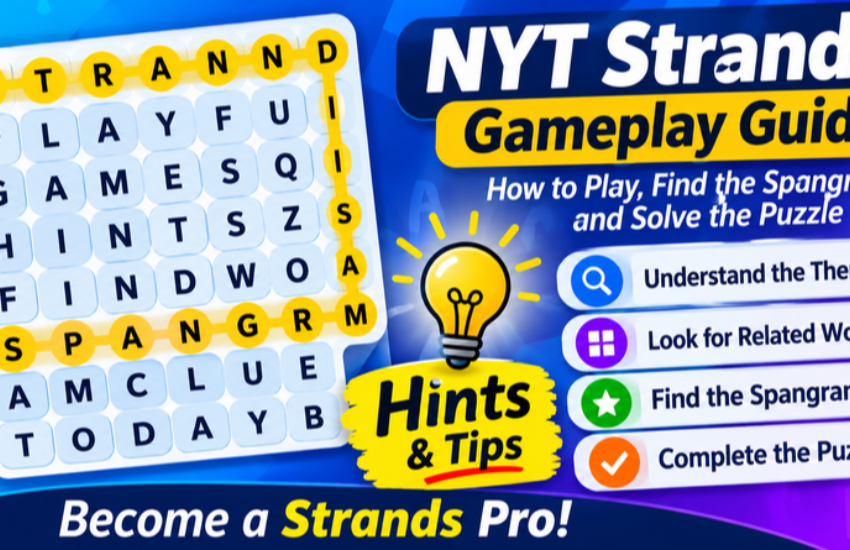
Daily word puzzles have become a popular part of the internet, especially for people who enjoy testing their vocabulary, improving their problem-solving skills, and starting the day with a little mental challenge. Among the many online word games available today, The New York Times’ Strands has developed a dedicated following. Its unusual letter-grid format, creative daily themes, and special Spangram feature make every puzzle feel a little different.
If you have searched for Strands hints today Mashable, you are probably looking for helpful clues that make solving the latest puzzle easier without immediately revealing every answer. Mashable is one of the websites that publishes daily guidance for NYT Strands, giving players access to theme explanations, hints, Spangram information, and complete solutions.
Strands is not quite like a traditional word search. Players must connect neighboring letters to create words related to a hidden theme. The words can move in different directions, turn around corners, and follow unexpected paths across the board. This makes the game entertaining, but it can also become challenging when the theme is unclear or the remaining letters seem impossible to organize.
The good news is that you do not need to be an expert word-game player to enjoy Strands. With a little patience, a good understanding of its rules, and carefully selected hints, you can solve most puzzles without feeling overwhelmed.
Let’s go through everything worth knowing about Strands hints today Mashable, including the November 16, 2026 puzzle, the meaning of its theme, the Spangram, useful solving techniques, and reasons why this daily word game continues to attract players.
Updated: Monday, November 16, 2026 | Today’s puzzle: NYT Strands #988
What Is Strands Hints Today Mashable?
Strands hints today Mashable refers to the daily clues and answer guides published for the New York Times Strands word puzzle. Mashable provides readers with information that can help them understand the day’s theme, identify possible answers, and complete the puzzle when they become stuck.
The search phrase is particularly useful for players who do not want to spend too much time searching randomly through the letter grid. Instead of immediately looking at a complete solution, readers can use smaller clues to work toward the correct words. This approach allows them to enjoy the challenge while receiving enough assistance to make progress.
Mashable’s daily Strands coverage generally follows a helpful structure. It introduces the theme, explains the central idea, provides a Spangram clue, and eventually reveals the complete word list. This makes it possible for players to choose how much assistance they want before seeing the answers.
Another reason people search for this phrase is convenience. Players often want one straightforward place to find information about the current puzzle rather than opening several websites. A daily guide can save time, especially when someone is trying to maintain a regular puzzle-solving routine.
Today’s NYT Strands Puzzle for November 16, 2026
Today’s puzzle #988
The November 16, 2026, Strands puzzle features the theme “What’s the big idea?” The central concept is related to becoming bigger, increasing in size, or experiencing an increase in volume or intensity.
At first, the theme might sound as though it refers to inventions, major discoveries, or important concepts. However, the actual answers focus on different ways something can increase in size. Recognizing this connection makes the puzzle considerably easier.
Today’s puzzle contains six regular theme words and one Spangram. The regular answers include words associated with growth, expansion, swelling, and increases. Once you understand that the theme is about getting bigger, several possibilities become easier to recognize.
The complete solution is provided below, but you can stop reading before the answer section if you would prefer to solve the puzzle independently.
Today’s Strands Theme Explained
The official theme for Monday, November 16, 2026, is “What’s the big idea?” This playful phrase encourages players to think about the meaning of something becoming larger rather than focusing on the general meaning of a big idea.
The theme connects six words that describe growth or an increase in size. Some refer to physical expansion, while others can describe an increase in quantity, intensity, or scale. This variety is what makes the puzzle interesting.
For example, something can grow naturally over time, expand into a larger space, or inflate when air enters it. A sudden increase can also be described as a surge. Although these words have slightly different meanings, they share the same general concept.
Understanding the relationship between the answers is more important than guessing individual words randomly. Once you identify the common idea, the letter grid begins to look much more manageable.
Strands Hints Today Mashable: Spoiler-Free Clues
One of the best ways to enjoy Strands is to use hints gradually. Looking at the complete answer list immediately can remove much of the excitement, particularly when the puzzle is not especially difficult. A spoiler-free approach gives you an opportunity to discover the words yourself.
For November 16, the central clue is about increasing size. Think about words that describe something becoming larger, expanding, or increasing in volume. You do not need to interpret the theme as a reference to inventions or intellectual ideas.
Here are some additional clues to help you approach today’s board:
- General hint: Think about things getting bigger.
- Meaning-based hint: Consider growth, swelling, and expansion.
- Shortest answer: It contains four letters and begins with G.
- Longest answers: Two theme words contain seven letters.
- Spangram clue: Look for a phrase that connects the idea of something being impressive or increasing in size.
These clues should give most players a reasonable starting point without immediately revealing the entire solution.
First Two Letters of Today’s Answers
If the general theme is not enough, the first two letters can provide another useful level of assistance. They help narrow down the possibilities while still requiring you to identify the complete words.
The starting-letter clues for today’s puzzle are:
| Answer position | First two letters |
|---|---|
| Theme word 1 | IN |
| Theme word 2 | GR |
| Theme word 3 | EX |
| Theme word 4 | SU |
| Theme word 5 | BL |
| Theme word 6 | EN |
| Spangram | TH |
These starting letters are particularly useful when you have already identified a few words but cannot work out the remaining combinations.
Try connecting the letters around each starting point rather than searching for the complete word in a straight line. Remember that Strands allows letters to change direction, so a word may take a surprising route through the board.
Today’s Strands Spangram Hint
The Spangram is one of the most important parts of every Strands puzzle. It is a special word or phrase that connects the daily theme and stretches across the board, touching two opposite sides.
For the November 16 puzzle, the Spangram is a phrase containing 14 letters when spaces are removed. Its wording connects naturally with the idea of something being particularly impressive or swell.
A useful strategy is to search for familiar expressions rather than concentrating exclusively on individual vocabulary words. Sometimes, a Spangram is a common phrase, a saying, or a combination of words that players recognize from everyday conversations.
Today’s Spangram is THATSJUSTSWELL.
This phrase provides an additional connection to the puzzle’s theme. The word “swell” can describe something becoming larger, while the expression can also be used to communicate approval or enthusiasm.
Finding the Spangram can make the remaining theme words easier to discover because it gives you a stronger understanding of the puzzle’s overall direction.
Today’s NYT Strands Answers for November 16, 2026
Spoilers ahead
If you have already tried the puzzle and want the complete solution, this section contains the answers for Strands #988.
The six regular theme words and the Spangram are:
| Type | Today’s answer |
|---|---|
| Theme word | BLOAT |
| Theme word | ENLARGE |
| Theme word | EXPAND |
| Theme word | GROW |
| Theme word | INFLATE |
| Theme word | SURGE |
| Spangram | THATSJUSTSWELL |
All six regular words describe an increase in size, volume, or intensity. The Spangram ties the concept together with a familiar expression.
The answer list is consistent with the November 16 puzzle guides published by Beebom, TechRadar, and other daily puzzle coverage. Beebom Puzzle+2
1. BLOAT
BLOAT is a five-letter word describing something that becomes excessively large, swollen, or expanded. It can refer to physical swelling, an inflated object, or something that has grown beyond its normal size.
The word is commonly used in everyday English. For example, a computer program might become bloated when unnecessary features and extra files make it unnecessarily large. Similarly, a person might describe a stomach as bloated when it feels swollen.
In today’s Strands puzzle, BLOAT fits because it represents an increase in size. Its meaning is slightly different from simple growth because it can suggest that the increase has become excessive.
2. ENLARGE
ENLARGE is a seven-letter word meaning to make something bigger or increase its dimensions. It is often used when discussing photographs, images, objects, documents, or physical spaces.
For instance, someone might enlarge a photograph before printing it. A business might enlarge its office to accommodate additional employees. In both situations, the original object or space becomes larger.
This word is a natural match for today’s theme because it directly communicates the process of increasing size. It is also one of the longer answers, which can make it slightly harder to locate within the grid.
3. EXPAND
EXPAND is another six-letter answer connected to growth and increased size. It describes something spreading out, becoming larger, or increasing in scope.
The word appears in many different contexts. A company can expand into new markets, a gas can expand when heated, and a person can expand their knowledge by learning new subjects.
What makes EXPAND interesting is that it does not always describe physical growth. It can also refer to opportunities, responsibilities, businesses, and ideas becoming broader.
In the November 16 puzzle, EXPAND is an important answer because it clearly supports the central concept of increasing size.
4. GROW
GROW is the shortest regular theme word in today’s puzzle. It contains only four letters, but its meaning is broad enough to cover many different situations.
Plants grow when they receive the resources needed to develop. Children grow as they become older, and businesses grow when their customers, operations, or revenue increase.
The word can also describe personal development. Someone can grow professionally by gaining experience, learning new skills, or taking on greater responsibilities.
Because GROW is short and commonly used, it is a useful word to search for early when solving today’s board.
5. INFLATE
INFLATE contains seven letters and describes the process of filling something with air or gas so that it increases in size. It can also refer to an increase in prices, costs, or monetary values.
A simple example is inflating a balloon. As air enters the balloon, it becomes larger and takes up more space. Another example is economic inflation, where the general prices of goods and services increase over time.
The word fits the theme because it represents a clear increase in volume or value. Its connection to the puzzle is especially easy to understand once you have identified the other growth-related answers.
6. SURGE
SURGE is a five-letter word describing a sudden increase or powerful upward movement. It can refer to a rise in demand, a sudden increase in water levels, or a rapid movement of people.
For example, an online store might experience a surge in visitors during a major sale. Electricity demand might surge during extremely hot weather when people use more cooling equipment.
Unlike GROW or ENLARGE, SURGE often emphasizes speed and intensity. The increase happens quickly rather than developing gradually over a long period.
That difference makes SURGE an interesting addition to today’s word list.
7. THATSJUSTSWELL – The Spangram
THATSJUSTSWELL is the special phrase connecting today’s puzzle. It contains 14 letters when written without spaces.
The expression “that’s just swell” is a familiar way of expressing enthusiasm or approval. The word “swell” also relates to increasing size, which makes the phrase especially appropriate for the daily theme.
Spangrams are often more challenging than ordinary theme words because they can contain multiple words and follow unusual paths through the board. Players need to think about the overall meaning rather than searching only for familiar single-word answers.
Today’s phrase provides a satisfying ending because it connects the playful wording of the theme with the vocabulary of growth and expansion.
How to Play NYT Strands
Understanding the basic rules makes it easier to enjoy Strands and use daily hints effectively. Although the game looks like a traditional word search, it introduces several mechanics that require a different approach.
The board contains letters arranged in a grid. Your job is to connect neighboring letters to create words associated with a hidden theme. Every letter on the board belongs to one of the final answers.
You can move horizontally, vertically, or diagonally between neighboring letters. Unlike a standard word search, however, the words do not have to follow a straight line. They can change direction as you trace their letters.
The game requires you to discover every theme word and the Spangram before completing the board. Once all the answers are found, the puzzle is considered solved.
Understanding the Daily Theme
Every Strands puzzle begins with a short theme description. This clue is designed to guide your thinking without revealing the complete word list.
Some themes are straightforward, while others involve expressions, cultural references, categories, or unusual connections between words.
For example, a theme involving animals might lead you toward names of different species. A puzzle about movement could include words describing walking, running, jumping, or dancing.
Today’s theme, “What’s the big idea?”, is an example of a clue that requires a little interpretation. Instead of thinking about inventions or important concepts, players need to recognize that the answers describe different forms of growth.
Connecting Letters in Different Directions
One of the most important Strands mechanics is the ability to change direction while connecting letters. This means that a correct word might move upward, downward, sideways, or diagonally.
Traditional word-search strategies are not always enough. Players who only search for straight horizontal or vertical words may overlook several correct answers.
A better approach is to identify a possible starting letter and examine all the neighboring positions. If the next letter matches the word you are considering, continue following the path.
You can adjust your selection when the letters do not form a valid word. This makes experimentation an important part of the game.
Finding Every Letter on the Board
Strands has an additional requirement that makes it different from many other word games: every letter must be used in a final answer.
You cannot simply find a few theme words and leave the remaining letters untouched. The complete board must be accounted for before the puzzle is finished.
This rule makes the Spangram especially important. Because it stretches across the board and connects opposite sides, discovering it can help organize the remaining letters.
It also explains why some puzzles become easier toward the end. Once several words have been removed, the remaining letters may form more recognizable patterns.
What Is a Spangram in NYT Strands?
A Spangram is a special answer that summarizes the central idea of a Strands puzzle. Unlike regular theme words, it must stretch across the board and touch two opposite sides.
The term combines the ideas of a span and an anagram-like word puzzle. It is one of the features that makes Strands different from ordinary word searches.
A Spangram can consist of a single word or multiple words written together. Players must identify its letters in the correct order, even when the path moves in unexpected directions.
Why Is the Spangram Important?
The Spangram provides an important clue about the overall theme. Once you discover it, you often have a much better understanding of what the remaining answers should describe.
For example, today’s THATSJUSTSWELL connects the idea of something becoming larger with a familiar expression. That connection makes BLOAT, ENLARGE, EXPAND, GROW, INFLATE, and SURGE easier to recognize.
Finding the Spangram can also help divide the board into smaller sections. This makes it easier to inspect the remaining letters and identify possible word combinations.
Does the Spangram Always Run in a Straight Line?
No. A Spangram does not have to follow a perfectly straight horizontal or vertical path. It can move through neighboring letters in different directions, depending on the arrangement of the board.
This is why players should avoid assuming that a long answer will always appear in a simple line. Looking for changes in direction can reveal possibilities that are easy to miss.
The most useful strategy is to combine the theme clue with the letters you can see. If a familiar expression fits the theme, try searching for its letters throughout the grid.
How to Get Hints in Strands Without Looking Up Answers
You do not always need an external website to receive assistance. Strands includes an in-game hint system that can help you discover theme words when you become stuck.
One useful feature is the ability to earn hints by finding non-theme words. These are valid words that appear in the letter grid but are not part of the final theme answer list.
Finding three qualifying non-theme words earns an in-game hint. The hint helps reveal the letters of a theme word, making it easier to complete the puzzle.
This system encourages exploration instead of requiring players to guess the answers immediately.
Search for Short Everyday Words
A good way to earn hints is to look for short, familiar words in the grid. You might discover words related to ordinary activities, objects, or descriptions.
Do not focus exclusively on the daily theme when searching for these extra words. Sometimes, looking at the letters from a different perspective reveals combinations that you would otherwise overlook.
The important thing is to find valid words that meet the game’s requirements. Once you have earned a hint, use the revealed information to return to the main puzzle.
Use Hints Only When Necessary
It is tempting to use a hint whenever you encounter a difficult section. However, waiting a little longer can make the eventual discovery more satisfying.
Try identifying the theme, searching for shorter words, and examining the edges of the board before requesting help. You may discover that the answer was visible all along.
There is no need to feel bad about using the hint feature, though. The game is designed to be entertaining, and hints are available to help players continue enjoying it.
Best Strategies for Solving NYT Strands Faster
Solving Strands consistently requires a combination of vocabulary, observation, patience, and logical thinking. You do not need an advanced vocabulary to become better at the game, but developing a few habits can make a significant difference.
The following strategies can help you recognize answers more quickly while reducing unnecessary guessing.
1. Read the Theme More Than Once
Before connecting any letters, spend a few moments thinking about the theme. A short description can have several possible meanings, so it is important not to settle on the first interpretation that comes to mind.
For example, today’s “What’s the big idea?” could initially suggest inventions, important discoveries, or major plans. However, the actual answers focus on growth and increases in size.
Thinking about alternative interpretations can help you avoid wasting time searching for unrelated words.
2. Look for the Shortest Possible Answers
Short words are often easier to identify because they require fewer connected letters. They can also provide useful clues about the daily theme.
Today’s GROW is a good example. Once you discover this four-letter word, you immediately know that the puzzle involves getting bigger.
From there, you can search for longer words with similar meanings, such as EXPAND and ENLARGE.
3. Examine the Corners and Edges
Letters positioned near the corners and edges of the board can be useful starting points. They have fewer neighboring positions than letters in the middle, which can sometimes make potential connections easier to evaluate.
However, do not assume that every important answer begins at an edge. A word may start in the center and travel toward the outside.
Use the edges as an initial scanning strategy rather than a strict rule.
4. Think About Synonyms
Synonyms are extremely useful when solving themed word puzzles. If you understand the general meaning of the theme, start thinking about alternative words that express the same idea.
For a theme about growth, possible words might include increase, enlarge, expand, rise, and develop.
Not every synonym will appear in the actual puzzle, but creating a small list of possibilities gives you a useful starting point.
5. Do Not Ignore Diagonal Connections
Diagonal movement is an important part of Strands. Some answers may be difficult to identify because their letters do not follow a familiar horizontal or vertical pattern.
When searching for a word, inspect all neighboring directions. A diagonal connection might be the missing link between two letters.
This technique is particularly useful when you recognize most of a word but cannot identify the position of one letter.
6. Find the Spangram Early
Many experienced players prefer to search for the Spangram early because it can clarify the theme and make the rest of the puzzle easier.
However, there is no requirement to find it first. Some players prefer discovering several shorter words before attempting the longest answer.
Experiment with both approaches and see which one feels more natural.
7. Avoid Random Letter Selection
Randomly connecting letters can waste time and make the board feel more confusing. It is better to begin with a word you believe might fit the theme.
Look for its starting letter, check the neighboring positions, and follow a logical path. If the combination does not work, move on to another possibility.
A thoughtful approach usually produces better results than repeatedly selecting unrelated letters.
Why Players Search for Strands Hints Today Mashable
The popularity of searches for Strands hints today Mashable reflects the growing interest in daily word puzzles. People want quick access to reliable clues without spending too much time navigating complicated websites.
Mashable has developed a recognizable approach to daily puzzle coverage. Its articles generally offer a theme explanation, supporting hints, Spangram information, and the complete word list.
This format is useful for people with different solving preferences. Someone who only needs a small clue can stop early, while someone who wants to finish the entire puzzle can continue to the solution.
Quick Access to Daily Puzzle Information
One reason players use daily hint articles is convenience. Instead of searching for every answer individually, they can find the important information in one place.
A well-organized article also makes it easier to distinguish between a general hint and a complete spoiler. This is important because not everyone wants the entire solution immediately.
Players can use the information at their own pace, depending on how much of the puzzle they have already completed.
Helpful Explanations Instead of Just Answers
A good puzzle guide should explain why the answers fit the theme. Simply listing six words does not always help someone understand the puzzle.
For instance, knowing that SURGE means a sudden increase provides more context than seeing the word by itself.
Similarly, explaining why THATSJUSTSWELL works as the Spangram helps players recognize the connection between the expression and the idea of growth.
This type of explanation makes daily guides useful for learning as well as completing puzzles.
A Convenient Resource for Regular Players
People who solve Strands every morning often develop a routine. They may play before work, during a break, or while relaxing at home.
Daily hint pages fit naturally into this routine because they offer a quick way to overcome difficult sections.
However, it is worth remembering that the New York Times is the source of the original game. Mashable and other publications provide independent guides rather than creating the official puzzle.
Difference Between Strands, Wordle, and Connections
The New York Times offers several popular word games, but each one has a different format. Strands, Wordle, and Connections all test language skills, although they require different approaches.
Understanding these differences can help players decide which game they enjoy most.
| Feature | Strands | Wordle | Connections |
|---|---|---|---|
| Main objective | Find themed words | Guess a hidden word | Group related words |
| Gameplay | Letter connections | Word guesses | Category identification |
| Main challenge | Finding word paths | Identifying letters | Recognizing relationships |
| Special feature | Spangram | Limited guesses | Four word groups |
| Daily format | Yes | Yes | Yes |
Strands Compared With Wordle
Wordle focuses on identifying one five-letter word within a limited number of guesses. Players receive feedback after each attempt, showing whether their letters are correctly positioned or included in the answer.
Strands is more focused on discovering several words within a shared theme. Instead of entering complete guesses, players connect letters directly on the board.
Both games require vocabulary knowledge, but Strands introduces an additional visual challenge. Players must recognize words and understand how their letters connect.
Strands Compared With Connections
Connections challenges players to identify relationships between 16 words and organize them into four groups.
Strands also uses themes, but its answers are hidden within a letter grid rather than presented as a list of separate words.
Both games reward creative thinking. Sometimes, the biggest challenge is not recognizing a familiar word but understanding the less obvious relationship connecting several answers.
Common Mistakes Players Make While Solving Strands
Even experienced players sometimes struggle with Strands. The game may appear simple, but small mistakes can make the board unnecessarily difficult.
Recognizing these mistakes can help you develop a more effective solving strategy.
Ignoring Alternative Meanings of the Theme
One common mistake is interpreting the daily theme too literally. A short phrase might have several possible meanings, and choosing the wrong interpretation can send you in the wrong direction.
Today’s theme is a good example. “What’s the big idea?” could suggest something intellectual, but the answers are actually connected to growth and increased size.
Always consider alternative meanings before deciding what types of words to search for.
Searching Only for Long Words
Long words can look impressive, but they are not necessarily the easiest answers to identify. Starting with shorter words can provide valuable information about the puzzle.
For example, discovering GROW immediately establishes a connection with the idea of increasing size.
Once that connection becomes clear, longer answers such as INFLATE and ENLARGE become easier to recognize.
Forgetting About the Spangram
Some players concentrate so heavily on the regular theme words that they forget to search for the Spangram.
This can make the remaining board harder to understand. The Spangram is not just another answer; it summarizes the theme and provides an important clue.
Make a habit of considering possible Spangrams whenever you understand the daily concept.
Using Too Many Random Guesses
Randomly selecting letters without a clear idea can lead to unnecessary frustration.
Instead, think about possible words and use the board to test those possibilities. This approach makes your decisions more organized and reduces wasted effort.
If you become stuck, take a short break and return with a fresh perspective.
Is NYT Strands Good for Improving Vocabulary?
Strands can be an enjoyable way to interact with language and discover different word meanings. Although it is primarily designed as entertainment, the game also encourages several useful mental activities.
Players regularly encounter synonyms, expressions, and words that describe related concepts. Over time, this can help them become more comfortable recognizing vocabulary relationships.
Today’s puzzle provides a good example because its answers include several different ways of describing growth.
Learning New Words Through Context
Words become easier to understand when they are connected to familiar situations.
For example, ENLARGE describes making something bigger, while EXPAND can refer to increasing physical size or broadening an idea. SURGE generally emphasizes a sudden increase.
Understanding these differences makes vocabulary more meaningful than simply memorizing definitions.
Developing Better Word Recognition
Regularly solving word puzzles encourages players to recognize common letter combinations and familiar expressions.
When you repeatedly search for words, you may become quicker at identifying their possible starting and ending letters.
This does not mean that playing Strands guarantees improvements in every language skill. However, it provides an enjoyable opportunity to practice recognizing patterns and working with vocabulary.
Encouraging Critical Thinking
The game also encourages players to consider multiple possibilities before making a decision.
A word may seem obvious at first, but its letters might not connect in the required order. You must evaluate the available options and adjust your thinking.
This process makes Strands more engaging than a basic word-search activity.
Where Can You Play the Official NYT Strands Game?
The official Strands puzzle is available through the New York Times Games platform. Players can access it through the website or supported mobile experiences.
The game is designed around a daily puzzle format, meaning a new challenge becomes available each day.
For the most accurate puzzle experience, use the official game rather than relying on unofficial copies that may have different rules or outdated answers.
You can visit the official website here:
Play NYT Strands – Official Game.
Playing on a Desktop Computer
Playing Strands on a desktop provides a larger view of the letter grid. This can be useful when you want to inspect several possible word paths at once.
Use your mouse to select and connect letters. The larger display may also make it easier to compare different sections of the board.
Desktop play is a convenient option for people who already spend time working or browsing online.
Playing on a Smartphone
Smartphone users can enjoy Strands through a supported mobile browser or the New York Times Games experience.
The touchscreen format makes it possible to connect letters by dragging a finger across the board.
Mobile gaming is especially convenient because you can solve the daily puzzle during a break or while traveling.
Does Strands Require an Internet Connection?
The official online experience generally requires an internet connection to access the current daily puzzle and its game features.
Availability and access conditions can depend on the New York Times platform, account status, and subscription arrangements.
It is best to check the official website for current access requirements rather than assuming that every feature is available without restrictions.
Frequently Asked Questions About Strands Hints Today Mashable
1. What Are the Strands Hints Today for November 16, 2026?
Today’s Strands theme is “What’s the big idea?” The puzzle focuses on words associated with increasing size, volume, or intensity. The six regular answers are BLOAT, ENLARGE, EXPAND, GROW, INFLATE, and SURGE. The Spangram is THATSJUSTSWELL.
2. What Is Today’s NYT Strands Spangram?
The Spangram for Monday, November 16, 2026, is THATSJUSTSWELL. It contains 14 letters when spaces are removed. The phrase connects the idea of something becoming larger with the familiar expression “that’s just swell.”
3. What Is the Theme of Today’s Strands Puzzle?
Today’s official theme is “What’s the big idea?” It focuses on different words that describe growth, enlargement, expansion, and increases. Understanding this relationship makes the regular theme words easier to discover.
4. How Many Words Are in Today’s Strands Puzzle?
Today’s puzzle contains six regular theme words and one Spangram, making seven answers in total. Every letter on the board belongs to one of these answers.
5. Is Mashable a Good Place to Find Strands Hints?
Mashable is a useful source for daily Strands guidance. Its puzzle coverage generally includes theme explanations, clues, Spangram information, and complete answers. Players should still verify the puzzle date because daily answers change.
6. How Does the Strands Hint System Work?
Players can earn an in-game hint by finding three qualifying non-theme words of at least four letters. The hint reveals information about a theme word and helps players continue solving the puzzle.
7. Can Words Move Diagonally in NYT Strands?
Yes. Words can connect horizontally, vertically, and diagonally. They can also change direction during the selection process. This is one of the main differences between Strands and traditional word-search games.
8. What Happens When You Find the Spangram?
The Spangram is highlighted when successfully identified. It provides a strong indication of the daily theme and can help players recognize the remaining answers. Finding it is an important milestone in completing the puzzle.
9. Is NYT Strands Similar to Wordle?
Both games are daily word puzzles published by The New York Times, but their gameplay is different. Wordle involves guessing one hidden five-letter word, while Strands requires players to discover several themed words within a connected letter grid.
10. Can Beginners Play NYT Strands?
Absolutely. Beginners can start playing without advanced vocabulary knowledge. The daily theme, letter connections, and built-in hint system make the game approachable. With regular practice, players can gradually become more comfortable identifying possible answers.
11. Does Every Strands Puzzle Have a Spangram?
Yes. The Spangram is a central feature of the Strands format. It connects opposite sides of the grid and represents the main idea behind the day’s theme.
12. When Does a New Strands Puzzle Become Available?
Strands follows a daily release schedule, with a new puzzle becoming available around midnight according to the relevant time zone. Because release timing depends on location, players in different parts of the world may experience the daily change at different local times.
Conclusion
Searching for Strands hints today Mashable is a convenient way to find daily clues, understand the latest NYT Strands theme, and complete a challenging word puzzle. The game combines traditional word-search mechanics with creative themes, flexible letter connections, and the unique Spangram feature.
Today’s November 16, 2026, puzzle, #988, revolves around the theme “What’s the big idea?” Its six regular answers are BLOAT, ENLARGE, EXPAND, GROW, INFLATE, and SURGE, while the Spangram is THATSJUSTSWELL.
The most effective way to approach Strands is to understand the theme first, search for shorter words, explore diagonal connections, and use the in-game hint system when necessary. Finding the Spangram can also make the remaining answers easier to recognize.
Whether you are a beginner or an experienced word-game enthusiast, Strands offers an enjoyable daily challenge. You can use Mashable’s hints when you need assistance, but try solving as much as possible independently before revealing the complete answer list.
Ultimately, the best part of Strands is the satisfaction of recognizing a hidden connection and watching the entire board come together. Make it part of your daily routine, enjoy the challenge, and keep developing your word-solving skills one puzzle at a time.
YOU MAY HAVE MISSED