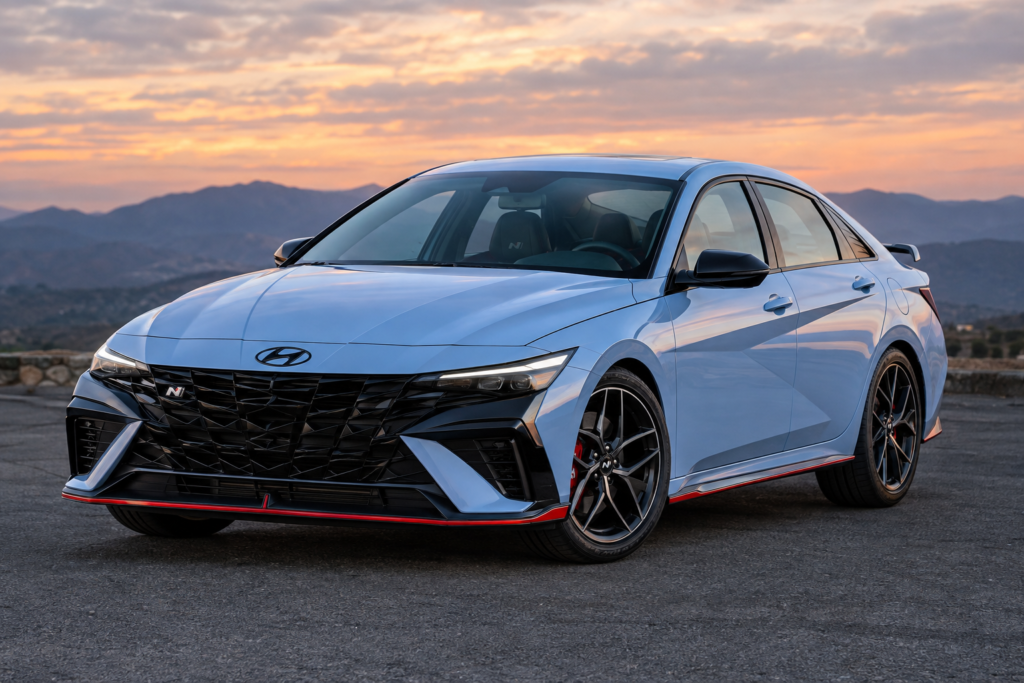
The Elantra N is one of those cars that seems almost too good to exist in the modern performance-car market. It takes the familiar practicality of a compact sedan and combines it with a serious performance package designed for drivers who actually enjoy being behind the wheel. Instead of simply adding a few aggressive styling pieces to an ordinary Elantra, Hyundai developed the N as a genuine performance model with a turbocharged engine, electronically controlled suspension, high-performance brakes, an electronic limited-slip differential, and a choice of manual or dual-clutch transmissions.
What makes the Elantra N especially interesting is its personality. It can be perfectly usable during a normal commute, yet it has the hardware and software necessary to become dramatically more entertaining when the road opens up. The 2026 U.S.-market model uses a 2.0-liter turbocharged four-cylinder producing 276 horsepower and 289 lb-ft of torque, with front-wheel drive as standard. Buyers can choose between a six-speed manual transmission and an eight-speed wet dual-clutch transmission.
The result is a sports sedan that does not take itself too seriously. The exhaust can be loud, the styling can be bold, and the driving modes can completely change the character of the car. At the same time, there is enough practicality for everyday life. That combination is the real reason the Elantra N has developed such a strong following among enthusiasts.
What Is the Elantra N?
The Elantra N is the high-performance version of Hyundai’s Elantra sedan. The “N” badge represents Hyundai’s performance division, which developed its reputation by combining motorsport-inspired engineering with road-going cars. The Elantra N takes that philosophy seriously rather than treating performance as nothing more than an appearance package.
Under the hood is a 2.0-liter turbocharged four-cylinder engine. In the current U.S. specification, it produces 276 horsepower and 289 lb-ft of torque. Hyundai pairs that engine with front-wheel drive and gives customers the choice of a six-speed manual or an eight-speed wet dual-clutch transmission. The car also includes an N Corner Carving Differential, electronically controlled suspension, launch control, and several selectable driving modes.
That hardware gives the Elantra N a much more focused personality than the standard Elantra. It is still a four-door sedan with useful passenger and cargo space, but its priorities change dramatically when the driver selects one of the more aggressive N modes. The car becomes sharper, louder, and more responsive, making it equally interesting to enthusiasts who want a daily driver and those who occasionally visit a racetrack.
Elantra N Engine and Performance
The heart of the Elantra N is its 2.0-liter turbocharged four-cylinder engine. Hyundai rates the U.S.-market engine at 276 horsepower and 289 lb-ft of torque. That is substantial output for a compact front-wheel-drive sedan, and it gives the car strong acceleration without requiring a large-displacement engine.
One of the most appealing aspects of this engine is its broad torque delivery. Maximum torque is available across a useful portion of the rev range, which means the car does not need to be driven at extremely high RPM to feel quick. Whether accelerating onto a highway or powering out of a corner, the engine has enough mid-range strength to make the Elantra N feel energetic.
The engine also responds well to the car’s different driving modes. Hyundai designed the N system so that drivers can alter throttle response, steering, suspension, exhaust behavior, and other characteristics. The result is not simply a powerful engine but a powertrain that can feel completely different depending on how the driver configures the vehicle.
How Fast Is the Elantra N?
Straight-line speed is not the only reason people buy the Elantra N, but the car is certainly quick. Independent testing has demonstrated that the dual-clutch version can reach 60 mph in well under five seconds. Car and Driver has recorded a 4.8-second 0-to-60-mph time for an automatic-equipped Elantra N, while the manual version is slower but adds a much more traditional enthusiast experience.
The eight-speed dual-clutch transmission has another trick available through Hyundai’s N Grin Shift system. When activated, the system temporarily increases engine output on DCT-equipped cars and changes the behavior of the transmission to deliver a more aggressive acceleration experience. Hyundai markets this feature as part of the car’s performance-focused N philosophy.
However, acceleration numbers only tell part of the story. The Elantra N becomes more impressive when speed has to be carried through corners. Its electronically controlled suspension, performance tires, electronic limited-slip differential, and steering system work together to make the car feel much more capable than a typical compact sedan.
Elantra N Manual vs. DCT
Choosing between the six-speed manual and eight-speed dual-clutch transmission depends largely on what the driver values. The manual is the obvious choice for someone who wants maximum involvement. It gives the driver direct control over gear selection and allows them to coordinate clutch, throttle, braking, and shifting themselves.
The manual transmission also gives the Elantra N a classic sports-car character. Hyundai includes rev-matching technology to make downshifts smoother, while the driver can still choose how aggressively to operate the car. For an enthusiast who sees driving as an activity rather than simply transportation, that involvement is difficult to replace.
The DCT, meanwhile, is the performance-oriented choice for drivers who want maximum acceleration and rapid shifts. It also makes the car easier to use in traffic because there is no clutch pedal to manage. The DCT version is capable of extremely quick acceleration, although some independent reviews have noted that its low-speed behavior can occasionally feel less smooth than a conventional automatic.
Elantra N Handling and Cornering Ability
Handling is arguably where the Elantra N separates itself from many ordinary sport sedans. Hyundai did not simply increase engine output and call the job finished. The chassis received extensive performance-focused engineering, including electronically controlled suspension and an electronically controlled limited-slip differential.
The N Corner Carving Differential is particularly important. During cornering, the system can distribute torque between the front wheels to improve traction and reduce understeer. That allows the driver to carry more speed through corners and gives the car a more controlled response when accelerating out of a bend.
The electronically controlled suspension is another major part of the experience. Instead of relying on one fixed suspension setting, the car can adjust damping according to the selected drive mode and driving conditions. That means the Elantra N can be relatively comfortable when cruising but much more aggressive when the driver chooses a performance setting.
The Role of the eLSD
Front-wheel drive creates an interesting engineering challenge for a high-powered performance car. When a powerful engine sends torque through the front wheels, the inside tire can lose traction during hard cornering. That can create understeer and reduce the driver’s ability to accelerate efficiently.
Hyundai addresses this with the N Corner Carving Differential, commonly referred to as the eLSD. The system actively manages torque distribution between the front wheels. Instead of allowing one wheel to spin excessively, the differential helps the car put power down more effectively.
This is one of the features that makes the Elantra N feel like a purpose-built performance car rather than an ordinary sedan with a powerful engine. The eLSD works in combination with the suspension, steering, tires, and electronic controls to make corner exits more controlled and exciting.
For enthusiastic drivers, the difference can be particularly noticeable on a winding road or racetrack. Rather than simply asking the driver to be gentle with the throttle, the chassis is designed to help manage the engine’s power.
Elantra N Brakes and Track Capability
A performance car needs more than acceleration. Once the car is moving quickly, it needs to slow down repeatedly without losing braking performance. The Elantra N therefore receives larger performance-oriented brakes designed to tolerate higher temperatures than ordinary passenger-car braking systems.
The current U.S. model uses ventilated front and rear rotors, with 14.2-inch front rotors and 12.4-inch rear rotors. Hyundai also uses high-performance calipers and friction materials intended to provide strong stopping performance.
Hyundai’s N engineering philosophy goes further than simply fitting larger rotors. The N model includes features intended to improve brake cooling and durability during demanding driving. Hyundai’s global N information highlights air-guiding and cooling solutions designed to help manage heat generated during braking.
That does not mean every Elantra N owner should immediately take the car to a racetrack without preparation. Track driving places much greater demands on tires, fluids, brakes, and other components than normal road driving. Still, the factory hardware gives the Elantra N a strong foundation for occasional track use.
Elantra N Suspension and Ride Quality
The suspension is one of the most carefully balanced parts of the Elantra N. A performance car needs enough stiffness to control body movement, but a daily driver cannot be so rigid that every road imperfection becomes unpleasant.
Hyundai addresses this with electronically controlled suspension. Drivers can change the character of the car through its drive modes, allowing the suspension to behave differently depending on the situation. A softer configuration can make normal driving more comfortable, while the aggressive settings are better suited to spirited driving.
There is still no pretending that the Elantra N is a luxury sedan. Its performance tires and firm chassis mean that sharp bumps can be noticeable. That is part of the trade-off for the car’s impressive cornering ability.
For most enthusiasts, however, that compromise makes sense. The Elantra N is supposed to communicate with its driver. The steering, suspension, tires, and brakes are all designed to provide information rather than isolate the driver completely from the road.
Elantra N Exterior Design
The Elantra N looks considerably more aggressive than a standard Elantra. Its front fascia is lower and more purposeful, while the car receives N-specific aerodynamic elements, darker exterior details, side sill extensions, a rear spoiler, and a diffuser-style rear treatment.
The styling is intentionally dramatic. Some buyers will love the aggressive appearance, while others may find it too busy. That is a matter of personal taste, but there is little doubt that the Elantra N has a strong visual identity.
The performance tires are another important visual and functional element. The current U.S. model uses 19-inch wheels with wide Michelin Pilot Sport 4 S summer tires. Hyundai specifically positions these tires as part of the car’s performance package, providing a large contact patch for improved grip.
The result is a sedan that does not hide its intentions. Even when parked, the Elantra N looks like a car designed to be driven enthusiastically.
Elantra N Interior and Comfort
Inside, Hyundai gives the Elantra N a cabin that blends everyday usability with performance details. Sport-oriented seats, an N-specific steering wheel, performance displays, alloy pedals, and other details help distinguish it from a regular Elantra.
The sport seats are particularly useful during enthusiastic driving because they provide more support than ordinary passenger-car seats. At the same time, the cabin remains practical enough for everyday use, which is one of the Elantra N’s biggest strengths.
Technology is also a significant part of the package. The 2026 model includes a 10.25-inch touchscreen navigation system, a digital gauge cluster, performance information, a lap timer, N track-related displays, Apple CarPlay, Android Auto, wireless charging, and a Bose premium audio system.
This combination makes the car easier to live with than a stripped-down track special. You can enjoy performance features on a weekend drive and still have the technology and convenience expected from a modern daily driver.
Elantra N Driving Modes
One of the most entertaining parts of the Elantra N is its ability to change personality. Hyundai provides multiple driving modes, including Eco, Normal, Sport, N, and Custom. Each setting can alter different aspects of the car’s behavior.
Eco and Normal are useful for ordinary commuting. The car can be driven calmly and efficiently when there is no reason to use its more aggressive characteristics. This flexibility is important because nobody wants to drive at maximum intensity every time they leave home.
Sport and N modes bring a sharper response. Throttle sensitivity increases, steering behavior changes, suspension settings can become more aggressive, and the exhaust system becomes more vocal. The driver can also create a Custom setup that combines preferred settings.
That flexibility is one of the Elantra N’s biggest advantages. Instead of forcing the owner to accept one personality, the car lets the driver decide how much performance is appropriate at any given moment.
Elantra N Exhaust Sound
Sound is an important part of the N experience. Hyundai gives the Elantra N a variable exhaust valve system designed to change exhaust character depending on driving conditions and selected settings.
The exhaust note is deliberately energetic. Under aggressive driving, the car produces a much more dramatic sound than a normal compact sedan. This contributes to the sense of occasion and makes acceleration feel more exciting.
Hyundai has also developed electronic sound-related features as part of its broader N philosophy. The global Elantra N specification describes an N Sound Equalizer designed to enhance the driving experience through selectable sound characteristics.
That said, the loudest setting is not always the best setting. During a long highway trip, a quieter configuration may be more pleasant. The ability to switch between personalities is therefore more useful than simply having an extremely loud exhaust all the time.
Elantra N Fuel Economy
Despite its performance focus, the Elantra N is not impossibly expensive to operate. The official U.S. specifications list the manual model at an EPA-estimated 21 mpg city, 29 mpg highway, and 24 mpg combined. The DCT version is rated at 20 mpg city, 27 mpg highway, and 23 mpg combined.
Real-world fuel economy can vary considerably depending on driving style. A driver who frequently uses high RPM, aggressive acceleration, and performance modes will naturally use more fuel than someone who cruises gently on highways.
Interestingly, independent testing has shown that the Elantra N can perform reasonably well during steady highway driving. Car and Driver recorded 37 mpg in a 75-mph highway fuel-economy test with an automatic-equipped example, demonstrating that the engine does not have to consume enormous amounts of fuel simply because it is capable of producing serious power.
That efficiency helps make the Elantra N more practical as an everyday car. It is not an economy sedan, but its performance does not make it completely impractical for regular commuting.
Is the Elantra N Good for Daily Driving?
One of the most impressive things about the Elantra N is that it can serve as a daily driver without giving up its performance identity. It has four doors, usable rear seating, a practical trunk, modern technology, and a relatively manageable footprint.
The seating position and cabin layout are also familiar enough for normal driving. The car does not feel like a race car that has been barely adapted for road use. Instead, it feels like a production sedan that has received an extensive performance transformation.
There are compromises, of course. The ride can be firm, performance tires can generate road noise, and the aggressive exhaust can become tiring if used constantly. The DCT can also feel less refined at very low speeds than a traditional automatic, according to independent testing.
Still, those compromises are relatively easy to understand when you consider what the car is designed to do. If you want a compact sedan that can commute during the week and provide genuine driving excitement on weekends, the Elantra N makes a strong case for itself.
Elantra N Technology and Safety
Performance does not mean Hyundai ignored technology and safety. The current Elantra N includes a substantial collection of driver-assistance systems as standard equipment.
Available safety features include forward collision avoidance with pedestrian detection, blind-spot collision warning, rear cross-traffic collision avoidance, lane keeping assistance, lane following assistance, driver attention warning, high-beam assistance, and safe-exit warning.
The car also includes practical convenience technology such as Hyundai Digital Key, connected services, proximity entry, push-button starting, dual-zone automatic climate control, and a digital instrument cluster.
Of course, driver-assistance technology should not be confused with autonomous driving. These systems are designed to support the driver, not replace attention or responsibility. That is especially important in a performance-focused car, where the driver should remain actively engaged.
Elantra N vs. Other Performance Cars
The Elantra N competes in an increasingly interesting segment of affordable performance vehicles. Depending on the market, shoppers may compare it with cars such as the Honda Civic Si, Honda Civic Type R, Volkswagen GTI, Volkswagen Golf R, and Toyota GR Corolla.
Its biggest advantage is the balance between price and performance. Car and Driver has described the Elantra N as offering sports-sedan performance at a relatively accessible price, while ranking it among the strongest compact performance cars.
The competition is not identical, though. Some rivals offer all-wheel drive, some prioritize refinement, and others provide a more premium interior. The Elantra N instead focuses heavily on driver engagement and performance hardware while maintaining the practicality of a four-door sedan.
That makes it particularly attractive to enthusiasts who do not want to spend luxury-car money for a genuinely entertaining vehicle. It does not attempt to be everything to everyone, and that focus is part of its appeal.
Elantra N TCR and Motorsport Influence
The N brand has strong connections to motorsport, and the Elantra N’s engineering reflects that influence. Hyundai has developed racing versions of the Elantra, including Touring Car Racing applications, which have helped reinforce the connection between the road car and competition vehicles.
For 2026, Hyundai also introduced the limited-edition Elantra N TCR in certain markets. Independent testing found that the TCR version remained extremely close to the regular Elantra N in several performance tests, illustrating that the standard car was already highly capable.
That is an important point. You do not need a special racing-inspired edition to understand what makes the Elantra N interesting. The regular production model already incorporates many performance-focused technologies that enthusiasts normally associate with much more expensive vehicles.
The motorsport connection also explains why Hyundai places so much emphasis on braking, cooling, chassis balance, differential behavior, steering response, and track-oriented displays.
Elantra N Ownership Experience
Owning an Elantra N is different from owning a normal compact sedan because the performance hardware influences everyday expenses. Tires, brakes, fuel, and maintenance can cost more when the car is driven aggressively.
The performance summer tires deserve particular attention. They provide excellent grip in appropriate conditions, but summer tires are not designed for cold-weather use. Hyundai notes that performance summer tires can become noisy in low temperatures and recommends winter tires for appropriate cold-weather conditions.
Owners should also understand that spirited driving increases wear. A car that spends most of its life cruising gently on highways will experience a very different maintenance burden from one that frequently sees mountain roads and racetracks.
On the positive side, the Elantra N gives owners a lot of performance without requiring exotic-car ownership. Parts, service, and general vehicle support are much easier to approach than they would be with a rare European performance car.
Pros and Cons of the Elantra N
One of the biggest advantages of the Elantra N is its driving character. It feels genuinely engineered for enthusiasts rather than simply marketed toward them. The engine is strong, the chassis is capable, and the car provides an impressive amount of feedback.
Another advantage is flexibility. The manual transmission appeals to traditional enthusiasts, while the DCT provides rapid performance and easier everyday operation. The adjustable driving modes also mean that the car can be configured for commuting or spirited driving.
The disadvantages are mostly connected to the same performance-focused philosophy. The ride can be firm, the tires can be noisy, the styling may be polarizing, and the DCT can be somewhat clunky at low speeds. Car and Driver has also pointed out that adaptive cruise control is not offered, which may matter to buyers who prioritize highway-assistance features.
Overall, the strengths greatly outweigh the weaknesses for the type of buyer the car targets. Someone looking for a quiet, luxurious cruiser may not love it. Someone looking for an entertaining sports sedan is much more likely to appreciate it.
Who Should Buy the Elantra N?
The Elantra N makes the most sense for someone who wants a practical car but refuses to give up driving enjoyment. It is particularly appealing to enthusiasts who want a vehicle that can handle commuting, errands, road trips, and weekend driving without needing a second car.
The manual model is ideal for drivers who enjoy mechanical involvement. Shifting gears, controlling the clutch, and managing engine speed can make every drive feel more personal. It is the version that most strongly represents the traditional enthusiast formula.
The DCT version is better for someone who wants quick acceleration with less effort. It is especially attractive to drivers who spend a lot of time in traffic but still want serious performance when the road becomes interesting.
In either case, the Elantra N works best for buyers who value driving dynamics over luxury. If performance, feedback, practicality, and value are high on the priority list, it deserves serious consideration.
Is the Elantra N Worth It?
The Elantra N is worth considering because it offers something increasingly rare: a reasonably practical sedan that feels purpose-built for people who love driving. Its 2.0-liter turbocharged engine, manual transmission option, DCT, eLSD, electronically controlled suspension, performance brakes, and sticky tires give it legitimate sports-car credentials.
It also avoids the mistake of making performance the only priority. The cabin remains technologically equipped, there are four doors, and the car can comfortably perform ordinary daily duties. That versatility makes the Elantra N easier to justify than a vehicle designed almost exclusively for weekend use.
Perhaps the strongest argument for the car is how much personality it provides. Many modern vehicles are extremely capable but feel isolated from the driver. The Elantra N takes a different approach. It wants the driver to notice the engine, feel the steering, hear the exhaust, and understand what the tires are doing.
That sense of involvement is ultimately what makes the Elantra N special. It is not simply a fast Elantra. It is a performance sedan with a clear identity, and that identity has helped it become one of Hyundai’s most interesting enthusiast vehicles.
Final Thoughts on the Elantra N
The Elantra N proves that an affordable compact sedan can still be exciting in an era when many performance vehicles are becoming larger, heavier, more complicated, or significantly more expensive. Hyundai has taken the basic formula of a practical four-door car and added the technology and hardware necessary to make it genuinely entertaining.
Its 276-horsepower turbocharged engine provides plenty of punch, while the eLSD and electronically controlled suspension help turn that power into usable performance. The manual transmission keeps traditional enthusiasts interested, while the eight-speed wet DCT offers extremely quick acceleration and convenient everyday driving.
The car also demonstrates that performance does not necessarily require sacrificing practicality. You can drive it to work, carry passengers, use modern infotainment, travel on the highway, and still enjoy a focused performance experience when the opportunity appears.
Ultimately, the Elantra N is for drivers who believe a car should do more than simply move from one location to another. It should make you look forward to the next corner, the next open road, and sometimes even the next morning commute. That combination of usability, technology, personality, and performance is exactly what makes the Elantra N such an appealing modern sports sedan.
YOU MAY HAVE MISSED