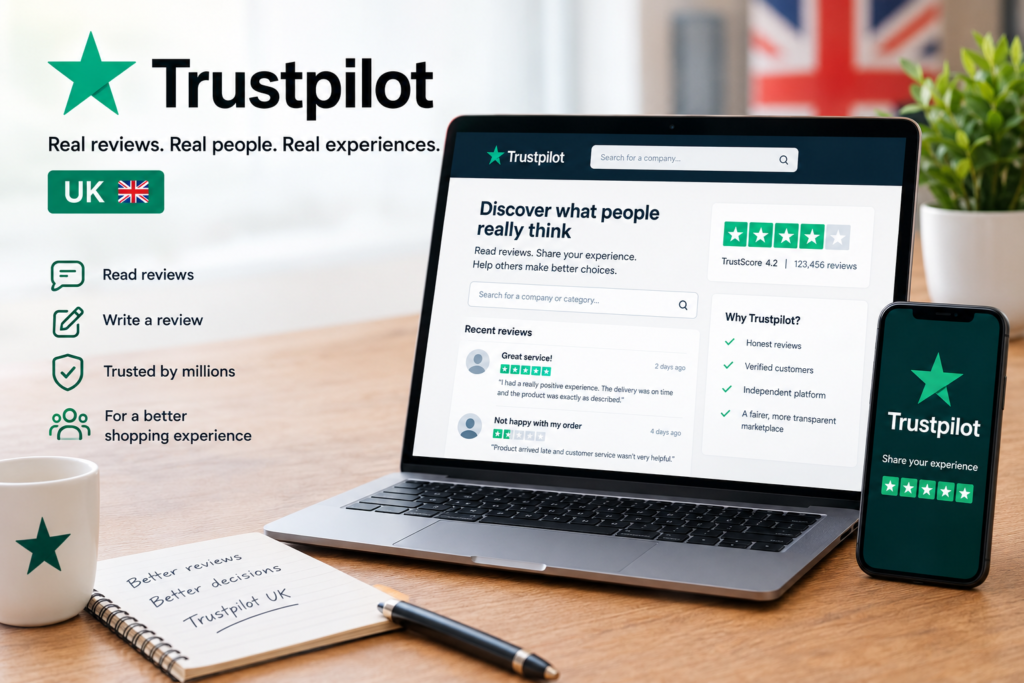
When people in the UK are about to buy something online, book a service, choose an insurance provider, or try an unfamiliar company, one of the first things they often do is search for customer feedback. This is where Trustpilot UK becomes useful. The platform gives consumers a place to read experiences shared by other customers and gives businesses a public space where they can receive, respond to, and learn from feedback.
Online reviews have become a normal part of everyday shopping. A polished company website can tell you what a business wants you to know, while customer reviews can provide another perspective based on individual experiences. Trustpilot brings these opinions together in one searchable platform, making it easier to investigate a business before spending money or committing to a service.
Trustpilot was founded in 2007 and describes itself as an open review platform connecting consumers and businesses. Its UK platform allows visitors to search companies and categories, read reviews, and write reviews based on genuine experiences. Trustpilot says its platform now contains hundreds of millions of reviews globally and covers more than a million websites.
What Is Trustpilot UK?
Trustpilot UK is the United Kingdom-focused version of Trustpilot, a major online review platform where consumers can share their experiences with businesses. The platform covers a huge variety of industries, including banking, travel, insurance, clothing, electronics, furniture, restaurants, automotive services, technology, and many others.
The basic idea is straightforward. A customer interacts with a business and can then share an honest account of that experience through a review. Other people can read that feedback when researching the same company. This creates a public feedback loop where businesses have an opportunity to respond and consumers have access to information beyond traditional advertising.
Trustpilot describes its platform as open because consumers can review businesses even when they were not specifically invited to do so. A business can claim its profile and respond publicly, while reviews remain accessible to people researching companies online.
How Trustpilot UK Works
Using Trustpilot is relatively simple for consumers. Someone searching for a company can visit the platform, enter the business name or category, and browse the available profile. Depending on the business, the profile may contain a large collection of customer reviews covering different experiences and time periods.
Reviews generally include a star rating and written comments. Consumers can look at recent reviews, examine individual experiences, and sometimes search reviews for specific subjects. This can be particularly helpful when someone has a particular concern, such as delivery times, customer service, product quality, refunds, or communication.
Businesses can also participate. According to Trustpilot’s current business guidelines, companies can claim and manage their profiles, respond to reviews, and flag reviews that they believe violate the platform’s rules. However, simply disliking a negative review is not considered a valid reason for removing it.
Why Trustpilot UK Matters to Consumers
The internet gives consumers access to an enormous number of businesses, but that choice also creates uncertainty. A company can have attractive branding, professional photography, and persuasive marketing without giving shoppers a complete picture of what the customer experience is actually like.
Reviews can help fill that information gap. Someone considering a purchase can look for patterns in customer feedback before making a decision. For example, if several unrelated customers discuss delivery delays, that information may be worth considering alongside the company’s advertised delivery promise.
Trustpilot is therefore most useful when treated as one source of evidence rather than the entire decision-making process. Reviews can reveal useful details, but individual experiences are still individual experiences. A thoughtful consumer should consider the number of reviews, their recency, the nature of the complaints or praise, and information from other reliable sources.
Understanding Trustpilot Star Ratings
The star rating is probably the most immediately visible part of a Trustpilot business profile. At a glance, consumers can see how reviewers have rated a company, but the number should not be interpreted without context.
A company with thousands of reviews provides a different volume of evidence from a company with only a handful. The distribution of ratings can also tell a more complete story than a single overall score. Looking at both positive and negative experiences can reveal recurring strengths and weaknesses.
Trustpilot explains that its TrustScore is calculated using several factors rather than being simply an arithmetic average of every rating. Consumers should therefore look beyond the headline score and read individual reviews to understand what customers are actually discussing.
Reading Reviews the Smart Way
Reading reviews carefully is more valuable than simply looking at the first few comments. Start by checking recent feedback because customer service, management, policies, suppliers, or products may change over time.
Next, look for recurring themes. One person reporting a problem might have had an unusual experience, while dozens of people independently describing the same issue could indicate a pattern worth investigating. The same principle applies to positive reviews.
It is also useful to read reviews across different star ratings. Five-star reviews can tell you what customers appreciate, while one- and two-star reviews can highlight potential problems. Three- and four-star reviews may sometimes provide particularly detailed accounts because the reviewer had a mixed experience.
How to Search for a Company on Trustpilot UK
Searching for a company on Trustpilot UK is straightforward. The platform’s UK homepage provides a search function where users can look for a company or category.
Before relying on a profile, make sure it belongs to the exact company you are researching. Some businesses have similar names, operate across multiple countries, or have separate websites for different markets. Trustpilot’s reviewer guidance specifically advises users to check that they are reviewing the correct business and country domain.
Once you find the profile, examine the company information, review volume, rating distribution, recent feedback, and business responses. Taking a few extra minutes to investigate can provide a much clearer picture than simply searching the company name and reading a single review.
How to Write a Trustpilot UK Review
Writing a Trustpilot review starts with creating or using a Trustpilot account. Trustpilot’s current reviewer guidelines state that anyone can read reviews for free, while a user account is required to write one. Reviews should be based on a genuine experience with the business.
A useful review should explain what actually happened. Instead of writing only “great company” or “terrible service,” provide enough context for another consumer to understand the experience. Mention relevant details such as what you purchased, the type of service received, communication, delivery, customer support, or how an issue was handled.
The best reviews are specific without revealing unnecessary personal information. Trustpilot’s guidelines prohibit certain types of content and advise reviewers not to include sensitive personal data or other people’s private information.
What Makes a Trustpilot Review Helpful?
A helpful review is honest, relevant, and based on personal experience. It does not need to be extremely long, but it should contain enough information to explain why you gave the particular rating.
For example, instead of simply saying that customer service was “bad,” explain what happened. You could describe how long you waited for a response, whether your issue was eventually resolved, and whether the company’s communication was clear.
Specificity makes reviews more useful to future customers. It also gives businesses actionable information. A company can learn much more from “my order arrived three days late and customer support did not respond to two emails” than from a vague one-star rating.
Trustpilot Rules About Fake Reviews
Fake reviews are one of the biggest concerns facing online review platforms. Trustpilot states that fake reviews are prohibited and that it uses automated systems and other measures to detect suspicious content.
Trustpilot’s Trust Centre says all submitted reviews are checked by automated fake-review detection systems. It also reports that 7.8 million reviews were detected as fake and removed during 2025.
The platform’s reviewer guidelines also prohibit incentivized reviews. This means users should not receive benefits such as discounts, refunds, freebies, or competition entries in exchange for writing or editing a review.
Can Businesses Remove Negative Reviews?
A common misconception is that businesses can simply pay to remove negative reviews. Trustpilot’s published policies do not work that way. Businesses can flag reviews that they believe violate platform guidelines, but disagreement with a review or dislike of a negative rating is not, by itself, a valid reason for removal.
Trustpilot’s business guidelines state that companies can flag content that breaches its rules, including potentially fake reviews, harmful content, or content containing personal information. The platform then determines whether the content violates its policies.
This distinction is important. A negative review can remain online even when a company believes it is unfair, provided it does not violate the applicable rules. That allows criticism to remain part of the public feedback record.
How Businesses Use Trustpilot UK
Trustpilot is not only designed for consumers. Businesses use the platform to collect feedback, respond to customers, identify recurring issues, and demonstrate customer experiences.
A business profile can become an important part of a company’s online reputation. Customers may discover the profile through search engines, direct searches, or links placed on company websites.
Businesses can also use feedback internally. For example, repeated complaints about delivery, communication, billing, or product quality can highlight areas that require attention. In this sense, a review platform can function as a public reputation channel as well as a source of customer insight.
Responding to Negative Trustpilot Reviews
A negative review does not necessarily have to become a long-term reputation problem. How a business responds can influence how future readers interpret the situation.
A professional response should focus on the customer’s issue rather than attacking the reviewer. Businesses can acknowledge the concern, explain relevant information, and invite the customer to continue the conversation privately when appropriate.
Trustpilot’s business guidelines encourage companies to engage with reviews professionally and politely. The objective should be to address the underlying customer experience rather than simply trying to win an argument in a public comment section.
Responding to Positive Reviews
Positive reviews also deserve attention. A short, genuine response can show that a business actually pays attention to customer feedback.
Businesses do not need to produce identical responses for every customer. Personalized replies can be more natural and can acknowledge a particular part of the customer’s experience.
Positive feedback can also reveal what customers value most. If customers repeatedly praise fast delivery, friendly support, product quality, or clear communication, a business can use that information to understand which parts of its service are working well.
Trustpilot and Online Reputation
Online reputation has become increasingly important because consumers frequently research companies before making purchases. A business may appear in search results alongside its own website, social media pages, news coverage, review platforms, and other third-party information.
Trustpilot can therefore form one component of a company’s broader digital reputation. A company with strong customer experiences may benefit from positive feedback, while recurring complaints can attract attention from potential customers.
However, businesses should not treat reviews as a replacement for operational improvements. Responding to complaints is useful, but fixing the underlying problem is more important. Reputation management works best when it is connected to actual improvements in products and services.
Is Trustpilot UK Free to Use?
For consumers, reading and writing reviews on Trustpilot is available without a consumer subscription fee. Trustpilot’s own materials describe the platform as free for consumers, while businesses can access basic services for free and have paid options available.
This distinction matters because Trustpilot operates both a consumer-facing review platform and a business service. Companies can use business tools to manage feedback and access additional features depending on their plan.
Consumers generally do not need to purchase anything to research a business’s reviews. They can search profiles and read publicly available customer feedback through the platform.
How Trustpilot Makes Money
People sometimes wonder how a review platform can remain free for consumers. The answer is that Trustpilot operates a business model in which companies can purchase additional business services while consumers can access reviews.
Trustpilot’s business platform promotes tools designed to help companies collect and engage with customer feedback. The company also offers different business plans and features for organizations seeking additional functionality.
The existence of paid business services is worth understanding when evaluating any review platform. It does not automatically determine whether an individual review is genuine or useful. Consumers should instead examine the platform’s published rules, moderation practices, review patterns, and the evidence contained in individual feedback.
Trustpilot’s Approach to Review Transparency
Transparency is a major part of Trustpilot’s stated operating principles. Its Trust Centre identifies neutrality, openness, fairness, transparency, and relevance as principles guiding its platform.
Trustpilot also publishes information about how reviews are collected, moderated, and handled. This is important because users need to understand not only what reviews say but also how the review system itself operates.
The platform states that businesses are not allowed to offer incentives for reviews or pay to hide reviews. It also says reviews are the opinions of individual users rather than opinions expressed by Trustpilot itself.
The Importance of Recent Reviews
A review from several years ago may describe a business that has changed considerably. Companies change staff, suppliers, websites, policies, products, pricing, and customer support systems.
For this reason, recent reviews are particularly useful when researching a company today. Look at whether current customers are describing the same issues that appeared in older feedback.
Older reviews can still provide useful historical context, especially when investigating long-term reputation, but they should not automatically be treated as a description of the company’s current operations.
Why You Should Read Both Positive and Negative Reviews
Only reading five-star reviews gives you an incomplete picture. Likewise, only reading one-star reviews can produce an unnecessarily narrow view.
A balanced approach involves reading different ratings and looking for recurring themes. Positive reviews can show what customers value, while negative reviews can identify potential problems. Middle-range reviews may reveal situations where the experience depended on particular circumstances.
The goal is not to find a business with zero complaints. Almost any company serving a large customer base will eventually receive criticism. What matters for research is understanding the nature, frequency, recency, and responses associated with that feedback.
Trustpilot UK for Online Shopping
Online shopping is one of the areas where Trustpilot can be particularly useful. Before ordering from an unfamiliar retailer, consumers may want to investigate whether other customers have reported receiving their orders, how quickly products arrived, and how customer support handled problems.
Reviews can also reveal details that product descriptions do not mention. Customers might discuss packaging, communication, returns, delivery partners, or the practical quality of an item.
Still, Trustpilot should be combined with other checks. Look at the company’s official website, payment options, contact details, return policy, and relevant consumer-protection information before making an important purchase.
Trustpilot Reviews and Customer Service
Customer service is one of the most frequently discussed subjects on review platforms. A company’s response to a problem can sometimes be just as important as whether the original problem occurred.
When reading reviews, look for details about response times, communication quality, refund handling, complaint resolution, and whether the company followed through on promises.
Business replies can provide another side of the story. They may explain circumstances that are not obvious from the original review. However, readers should remember that a company response is the company’s perspective, while the review represents the reviewer’s experience.
Common Mistakes People Make When Using Trustpilot
One common mistake is assuming that the highest star rating automatically means the company is suitable for everyone. Different customers have different priorities, and an excellent overall rating does not guarantee that every product or service will meet every individual’s needs.
Another mistake is judging a company from a single review. One extremely positive or negative experience may not represent the wider customer base. Looking at a larger collection of recent reviews usually provides more context.
A third mistake is ignoring the review text. A star rating tells you how someone felt about their experience, but the written explanation tells you why. The “why” is often the most valuable part when comparing businesses.
How Trustpilot Can Help Businesses Improve
Businesses can use customer feedback as an ongoing source of information. Reviews can highlight problems that internal reports do not immediately reveal.
For example, a company might believe that its delivery system is working well while customers repeatedly complain about tracking information. Another company may discover that customers appreciate a particular support team or product feature more than expected.
The value comes from identifying patterns and acting on them. Trustpilot can provide the feedback, but the business still needs to decide how to respond and improve its operations.
Trustpilot UK and Consumer Confidence
Trust is particularly important when consumers deal with unfamiliar companies. People cannot physically visit every online retailer, inspect every service provider, or speak with every business owner before buying.
Review platforms provide a way to gather experiences from other customers. Trustpilot’s stated goal is to help consumers make more informed choices while helping businesses learn from feedback.
The strongest approach is to combine review information with independent research. Trustpilot can be one part of that process rather than the sole source of information.
Tips for Getting the Most From Trustpilot UK
If you want to use Trustpilot effectively, start with the exact company profile rather than relying on search snippets alone. Confirm that the profile matches the company and relevant website.
Then examine recent reviews across several rating levels. Look for recurring themes involving the things that matter most to you, such as delivery, price, customer support, product quality, cancellations, or refunds.
Finally, consider the company’s responses. A business that responds thoughtfully to criticism provides additional information about how it handles customer problems. The response itself should be read carefully rather than treated automatically as proof that the company’s explanation is correct.
The Future of Online Reviews
Online reviews continue to play an important role in digital commerce. Consumers increasingly expect businesses to be transparent, while companies need reliable feedback to understand customer expectations.
Trustpilot is also developing its platform in response to changes in technology and online discovery. Its business platform now highlights the relationship between customer feedback, trust signals, and visibility in AI-driven search experiences.
As artificial intelligence becomes more involved in how people discover products and services, trustworthy underlying information may become even more important. Review platforms will therefore continue to face the challenge of distinguishing genuine customer experiences from manipulated or artificial content.
Frequently Asked Questions About Trustpilot UK
Is Trustpilot UK free for consumers?
Yes. Consumers can read Trustpilot reviews for free, and Trustpilot states that consumers can also write reviews without paying a consumer subscription fee. A user account is required to publish a review.
Can anyone leave a Trustpilot review?
A person does not have to receive an invitation from a company to leave a review. Trustpilot describes itself as an open platform, allowing people with genuine experiences to submit feedback.
Are fake reviews allowed on Trustpilot?
No. Trustpilot’s guidelines prohibit fake reviews. The company says it uses automated detection systems and other measures to identify and remove fraudulent content.
Can a business delete a negative review?
Businesses can flag reviews that they believe violate Trustpilot’s rules, but a negative review is not supposed to be removed simply because the business dislikes the rating or disagrees with the criticism.
Can I edit my Trustpilot review?
Yes. Trustpilot’s reviewer guidelines state that users can edit or delete their reviews.
Do businesses have to invite customers to leave reviews?
No. Consumers can leave reviews based on genuine experiences without being invited. Businesses can also send review invitations, but Trustpilot requires those invitations to be fair, neutral, and unbiased.
Should I trust every Trustpilot review?
No single review should automatically be treated as definitive evidence. It is better to consider multiple recent reviews, recurring themes, company responses, and information from other sources before making an important decision.
Why do some companies have many more reviews than others?
Businesses can use different methods to collect customer feedback, and review volume can vary according to company size, customer base, industry, and how actively the company encourages customers to share experiences. Trustpilot also allows consumers to review businesses without invitations.
Can businesses respond to reviews?
Yes. Businesses can claim their Trustpilot profiles and publicly respond to reviews. This allows companies to address customer concerns and provide additional context.
What should I include in my Trustpilot review?
Focus on your genuine experience. Explain what happened, mention relevant details, and keep the review respectful and useful. Avoid private information about yourself or other people and do not write a review in exchange for an incentive.
Final Thoughts on Trustpilot UK
Trustpilot UK has become a familiar destination for consumers researching businesses and for companies collecting public customer feedback. Its open review model gives people a place to share experiences while giving businesses an opportunity to respond and learn.
The most useful way to approach Trustpilot is as a research tool rather than a single source of truth. A star rating can provide a quick overview, but the real value often comes from reading detailed reviews, checking recent experiences, identifying repeated themes, and seeing how businesses respond to criticism.
For consumers, a few minutes of careful review research can provide useful context before making a purchase or choosing a service. For businesses, customer feedback can highlight opportunities to improve products, communication, delivery, and support.
Ultimately, Trustpilot UK is most valuable when reviews are considered thoughtfully. Look at the evidence, consider different experiences, check how current the information is, and combine review-platform information with other relevant sources. That approach gives consumers a more complete understanding of the companies they are considering while giving businesses meaningful insight into how customers experience their services.
YOU MAY HAVE MISSED