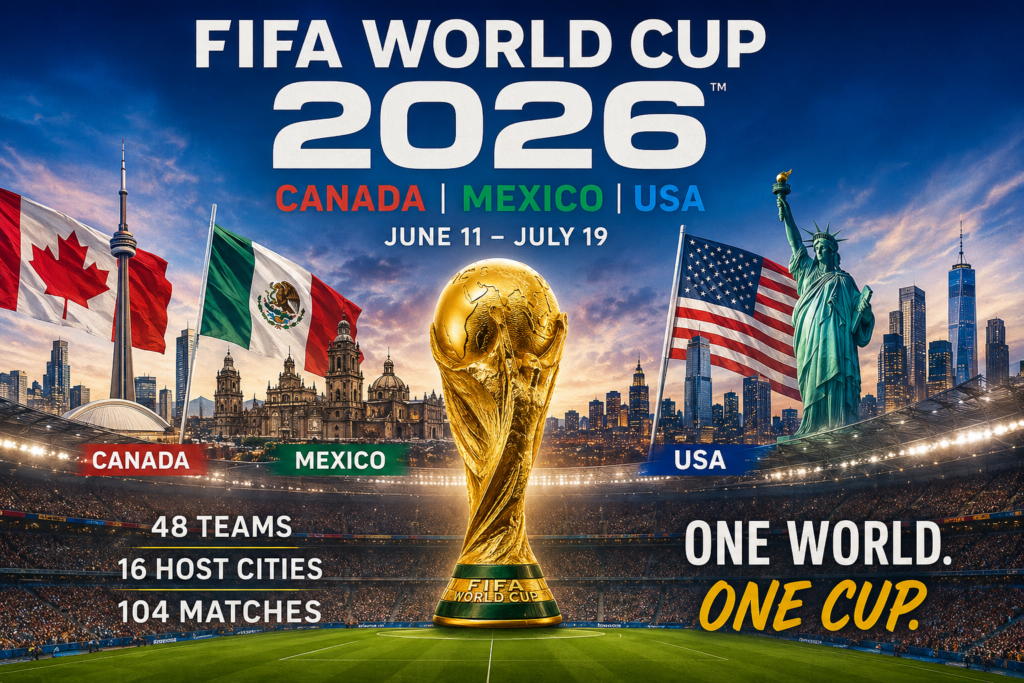
The FIFA World Cup 2026 was one of the most ambitious editions of the world’s biggest football tournament. Co-hosted by Canada, Mexico, and the United States, the competition introduced a much larger format, bringing 48 national teams together for 104 matches across 16 host cities. The tournament ran from June 11 to July 19, 2026, creating a month-long football celebration across North America.
This edition was historic for several reasons beyond its size. It was the first men’s FIFA World Cup to feature 48 teams, while Canada, Mexico, and the United States became the first three-country hosting combination for the tournament. Instead of the traditional 32-team structure, fans were treated to a broader competition that gave more nations the opportunity to experience football at the highest international level.
The tournament also produced a memorable ending. Spain and Argentina reached the final at New York New Jersey Stadium on July 19, with Spain eventually winning the championship after extra time. That result gave the 2026 tournament a dramatic conclusion and added another major chapter to the long history of the FIFA World Cup.
What Made FIFA World Cup 2026 Different?
The biggest change was the expansion from 32 teams to 48. For decades, football fans had become accustomed to the 32-team World Cup format, but FIFA decided to increase participation for the 2026 edition. The new structure created more opportunities for countries from different regions to qualify and compete on the biggest stage. It also increased the total number of matches from 64 in Qatar 2022 to 104 in 2026.
The competition featured 12 groups of four teams during the group stage. The top two teams from each group advanced automatically, while the eight best third-place teams also moved into the knockout phase. This created a Round of 32, meaning the knockout portion of the tournament started earlier in terms of the number of teams involved.
The expanded format changed the rhythm of the tournament. Instead of watching a small group of familiar football powers dominate the field, supporters had more chances to see nations with different football traditions compete against elite opposition. For developing football nations, simply reaching the tournament became an even bigger opportunity to gain experience, attract supporters, and raise the profile of the sport at home.
Canada, Mexico, and the United States as Host Countries
Hosting the FIFA World Cup across three countries gave the 2026 tournament a distinctive identity. Matches were played across Canada, Mexico, and the United States, with 16 host cities involved. The United States staged the largest share of the matches, while Canada and Mexico each hosted games in their selected venues.
Mexico had a particularly historic role because Mexico City hosted the opening match on June 11. Mexico became the first country to host World Cup matches in three different editions, following the tournaments held there in 1970 and 1986. The opening match also gave the tournament a traditional football atmosphere in a country where the sport has an enormous cultural following.
The United States provided the largest geographical footprint, with matches spread across numerous major metropolitan areas. Canada also welcomed the tournament as a co-host, giving Canadian football supporters an opportunity to experience men’s World Cup matches on home soil. Together, the three countries offered a mixture of established football culture, rapidly growing soccer markets, major cities, and enormous stadium infrastructure.
The Tournament Schedule and 104 Matches
The FIFA World Cup 2026 schedule was designed on a scale never previously seen at a men’s World Cup. A total of 104 matches were played, consisting of 72 group-stage games and 32 knockout matches. The larger schedule meant that fans had more football to follow, while broadcasters, host cities, teams, and supporters had to manage a significantly bigger tournament operation.
The tournament began on June 11 with Mexico playing South Africa at Mexico City Stadium. That opening fixture set the tone for a competition that would move through different cities and football environments before reaching the final on July 19. The opening match was particularly meaningful because Mexico became the first host nation to appear in the opening fixture of three different World Cups.
The final was played at New York New Jersey Stadium on July 19. The venue hosted the tournament’s biggest match in front of a huge global audience, bringing the competition to a conclusion after more than five weeks of preparation and action. New York and New Jersey therefore became central to the tournament’s closing story, just as Mexico City had been central to its opening chapter.
The New Knockout-Stage Format
One of the most interesting features of the FIFA World Cup 2026 was the introduction of the Round of 32. With 48 teams entering the competition, 32 teams advanced beyond the group stage. That created an additional knockout round before the traditional Round of 16, making the road to the trophy longer for teams that reached the final stages.
The knockout matches followed a straightforward elimination principle. A team had to win to move forward, while the losing side was immediately removed from the competition. This structure increased the pressure as the tournament progressed because one poor performance could end a country’s World Cup campaign. Every goal, defensive mistake, substitution, and penalty suddenly carried enormous consequences.
Another important consequence was that finalists played eight matches rather than the traditional seven. The additional knockout round meant that reaching the final required surviving one more elimination game. That made squad depth especially important because teams had to maintain their physical and tactical level over a longer tournament journey.
Spain and Argentina Reach the Final
The final brought together Spain and Argentina, two countries with enormous football histories. Spain entered the match as one of the leading modern football nations, while Argentina arrived as the defending world champions after their triumph in 2022. Their meeting created a fascinating contrast between a team looking to establish a new era of dominance and a reigning champion attempting to retain the trophy.
The final was played on July 19 at New York New Jersey Stadium. Rather than being decided during the normal 90 minutes, the match went into extra time, underlining just how closely contested the championship battle became. Spain ultimately secured a 1–0 victory after extra time, ending Argentina’s attempt to defend its World Cup title.
For Spain, the victory became the defining achievement of the 2026 tournament. For Argentina, the result represented a painful ending to a campaign that had carried the expectations of a reigning champion. The final also demonstrated one of the most appealing aspects of knockout football: even when two elite teams meet, the difference between victory and disappointment can come down to a single decisive moment.
Young Stars and the Next Generation of Football
Every World Cup introduces new players to a worldwide audience, and the 2026 edition was no exception. The expanded tournament gave fans more opportunities to watch young talent from different countries competing against experienced international stars. Some players arrived already famous, while others used the tournament as their introduction to a much larger global audience.
Spain’s campaign was especially significant in this respect. The Spanish team featured a generation of technically gifted players who represented the country’s continuing commitment to possession, movement, pressing, and intelligent attacking football. The final against Argentina added another high-profile stage for these players to demonstrate their ability under extraordinary pressure.
The tournament also highlighted how quickly football’s competitive landscape can change. A World Cup is never simply about established superstars. It is also about emerging players who can turn a single performance into the beginning of an international career. For young footballers, a World Cup appearance can transform their reputation, increase international interest, and create opportunities that may shape the rest of their professional lives.
The Role of Technology in FIFA World Cup 2026
Modern football depends heavily on technology, and the 2026 World Cup continued that trend. Video review, connected match technology, advanced tracking systems, and other digital tools played an important role in helping officials manage matches. As the tournament became larger, maintaining accurate officiating became even more important.
Technology does not remove controversy from football, of course. Supporters still debate decisions, refereeing interpretations, handballs, offsides, penalties, and the amount of time added to matches. What technology does provide is another layer of information that can help officials review difficult situations and make decisions with greater evidence.
The 2026 tournament also demonstrated how football is becoming increasingly connected. Fans followed games through television, mobile devices, social media, live statistics, video clips, and digital platforms. Official FIFA channels provided tournament information and match-related content, while online communities allowed supporters from different countries to discuss the competition almost instantly.
The Official FIFA World Cup 2026 Ball
The official match ball, Trionda, was another interesting part of the 2026 tournament. Its production also created a connection between the World Cup and Pakistan’s sporting manufacturing industry. The ball was manufactured in Sialkot, a Pakistani city internationally recognized for producing footballs and other sporting goods.
For Pakistan, this connection was a source of national pride even though the country’s men’s team did not qualify for the tournament. Sialkot has a long-standing reputation in the global sports manufacturing industry, and seeing a World Cup ball associated with the city gave football supporters in Pakistan another reason to follow the tournament closely.
The story was also a reminder that the FIFA World Cup is larger than the 90 minutes played inside a stadium. From manufacturing and transportation to broadcasting, hospitality, security, technology, tourism, and merchandise, thousands of people and businesses contribute to making the event possible. The football itself is the centerpiece, but the wider World Cup ecosystem reaches far beyond the pitch.
How the 2026 World Cup Changed the Fan Experience
With matches taking place in 16 host cities, fans experienced a World Cup unlike any previous edition. Supporters could travel between different countries and regions while following their teams, although the enormous distances involved also created practical challenges. North America’s size meant that transportation and planning became especially important for traveling fans.
The tournament’s host cities offered very different cultural experiences. A supporter attending a match in Mexico could experience an atmosphere rooted in a deep football tradition, while a fan visiting a Canadian or American host city could encounter a different sporting culture. That variety became one of the most distinctive features of the competition.
Fan events and public celebrations also helped take the World Cup outside the stadiums. Football supporters gathered in city centers, entertainment areas, restaurants, public viewing locations, and official fan zones. In Pakistan, for example, public screenings were organized for the final, showing how interest in the tournament extended far beyond the countries that hosted the matches.
The Economic and Cultural Impact of the World Cup
Hosting the World Cup can generate significant economic activity. Visitors spend money on accommodation, transportation, food, entertainment, merchandise, and tourism. Host cities also gain an opportunity to introduce themselves to international audiences that might otherwise never visit them.
The 2026 tournament was particularly large because three countries shared hosting responsibilities. That meant the potential economic and cultural impact was distributed across a much wider geographical area. Instead of one country receiving the majority of international attention, cities across Canada, Mexico, and the United States became part of the same global football story.
There was also a cultural benefit that is harder to measure. Football provides a common language for people from different backgrounds. During a World Cup, national rivalries exist, but supporters can still share the experience of watching extraordinary matches together. That mixture of competition, national pride, friendship, travel, and entertainment is a major reason the tournament remains one of the world’s most influential sporting events.
What the 2026 Tournament Means for the Future of Football
The FIFA World Cup 2026 will likely be remembered as a turning point because it tested the 48-team format on the biggest possible stage. FIFA now has real experience with how the expanded competition works in practice, including its scheduling demands, travel requirements, match volume, and effect on teams and supporters.
The larger tournament also gives more countries a path to the World Cup. Qualification can have a powerful effect on football development because national teams gain experience by playing against stronger opponents, while domestic interest can grow when supporters see their country represented at the world’s biggest tournament.
At the same time, the expanded format creates legitimate questions about player workload and tournament length. Elite footballers already play demanding club schedules, and adding more international matches can increase physical and mental pressure. Future World Cups will continue to face the challenge of balancing global participation with player welfare and competitive quality.
Why FIFA World Cup 2026 Will Be Remembered
The FIFA World Cup 2026 was not simply another edition of an established tournament. It represented a major expansion of the competition and brought together 48 teams across three host countries and 16 cities. With 104 matches, the tournament offered more football than any previous men’s World Cup.
Its final provided the perfect dramatic ending. Spain defeated Argentina 1–0 after extra time on July 19, completing a tournament that had begun more than five weeks earlier in Mexico City. The final also created a memorable contrast between Spain’s championship triumph and Argentina’s unsuccessful attempt to defend its crown.
Ultimately, the lasting appeal of the FIFA World Cup 2026 comes from the combination of scale, football quality, culture, technology, and human emotion. It introduced a new tournament structure, brought the World Cup to three host nations, gave more teams a chance to compete, and created new memories for supporters around the world. Whether someone watched every match or only followed the final, the 2026 edition added another unforgettable chapter to football’s greatest international competition.
YOU MAY HAVE MISSED