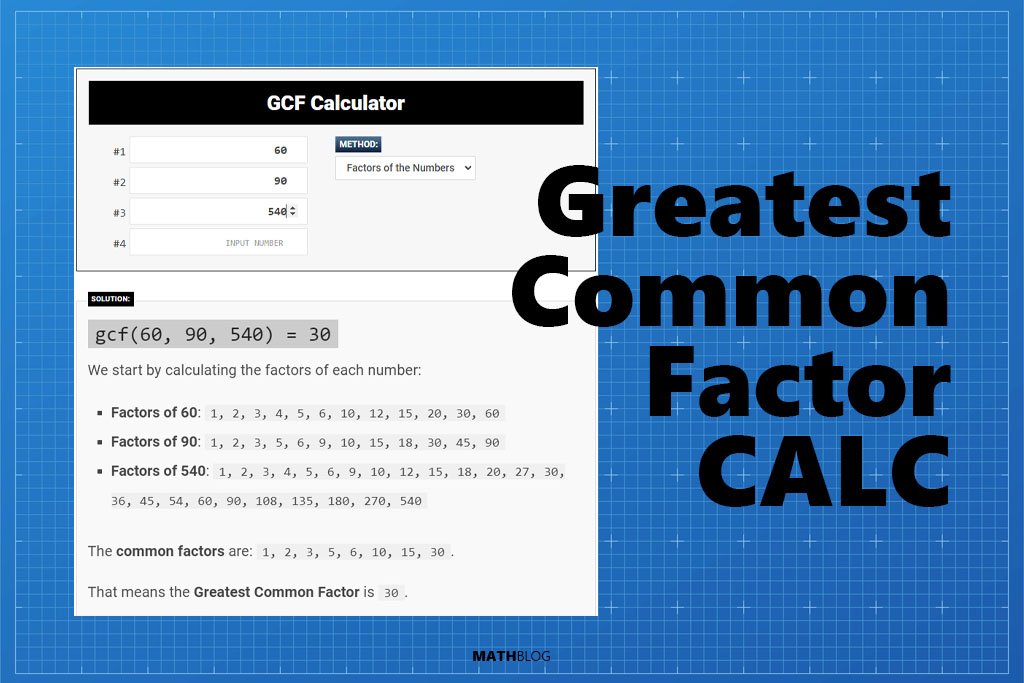
Introduction to the GCF Calculator
Mathematics becomes much easier when you have the right tools to solve problems quickly and accurately. One such helpful tool is a GCF calculator, which allows you to find the greatest common factor of two or more numbers without going through lengthy calculations. Whether you are a student learning basic arithmetic, a teacher preparing classroom exercises, or someone who regularly works with numbers, understanding how a GCF calculator works can save time and reduce mistakes.
GCF stands for Greatest Common Factor. It is the largest positive whole number that divides two or more integers without leaving a remainder. For example, the greatest common factor of 12 and 18 is 6 because 6 divides both numbers evenly, and no larger positive whole number can divide them both. Although this definition may sound technical at first, the concept becomes straightforward when you look at practical examples.
A GCF calculator automates this process by examining the numbers you enter and identifying their largest shared factor. Depending on the calculator, it may also display the common factors, prime factorization, or steps used to reach the answer. These features make the tool useful not only for getting answers but also for learning the mathematical principles behind them.
In this guide, we will explore what a GCF calculator is, how it works, different methods for calculating the greatest common factor, and how you can use the result in everyday mathematics. We will also discuss common mistakes, practical examples, and frequently asked questions to help you develop a stronger understanding of the subject.
What Is a GCF Calculator?
A GCF calculator is an online or digital mathematics tool designed to find the greatest common factor of two or more numbers. You enter the numbers into the calculator, select the appropriate option if necessary, and receive the result. Instead of listing every factor manually, the tool performs the calculations automatically.
For instance, suppose you want to find the greatest common factor of 24 and 36. The factors of 24 include 1, 2, 3, 4, 6, 8, 12, and 24. The factors of 36 include 1, 2, 3, 4, 6, 9, 12, 18, and 36. Their common factors are 1, 2, 3, 4, 6, and 12. The greatest of these is 12, so the GCF is 12.
A calculator can identify this answer almost instantly. Some advanced versions also explain why 12 is the correct result or show how the numbers can be broken down into prime factors. This is especially helpful for students who need to understand the process rather than simply copy an answer.
The main advantage of a GCF calculator is convenience. It reduces repetitive work, makes checking homework easier, and helps users solve more complicated problems. However, learning the underlying concept remains important because it allows you to recognize incorrect answers and apply the same method when a calculator is unavailable.
Understanding the Meaning of Greatest Common Factor
To understand a GCF calculator properly, it helps to break down the term into its three parts: greatest, common, and factor. Each word describes an important property of the final answer.
A factor is a whole number that divides another whole number evenly. For example, 5 is a factor of 20 because 20 divided by 5 equals 4, with no remainder. Similarly, 1, 2, 4, 5, 10, and 20 are all factors of 20. These numbers can be multiplied in different combinations to produce the original number.
The word common means that a factor belongs to more than one number. If you are comparing 16 and 24, both numbers can be divided by 1, 2, 4, and 8 without leaving a remainder. These are their common factors. The word greatest indicates that you must choose the largest number from this shared group. Therefore, the GCF of 16 and 24 is 8.
This distinction matters because the smallest common factor of positive integers is usually 1, but the GCF is not simply any common factor. It is the largest one. A GCF calculator follows this rule automatically, making it easier to avoid confusing the answer with another valid but smaller common factor.
How Does a GCF Calculator Work?
A GCF calculator receives the numbers you provide and applies a mathematical procedure to determine which positive integer divides them all evenly. The exact process depends on how the calculator has been programmed, but the underlying mathematics remains the same.
One simple approach is to identify the factors of each number and compare the lists. For small numbers, this method is easy to understand. For example, the factors of 10 are 1, 2, 5, and 10, while the factors of 15 are 1, 3, 5, and 15. Their greatest shared factor is 5. A calculator can carry out this comparison automatically.
For larger numbers, many calculators use prime factorization or the Euclidean algorithm. Prime factorization breaks each number into prime numbers, while the Euclidean algorithm repeatedly divides numbers and uses the remainders to find their GCF. These methods are generally more efficient than listing every factor when the numbers become large.
After completing the calculation, the calculator displays the greatest common factor. Some tools also provide intermediate steps, common factors, or related results such as the least common multiple. The output depends on the features available, so it is useful to choose a calculator that matches your learning or calculation needs.
How to Use a GCF Calculator Step by Step
Using a GCF calculator is usually straightforward, even if you have limited experience with mathematics tools. The first step is to identify the numbers you need to compare. Make sure you enter the correct values because a single incorrect digit can change the final answer.
Next, enter the numbers into the calculator’s input fields. A basic calculator may accept two numbers, while a more advanced version may allow three, four, or many additional integers. If the calculator includes separate boxes, place each number in the correct field. If it accepts a list, follow the instructions provided by the tool.
Once you have entered the values, select the calculate button or the equivalent command. The calculator will process the numbers and display the GCF. For example, entering 42 and 56 should produce 14 because 14 is the largest positive integer that divides both numbers evenly.
Finally, check the result against the original numbers. Divide each input by the displayed GCF. If every division produces a whole number with no remainder, the result is a valid common factor. To confirm that it is the greatest factor, you can compare the prime factorizations or use another mathematical method. This final check is particularly useful when completing homework or preparing answers for an assignment.
Finding the GCF by Listing Factors
Listing factors is one of the simplest methods for finding the greatest common factor. It is especially useful when working with small numbers because it makes the relationship between the numbers easy to see.
Consider the numbers 18 and 30. The positive factors of 18 are 1, 2, 3, 6, 9, and 18. The positive factors of 30 are 1, 2, 3, 5, 6, 10, 15, and 30. By comparing the two lists, you can identify the common factors: 1, 2, 3, and 6. The greatest common factor is therefore 6.
This method is valuable for beginners because it shows exactly where the answer comes from. Rather than treating the GCF as a number that appears without explanation, students can see how factors overlap and why one shared factor is greater than the others.
However, listing factors becomes less practical when dealing with large integers. A number such as 12,600 has many factors, and writing them all down can take considerable time. In these situations, a GCF calculator or a more efficient mathematical method is preferable. Learning factor listing first still provides a useful foundation for understanding how the calculator arrives at its result.
Finding the GCF Using Prime Factorization
Prime factorization is another reliable way to calculate the greatest common factor. A prime number is a whole number greater than 1 that has exactly two positive factors: 1 and itself. Examples include 2, 3, 5, 7, and 11.
To find the GCF using prime factorization, break each number into a product of prime numbers. For example, 48 can be written as 2 × 2 × 2 × 2 × 3, while 72 can be written as 2 × 2 × 2 × 3 × 3. Both numbers contain three factors of 2 and one factor of 3 in common. Multiplying those shared prime factors gives 2 × 2 × 2 × 3 = 24. Therefore, the GCF of 48 and 72 is 24.
The important rule is to use only the prime factors that appear in every number, taking the smallest exponent of each shared prime. If one number contains four factors of 2 and another contains three, only three factors of 2 can be included in the GCF.
Many GCF calculators use a process based on prime factorization or can display the prime factorization as an additional feature. This method is particularly helpful for students studying fractions, algebra, and number theory because it connects the GCF to several other mathematical concepts.
Finding the GCF with the Euclidean Algorithm
The Euclidean algorithm is an efficient method for finding the greatest common factor of two positive integers. It is especially useful when the numbers are large because it avoids the need to list every factor or fully break down both numbers into primes.
The method works by dividing the larger number by the smaller number and recording the remainder. You then replace the larger number with the smaller number and the smaller number with the remainder. Repeat the process until the remainder becomes zero. The last nonzero remainder, or equivalently the divisor in the final division, is the GCF.
For example, consider 252 and 105. Divide 252 by 105 to obtain a remainder of 42. Next, divide 105 by 42, which leaves a remainder of 21. Finally, divide 42 by 21, leaving a remainder of zero. The last nonzero remainder is 21, so the GCF of 252 and 105 is 21.
This method is widely used in computer programs because it requires relatively few operations, even for large integers. A GCF calculator may use the Euclidean algorithm internally to produce a quick answer. Understanding the method gives you a useful way to verify results and solve problems without manually listing long sets of factors.
GCF Calculator for Two Numbers
The most common use of a GCF calculator is finding the greatest common factor of two numbers. This is the type of calculation introduced in many elementary and middle-school mathematics lessons.
Suppose you need to calculate the GCF of 32 and 48. The factors of 32 include 1, 2, 4, 8, 16, and 32. The factors of 48 include 1, 2, 3, 4, 6, 8, 12, 16, 24, and 48. The common factors are 1, 2, 4, 8, and 16. The greatest shared factor is 16.
The result means that both 32 and 48 can be divided into equal groups of 16 without leaving anything over. It also means that 16 is the largest positive integer that divides both original numbers exactly.
A two-number GCF calculator is useful for checking these calculations quickly. It can also help students practice identifying patterns between numbers. For example, comparing multiples of the same number often reveals a predictable GCF. As you solve more examples, you may begin to recognize common factors without needing to write every step down.
GCF Calculator for Three or More Numbers
Some problems require you to find the greatest common factor of three or more numbers. The same principle applies: the answer must divide every number in the group without leaving a remainder.
Consider the numbers 24, 36, and 60. The GCF of 24 and 36 is 12. Next, find the GCF of 12 and 60, which is also 12. Therefore, the GCF of all three numbers is 12. You can verify the result because 24 ÷ 12 = 2, 36 ÷ 12 = 3, and 60 ÷ 12 = 5.
A calculator that supports multiple inputs can perform this task directly. If your calculator accepts only two numbers, you can still solve the problem by calculating the GCF of the first two numbers and then finding the GCF of that result and the next number. Repeat this process until every number has been included.
This approach works for any finite collection of integers, provided you follow the same procedure consistently. It is particularly useful when dividing items into equal groups, simplifying several related fractions, or solving word problems that involve multiple quantities.
GCF Calculator and Fraction Simplification
One of the most practical applications of a GCF calculator is simplifying fractions. A fraction is in its simplest form when its numerator and denominator have no common positive factor greater than 1.
For example, consider the fraction 36/48. The GCF of 36 and 48 is 12. Divide both the numerator and denominator by 12 to obtain 3/4. Since 3 and 4 have no common factor greater than 1, the simplified fraction is 3/4.
The key rule is that you must divide the numerator and denominator by the same nonzero number. Dividing only one part of the fraction changes its value, which means the resulting fraction is no longer equivalent to the original one. Using the GCF ensures that the fraction is reduced as much as possible in one step.
A GCF calculator can be helpful when the numerator and denominator are large. For instance, simplifying 168/252 may be difficult to do mentally, but the GCF is 84, giving the simplified fraction 2/3. This makes calculations easier and reduces the chance of arithmetic errors in later steps.
GCF Calculator in Algebra
The greatest common factor is not limited to ordinary numbers. It is also an important tool in algebra, where it helps simplify expressions and factor polynomials.
Consider the expression 12x + 18. Both terms are divisible by 6, so 6 is their greatest common numerical factor. Factoring out 6 gives 6(2x + 3). Expanding the expression confirms the result because 6 multiplied by 2x gives 12x, while 6 multiplied by 3 gives 18.
Variables can also be included in the common factor. For example, in the expression 12x² + 18x, both terms contain the numerical factor 6 and at least one factor of x. The greatest common factor is 6x, so the expression becomes 6x(2x + 3).
A standard numerical GCF calculator may not automatically factor every algebraic expression. You should check whether the tool supports polynomial factoring or only integer inputs. Even when using a numerical calculator, however, you can calculate the common numerical factor and then inspect the variables separately. This approach provides a useful foundation for more advanced algebra.
Difference Between GCF and LCM
The greatest common factor and the least common multiple are related mathematical concepts, but they answer different questions. Understanding the difference prevents confusion when selecting a calculator or solving a problem.
The GCF is the largest positive integer that divides two or more numbers evenly. The least common multiple, or LCM, is the smallest positive integer that is a multiple of each number. For example, the GCF of 12 and 18 is 6, while their LCM is 36.
You can understand the distinction by looking at the factors and multiples of the same numbers. Factors divide a number into equal parts, while multiples are obtained by multiplying a number by whole numbers. The GCF focuses on the largest shared divisor, whereas the LCM focuses on the smallest shared multiple.
Both concepts are useful in fraction arithmetic. The GCF helps simplify fractions, while the LCM is often used to find a common denominator when adding or subtracting fractions. Some online calculators include both functions, but you should select the correct operation based on the problem you are solving.
Important Properties of the Greatest Common Factor
The greatest common factor follows several mathematical properties that make calculations easier. One important property is that the GCF of a positive integer and 1 is always 1. This is because 1 is the only positive factor that every positive integer shares with 1.
Another useful property is that the GCF of a positive integer with itself is the number itself. For example, the GCF of 27 and 27 is 27 because every factor of 27 divides both inputs, and 27 is the largest such factor. This provides a simple way to check certain calculator results.
The GCF is also commutative, meaning that changing the order of the numbers does not change the answer. The GCF of 20 and 30 is the same as the GCF of 30 and 20. Similarly, for three or more integers, rearranging the input numbers does not change the final GCF.
For positive integers, the GCF cannot be larger than the smallest number in the group. If you enter 18 and 42, the answer cannot exceed 18 because no positive factor of 18 is greater than 18. These properties are useful for checking whether a calculator’s result makes sense before using it in a larger problem.
Practical Uses of a GCF Calculator in Everyday Life
The greatest common factor has several everyday applications, especially when objects need to be divided into equal groups. Imagine that you have 24 red buttons and 36 blue buttons and want to make identical packages without leaving any buttons unused. The GCF of 24 and 36 is 12, so you can create 12 identical packages, each containing two red buttons and three blue buttons.
The same idea applies to arranging objects in equal rows or creating matching sets of supplies. If a teacher has 30 pencils and 45 notebooks, the GCF is 15. This means the supplies can be divided into 15 identical groups, with two pencils and three notebooks in each group. The GCF helps identify the greatest number of equal groups possible when every item must be used.
In cooking, craft projects, and event preparation, a GCF calculation can help when dividing quantities into equal portions. For example, if a project uses 18 small pieces and 30 large pieces, the GCF of 6 indicates that six identical sets can be created, with three small pieces and five large pieces in each set.
These examples demonstrate why the GCF is more than a classroom exercise. It is a practical way to organize quantities, reduce waste, and find the largest possible number of identical groups when dealing with discrete items.
Common Mistakes to Avoid When Using a GCF Calculator
One frequent mistake is confusing the greatest common factor with the least common multiple. Although both calculations involve two or more numbers, their answers serve different purposes. Before entering numbers, make sure the question asks for the largest shared factor rather than the smallest shared multiple.
Another common error is entering an incorrect number. A calculator will generally process the values you provide, even if one of them contains a typing mistake. Carefully review the input fields before calculating, especially when working with long integers or several numbers at once.
Some users also assume that any common factor is the correct answer. For example, 2 is a common factor of 12 and 20, but it is not their GCF because 4 is a larger number that divides both evenly. Always confirm that the result is the greatest common factor rather than simply a factor shared by the inputs.
Finally, remember that calculators differ in the types of inputs they support. A basic GCF calculator may be designed for integers and may not handle decimals, fractions, or algebraic expressions as expected. If your problem contains variables or non-integer values, check the tool’s instructions or convert the problem into an appropriate mathematical form before proceeding.
Tips for Getting Accurate Results from a GCF Calculator
The easiest way to obtain reliable results is to enter the numbers carefully and understand the type of calculation required. If you are working with a school assignment, read the question fully before deciding whether you need a GCF, LCM, or another operation.
Choose a calculator that clearly displays its output. For educational purposes, a tool that explains the calculation steps may be more helpful than one that provides only a final number. Seeing the prime factors or division steps can help you understand why the answer is correct and improve your ability to solve similar problems independently.
It is also a good idea to verify the result manually when the calculation is important. Divide every input number by the proposed GCF and check that each result is an integer. Then use prime factorization or the Euclidean algorithm if you want to confirm that no larger common factor exists.
If you are practicing mathematics, try solving the problem yourself before checking it with a calculator. This turns the tool into a learning aid rather than a replacement for understanding. Over time, repeated practice will make factor patterns easier to recognize and calculations more comfortable.
Choosing the Right GCF Calculator
Not every GCF calculator offers the same features, so the best option depends on what you need to accomplish. For a quick calculation involving two small integers, a basic calculator is usually enough. You enter the values, click the calculation button, and read the answer.
If you are studying mathematics, consider using a calculator that displays the steps. Features such as prime factorization, lists of common factors, and intermediate division results can help you understand the method. These explanations are particularly useful when preparing for exams or checking homework because they show how the answer was obtained.
For more advanced tasks, a calculator that accepts multiple integers may be more convenient. It can handle questions involving three, four, or more numbers without requiring you to repeat the calculation manually. If you work with algebraic expressions, make sure the tool specifically supports polynomial factoring rather than assuming that a standard GCF calculator can process variables.
You should also pay attention to usability. A good calculator should have clearly labeled input fields, readable results, and straightforward instructions. There is generally no need to install complicated software for basic GCF calculations, since many simple online tools can perform the task directly in a browser.
GCF Calculator for Students and Teachers
Students can use a GCF calculator to check their homework, practice factorization, and review mathematical concepts before an exam. It can be particularly useful when a problem involves large numbers that would otherwise require a lot of repetitive work. By comparing their own calculations with the tool’s result, students can identify mistakes and learn how to correct them.
However, students should avoid relying entirely on automated answers. Teachers often expect learners to show their working, explain their reasoning, or demonstrate a particular method. A calculator can help verify the final answer, but it does not automatically replace the explanation required in an assignment.
Teachers can also use GCF calculators to prepare examples, verify worksheets, and demonstrate different solution methods. Showing the same problem through factor listing, prime factorization, and the Euclidean algorithm can help students understand that different approaches may lead to the same result.
For classroom practice, teachers can ask students to estimate or calculate the GCF manually before using a digital tool. This encourages active learning and helps learners develop number sense. The calculator then becomes a way to confirm understanding rather than a shortcut that prevents students from learning the process.
Frequently Asked Questions About GCF Calculators
What does GCF stand for?
GCF stands for Greatest Common Factor. It is the largest positive integer that divides two or more integers evenly, without leaving a remainder. For example, the GCF of 20 and 30 is 10 because 10 is the largest positive number that divides both numbers exactly.
How do I calculate the GCF of two numbers?
You can calculate the GCF by listing the factors of both numbers, comparing their prime factorizations, or using the Euclidean algorithm. A GCF calculator automates the process and displays the result. For small numbers, listing factors is often the easiest method to understand.
Is a GCF calculator free to use?
Many online GCF calculators are available free of charge. They generally allow you to enter numbers and receive an answer without installing software. Features and usage limits may vary, so check the individual tool if you need additional functions such as step-by-step explanations or support for multiple numbers.
Can a GCF calculator handle more than two numbers?
Yes, many calculators support three or more integers. The result must be the largest positive integer that divides every number in the input group evenly. If your calculator supports only two inputs, calculate the GCF of two numbers first and then use that result with the next number.
What is the GCF of 12 and 18?
The GCF of 12 and 18 is 6. The factors of 12 include 1, 2, 3, 4, 6, and 12, while the factors of 18 include 1, 2, 3, 6, 9, and 18. Their greatest shared factor is 6.
Can a GCF calculator simplify fractions?
A GCF calculator can help you simplify fractions by identifying the greatest common factor of the numerator and denominator. Divide both parts by that factor to obtain the simplest equivalent fraction. For example, 24/36 becomes 2/3 after dividing the numerator and denominator by 12.
What is the difference between GCF and LCM?
The GCF is the greatest number that divides the inputs evenly, while the LCM is the smallest positive number that is a multiple of every input. For 8 and 12, the GCF is 4 and the LCM is 24. Both concepts are useful, but they solve different types of problems.
Can the GCF be greater than one of the original numbers?
For positive integers, the GCF cannot be greater than the smallest number in the input group. A common factor must divide every number, so it cannot exceed any positive input. If a calculator produces a larger answer, check the numbers and make sure the correct operation was selected.
Is the GCF always 1 when two numbers are different?
No. Different numbers can share factors greater than 1. For example, 18 and 30 are different numbers, but their GCF is 6. Two positive integers have a GCF of 1 only when they have no common positive factor other than 1; such numbers are called relatively prime or coprime.
Which method is best for finding the GCF?
The best method depends on the numbers and your purpose. Listing factors is useful for small numbers and beginners, prime factorization helps explain the structure of numbers, and the Euclidean algorithm is efficient for large integers. A calculator can perform the calculation quickly, while learning these methods helps you understand and verify the result.
Conclusion
A GCF calculator is a simple but valuable mathematics tool that helps users find the greatest common factor of two or more integers quickly and accurately. By identifying the largest number that divides every input without leaving a remainder, it makes many common arithmetic tasks easier and reduces the amount of repetitive calculation required.
Understanding how the GCF works is just as important as knowing how to use the calculator. Methods such as listing factors, prime factorization, and the Euclidean algorithm provide different ways to reach the same result. Each method has its own advantages, and learning them gives you more flexibility when solving mathematics problems.
The greatest common factor is useful for simplifying fractions, factoring algebraic expressions, dividing objects into equal groups, and solving practical problems involving quantities. It also connects to other mathematical ideas, including prime numbers and the least common multiple. Once you understand these relationships, the GCF becomes much easier to recognize and apply.
Whether you are a student, teacher, or everyday learner, a GCF calculator can save time and help you check your work. Use it carefully, verify important results, and continue practicing the underlying methods. With a combination of mathematical understanding and the right digital tools, finding the greatest common factor can become a straightforward part of your problem-solving routine.
YOU MAY HAVE MISSED